Victorian is the longest and most productive furniture period, and the hardest to characterise because it has no single style. Industrial production made ornament cheap, and workshops responded by reviving every earlier manner at once. A drawing room could contain four centuries of design, all made in the same decade.
What changed with industrialisation?
Carving stopped being expensive. Machinery could produce moulded and carved decoration that had previously needed a skilled hand, so ornament that once signalled wealth became affordable to ordinary households.
The result is furniture that is heavier, darker and far more elaborately decorated than what came before, produced in enormous quantities. That volume is why so much survives and why ordinary examples are so cheap today.
Which timbers dominate?
Mahogany and walnut for better work, with oak for country and Gothic revival pieces, and rosewood earlier in the period. Later, cheaper timbers stained to imitate expensive ones appear widely.
Colour tends dark, partly through timber choice and partly through the polishes used. Look at unpolished interior surfaces, since a piece stained dark on the outside may be a much paler timber underneath, which is itself informative about quality.
What are the recognisable forms?
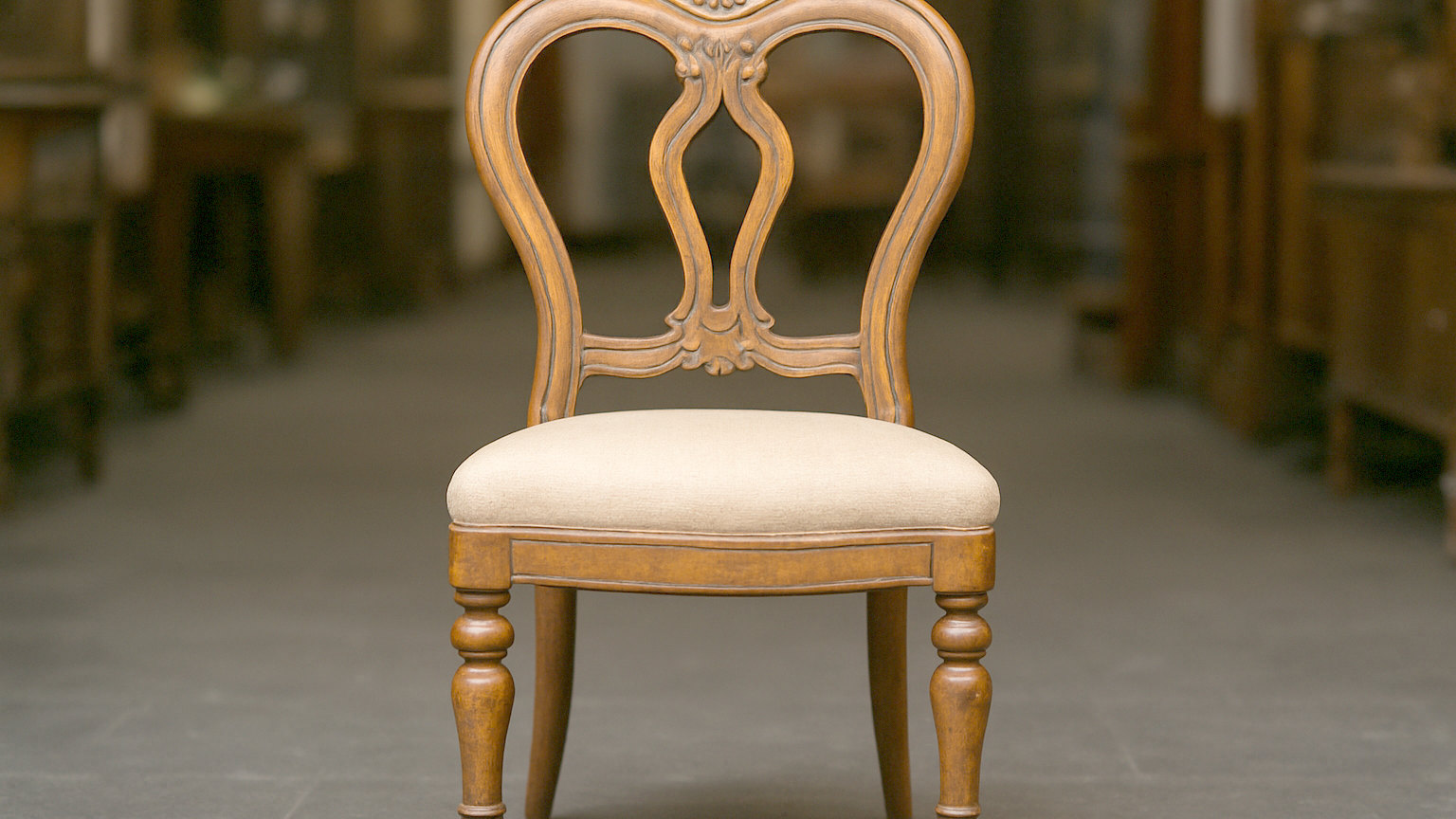
The balloon back chair, with its rounded waisted outline, is the most characteristic single form and survives in vast numbers. Buttoned upholstery, deep and heavily sprung, is equally typical.
Look also for heavily turned legs, cabriole legs revived from earlier periods, carved foliage and scrollwork, and marble tops on washstands and side tables. Furniture generally sits lower and broader than Georgian equivalents.
How do you spot machine carving?
By identical repeats. A machine cutter produces the same result every time, so a row of repeated motifs will match exactly in depth, spacing and tool marks.
Hand carving varies subtly between repeats, because no carver produces two identical results. Look at a run of decoration under raking light and compare each element. Applied ornament glued onto a flat surface, rather than carved from the solid, is another strong indicator of the period.
Why can style not date these pieces?
Because the period revived everything. Gothic, classical, rococo and eighteenth century forms were all produced simultaneously, and some copies were made well enough to have fooled people for a century since.
A piece that looks Georgian may be Victorian. Check construction instead: machine cut dovetails, circular saw marks on unfinished surfaces, and screws with perfectly regular threads all place a piece firmly in the industrial era whatever the design suggests.
What construction evidence should you check?
Pull out a drawer and look at the dovetails. Machine cut joints are numerous, identical and evenly spaced, with pins the same width as the tails, frequently with a rounded profile at the base from a routed cut.
Look at the back and underside for circular saw arcs, which cannot be produced by hand. Check the secondary timber used for linings and backboards, since pine linings indicate later or cheaper production than oak ones.
What is the market doing?
Ordinary Victorian furniture has fallen further than almost anything else, because it is large, dark and heavily decorated in a period that favours the opposite. Prices for common pieces are very low indeed.
Exceptional pieces have held, as they always do. Named makers, unusual designs, and anything of genuine quality still attract collectors. The gap between the best and the ordinary has widened enormously within this one period.
Is it worth buying?
For use, it is outstanding value. Solid timber, properly jointed, made to be repaired, and available for less than new furniture of far poorer construction.
Buy on proportion and condition rather than on decoration, since heavily carved pieces are harder to place in a modern room than plain ones. Original surface matters as much here as anywhere. A stripped and repolished Victorian piece is worth noticeably less than one carrying honest patina, and the difference is easy to see once you have compared two examples side by side.