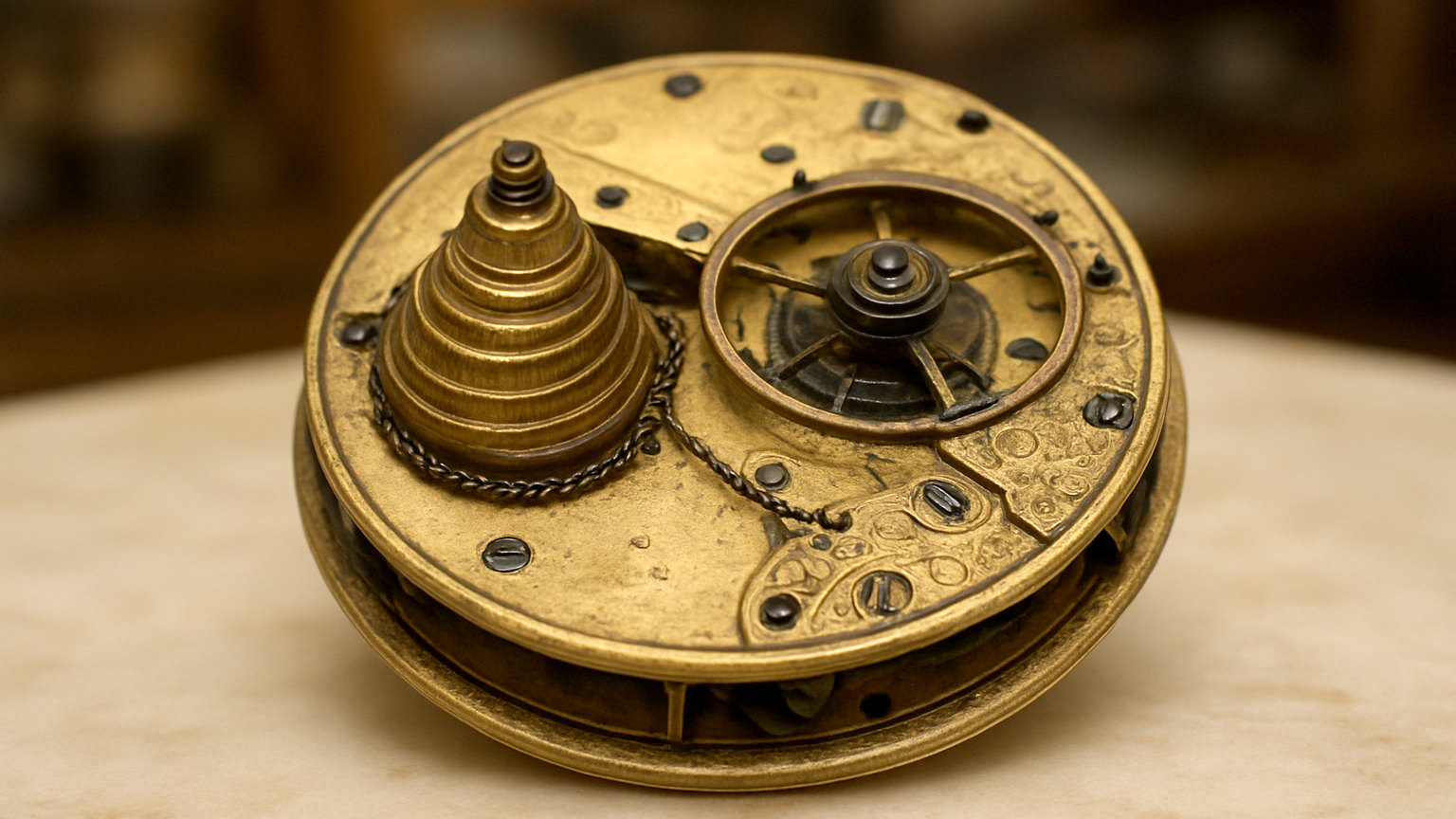
Open the case of an English pocket watch and you may find a small conical drum with a fine chain wrapped around it. That is a fusee, and it solves a problem inherent in every spring driven timepiece. Its presence tells you something useful about where and roughly when a watch was made, and usually something good about its quality.
What problem does the fusee solve?
A mainspring does not deliver constant force. Fully wound it pushes hard, and as it unwinds the force falls away steadily. That variation makes the watch run fast when freshly wound and slow towards the end, which ruins timekeeping.
The fusee compensates mechanically. A chain runs from the spring barrel to a cone shaped pulley, and as the spring weakens the chain pulls on progressively larger diameters of the cone. The increasing leverage offsets the decreasing force, so the output stays roughly even.
How do you recognise one?
Look for the cone and the chain. The fusee itself is a stepped conical drum, usually with a spiral groove cut around it, sitting alongside the barrel. The chain resembles a miniature bicycle chain and is astonishingly fine.
Some watches use a gut line rather than a chain, particularly earlier examples. Either way the arrangement is unmistakable once seen, because nothing else in a movement looks like a cone with a line wrapped round it. Wind the watch gently and you can watch the chain transfer from barrel to fusee.
What does it tell you about the watch?
That it is probably English and probably better than average. English workshops persisted with fusee construction long after continental makers moved to simpler arrangements, so it is strongly associated with English watchmaking.
It also indicates a certain seriousness of intent. A fusee is more expensive to make, takes more space and requires more precise work, so it was not fitted to the cheapest watches. Fusee movements are correspondingly better finished as a rule.
What is the chain and why is it fragile?
A miniature roller chain, made from hundreds of tiny links and pins, historically produced by hand in enormous quantities. It is one of the most remarkable pieces of small scale manufacturing in the whole subject.
It is also the most vulnerable part of the movement. Fusee chains break, and replacements are difficult and expensive because they must match the exact size. Never force the winding of a fusee watch, since overwinding against the stop is a common way to snap the chain. If a watch suddenly goes slack while winding, stop immediately.
Does a fusee mean the watch is early?
It suggests earlier rather than proving it, because the construction remained in use for a long period and overlaps considerably with later arrangements. Use it alongside other evidence rather than alone.
Look at the escapement as well. A verge escapement, recognisable by a balance wheel with no hairspring visible above it and a distinctive fat case profile, indicates earlier work. A lever escapement indicates later. The case hallmarks, where present, will date the case precisely, which is usually the firmest evidence available.
How does it affect value?
Positively, other things being equal. Fusee movements attract collectors specifically, and a good English fusee watch with a jewelled lever escapement and fine finishing sells well above an ordinary movement of similar age.
Condition and completeness matter as much as the mechanism. A fusee movement missing its chain is worth considerably less than a complete one, because sourcing a correct replacement is difficult. Check that the chain is present and intact before buying.
What should you know about servicing one?
That it needs a watchmaker familiar with the type. Fusee movements have particular quirks, including a maintaining power arrangement that keeps the watch running while it is being wound, and unfamiliar hands cause damage.
Ask specifically whether a repairer has worked on fusee watches before. Never run one that has stood unused for decades without a service first, since dried lubricant and a fine chain under load is a combination that ends in an expensive repair.