Model railways are among the largest and best organised collecting fields in toys, with a vocabulary and a structure that can be daunting from outside. Almost all of it starts from one measurement: the gauge. Establish that and the rest of the identification follows in an orderly way.
What is gauge?
The distance between the inside faces of the two running rails, which determines what will run on a given track. It is the fundamental organising principle of the whole hobby.
Measure across the inside of the rails with a rule rather than estimating, since several gauges are close together and confusing them makes everything else wrong. The gauge is usually the first thing quoted in any description and the first thing a buyer will ask.
What are the main gauges?
Early production used large gauges suited to floor running and tinplate construction, with a series of numbered sizes running from the biggest downwards. Later gauges became progressively smaller as modelling improved and rooms got smaller.
The larger early gauges are collected for their tinplate character and presence; the smaller later ones for detail and for practical layouts. Neither is inherently more valuable, and each has its own committed following.
What is the difference between tinplate and scale models?
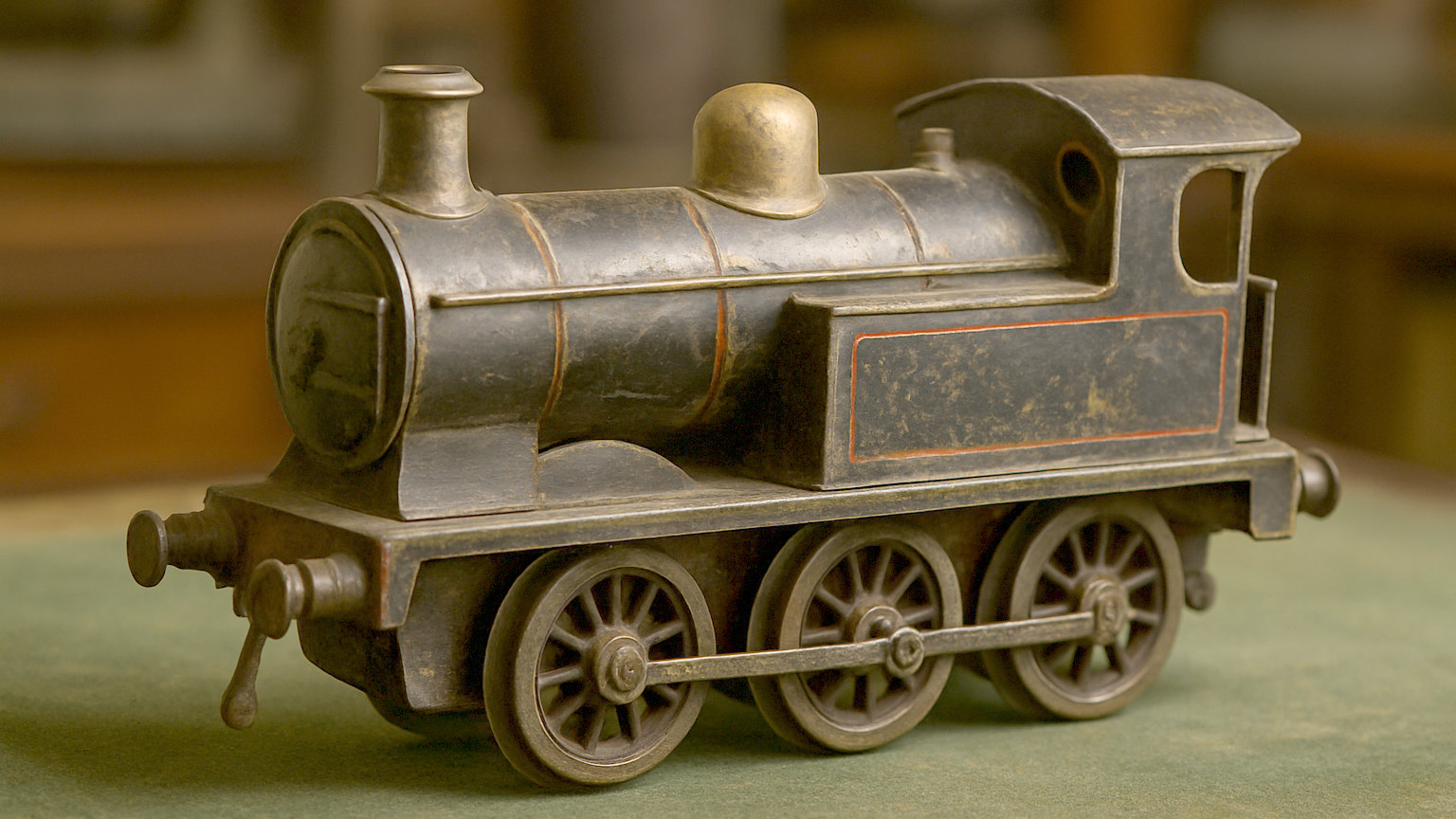
Intent. Tinplate trains are toys, made from pressed and lithographed tin, brightly coloured and only loosely representative of real locomotives.
Scale models aim at accuracy, with correct proportions and detail, made in die cast metal, brass or plastic. Both are collected seriously. Tinplate is judged on condition of the lithography and completeness; scale models on accuracy, finish and maker.
How are they powered?
Clockwork, steam or electric. Clockwork locomotives have a keyhole and a mainspring motor, live steam models have a boiler and burner, and electric models draw current from the track or a third rail.
Check clockwork motors by winding gently and stopping at resistance, since mainsprings break. Live steam models need careful inspection of the boiler and should never be fired without proper assessment. Electric models should be tested before purchase where possible.
Where are the maker marks?
Printed as part of the lithography on tinplate, or stamped, cast or transferred onto later models. Look on the underside of the chassis, on the cab side and on the tender.
Many manufacturers used a trademark device rather than a name. Country of origin wording indicates later production, since import rules required it from a known point. Check the box as well, since packaging frequently carries fuller information than the model does.
Why does the box matter so much?
For the same reason it does throughout toy collecting. Boxes were thrown away, survival rates are low, and a boxed model can be worth several times the same model loose.
The box also confirms the exact catalogue number and variant, which matters because manufacturers changed colours and details during production runs while the number stayed on the packaging. Check any box for reproduction, since these are made for the more valuable models.
What condition issues matter?
Paint and lithography above everything. Original finish with honest play wear is worth far more than a repaint, and the trade spots repaints instantly through paint thickness and wrong shades.
Check for rust, which is the enemy of tinplate and progressive. Look for replaced wheels, couplings and detail parts, all of which are available as reproductions and must be disclosed. Missing components reduce value considerably, so count buffers, couplings and any removable fittings.
How should they be stored?
Dry above everything, since rust destroys tinplate and damp warps card boxes. Avoid lofts and garages entirely.
Store with clockwork motors unwound to avoid stressing springs. Do not clean beyond removing dust with a soft brush, and never wash lithographed tin or use polish on it, since both strip the printed surface. Keep models in their original boxes where these survive, supported so that the card cannot crush under the weight of anything stacked above it.