Dolls are among the most systematically marked of all antique toys, which makes them unusually tractable to research. Most carry a maker mark and a mould number incised at the back of the head, and once you have those the field narrows quickly. The complication is that heads and bodies were frequently separated and recombined.
Where are the marks?
At the back of the head, low down near the neck opening, usually incised into the material before firing. You will need to lift the wig or move the hair aside to see them.
Handle this carefully, since old wigs are fragile and glued. The mark typically includes a maker name or initials, a mould number identifying the specific head design, and sometimes a size number. Record all of them, since the mould number is what identifies the doll.
What is a bisque head?
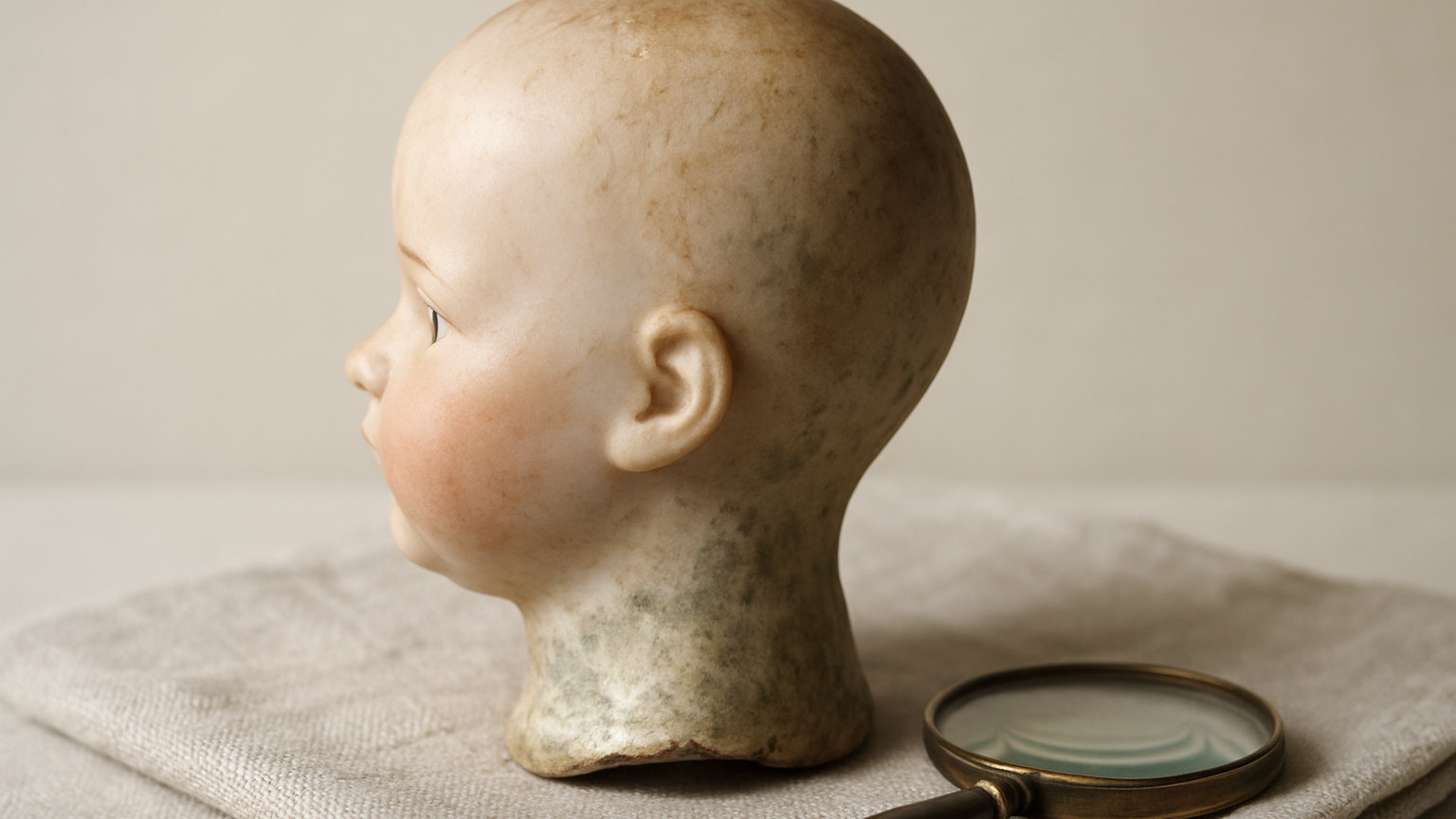
Unglazed porcelain, fired and then painted, giving a matt skin like surface quite unlike glossy glazed ceramic. It was the standard for quality dolls over a long period.
Bisque is hard, brittle and chips readily. Feel the surface, which should be smooth but not shiny. Later dolls use composition, a mixture of pulped material and glue, which is lighter, warmer to the touch and prone to crazing and flaking rather than chipping.
How do you check a head for damage?
Very carefully, because hairline cracks in bisque are common and substantially reduce value. Remove the wig only if it lifts easily, and examine the whole head under a strong light.
Look inside through the neck opening as well, since cracks are frequently visible from within before they show outside. Hold a torch inside a hollow head in a darkened room, which makes cracks glow through. Check around the eye sockets and the crown, which are the weak points.
Do the head and body belong together?
Frequently not, and it matters. Heads broke and were replaced, and bodies wore out while heads survived, so recombination is very common.
Check whether the head size suits the body proportionally, and whether the neck fits its socket properly rather than approximately. Compare the ageing of the two, since a head and body together for a century should have discoloured similarly. A pristine head on a heavily worn body is worth questioning.
What kinds of body are there?
Jointed composition bodies with ball joints at shoulders, elbows, hips and knees are the commonest on quality dolls. Kid leather bodies, cloth bodies and fully wooden bodies also appear.
Look at how the limbs are strung, since original stringing perishes and restringing is normal and acceptable. Check hands and fingers particularly, since these break constantly and replacements are common. Count the joints and check they all move as they should.
What about the eyes?
Glass eyes, either fixed or sleeping, meaning weighted to close when the doll is laid down. The mechanism is inside the head and can be examined through the neck opening.
Check both eyes match in colour and size, that any sleeping mechanism operates, and that the eyes are not loose in their sockets. Replaced eyes are common and reduce value. Original eyelashes and painted brows should be present and show consistent wear with the rest of the face.
How should a doll be looked after?
Kept dry, out of direct sunlight and at a stable temperature. Sunlight fades painting and clothing, and damp affects composition bodies, cloth and any original costume.
Never wash a bisque head or immerse any part of a doll. Dust with a very soft brush. Original clothing is valuable and should be kept even when worn, so do not replace it or wash it. Support the head when handling, since the neck is the weakest point and drops are how heads break.
Does original clothing matter?
Considerably, and it is frequently discarded because it looks shabby. Original costume, underclothes, shoes and any accessories add substantially to value and cannot be replaced convincingly.
Keep everything, including damaged items, and store textiles wrapped in acid free tissue rather than left on the doll where they stress old fabric at the seams.