Regency is the short, confident period between restrained Georgian classicism and the elaborate revivalism that followed. It is one of the easiest styles to recognise because it is deliberately theatrical, drawing on sources that had recently become fashionable and applying them boldly rather than subtly.
What was it reacting to?
Not much, in truth. It develops out of late Georgian classicism rather than rejecting it, but the temperature changes completely. Where earlier work is refined and evenly proportioned, Regency is bolder, lower and more dramatic.
New archaeological discoveries had made Greek, Egyptian and Roman forms fashionable, and military campaigns brought exotic motifs into circulation. The result is a style that borrows confidently and does not much care whether the sources sit comfortably together.
What are sabre legs?
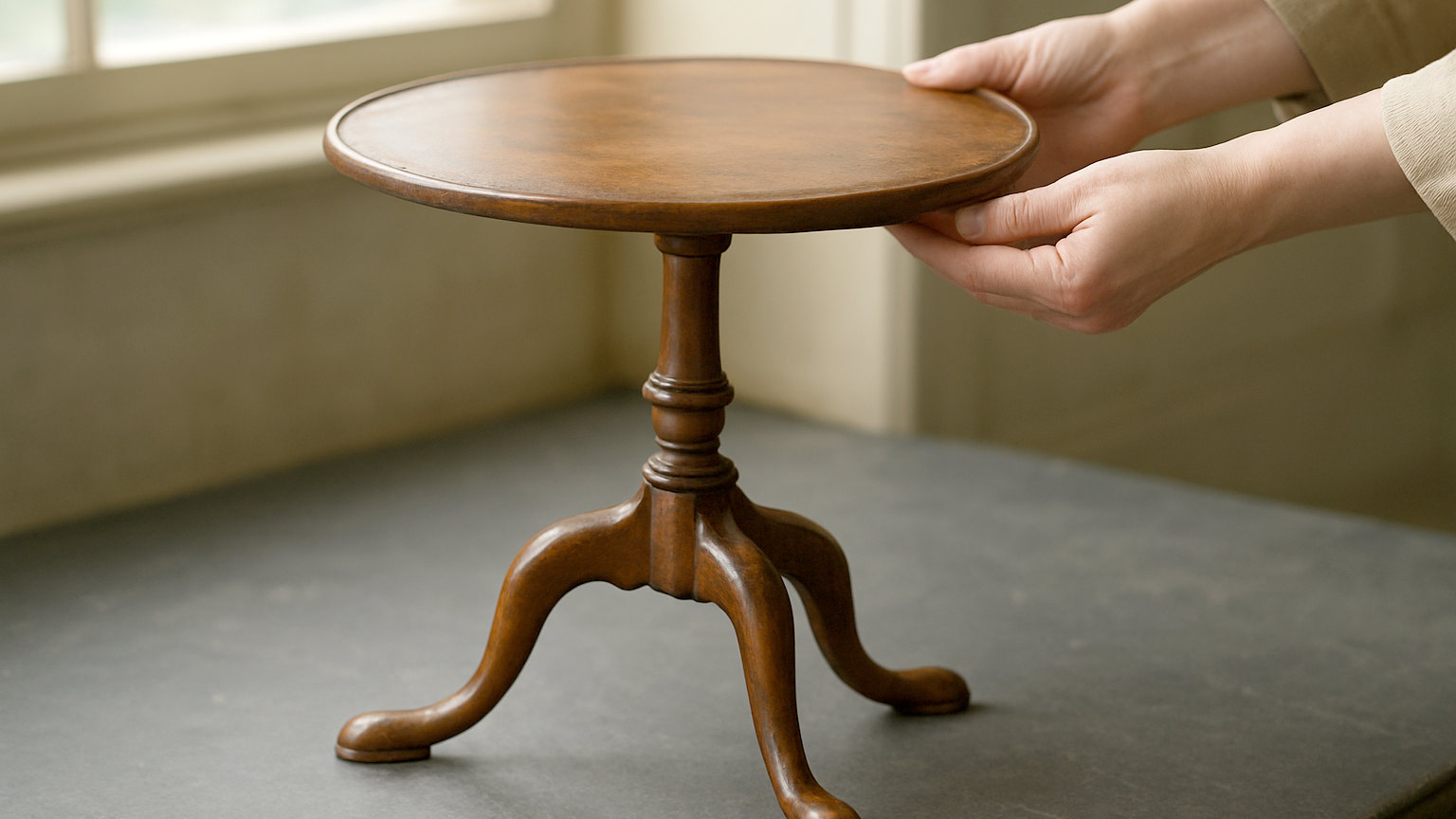
Legs that curve outward in a single sweep like the blade of a cavalry sabre, used on chairs and small tables. They are the single most recognisable Regency feature.
The curve is continuous and comparatively shallow rather than the double curve of a cabriole leg. Seen from the side, a Regency chair frequently has both front and back legs sweeping outward, which gives the whole piece a low braced stance quite unlike anything earlier.
Which timbers were used?
Rosewood above all, dark and strongly figured, alongside mahogany. Both suit the brass decoration that characterises the period.
Look for timber used in large plain areas so the figure itself provides the decoration, with ornament concentrated at edges and corners. Ebonised finishes appear, and calamander and other exotic timbers turn up on better pieces. Zebrawood and maple were used for banding and contrast.
What is brass inlay?
Thin brass let into the timber surface in decorative lines, borders and patterns, which is highly characteristic of the period and rarely seen before or after in the same way.
It appears as stringing along edges, as anthemion and scrolling foliage patterns on table tops and cabinet doors, and as decorative galleries. Check whether inlay is lifting, since brass and timber expand differently and losses are common. Missing sections are difficult and expensive to replace convincingly.
Which motifs recur?
Lion masks and paw feet, Egyptian heads, sphinxes, anthemion leaves, Greek key patterns, palmettes and lyre shapes. Applied brass or gilt mounts carry most of these.
Furniture frequently stands on paw or claw feet, and cabinet supports may be modelled as columns or as figures. The overall vocabulary is classical and military rather than floral, which is a quick way to separate it from what came later.
How does it differ from Georgian?
By proportion and weight. Georgian furniture is upright, evenly proportioned and relies on the figure of the timber and architectural mouldings. Regency is lower, broader and heavier, with applied metal decoration doing work that mouldings did before.
Colour differs too, since Georgian favours the warm red of mahogany while Regency reaches for darker rosewood and ebonised finishes. If a piece looks bold and slightly theatrical rather than quietly correct, it is probably Regency.
What about later revivals?
The style was revived repeatedly, and a great deal of furniture in the Regency manner was made decades or a century later. As always, construction dates a piece rather than style.
Check the joints, fixings, saw marks and secondary timbers. Machine cut dovetails, circular saw arcs and perfectly regular screws indicate later production regardless of how convincing the sabre legs are. Brass inlay was reproduced enthusiastically, so it is no guarantee of period.
Is it worth collecting?
Good Regency furniture has held its value better than most brown furniture, because the proportions suit modern rooms and the style reads as decisive rather than fussy.
Small tables, chairs and cabinets do particularly well. Check brass inlay for losses, check rosewood veneers for lifting, and buy original surface where you can, since the figure of the timber is much of what you are paying for and a stripped piece has lost it.