Edwardian furniture is frequently dismissed as merely late, which underrates it considerably. It represents a genuine reaction against Victorian heaviness, and the result is furniture that suits modern rooms better than almost anything else of comparable age. It is also among the best value in the market.
What defines the look?
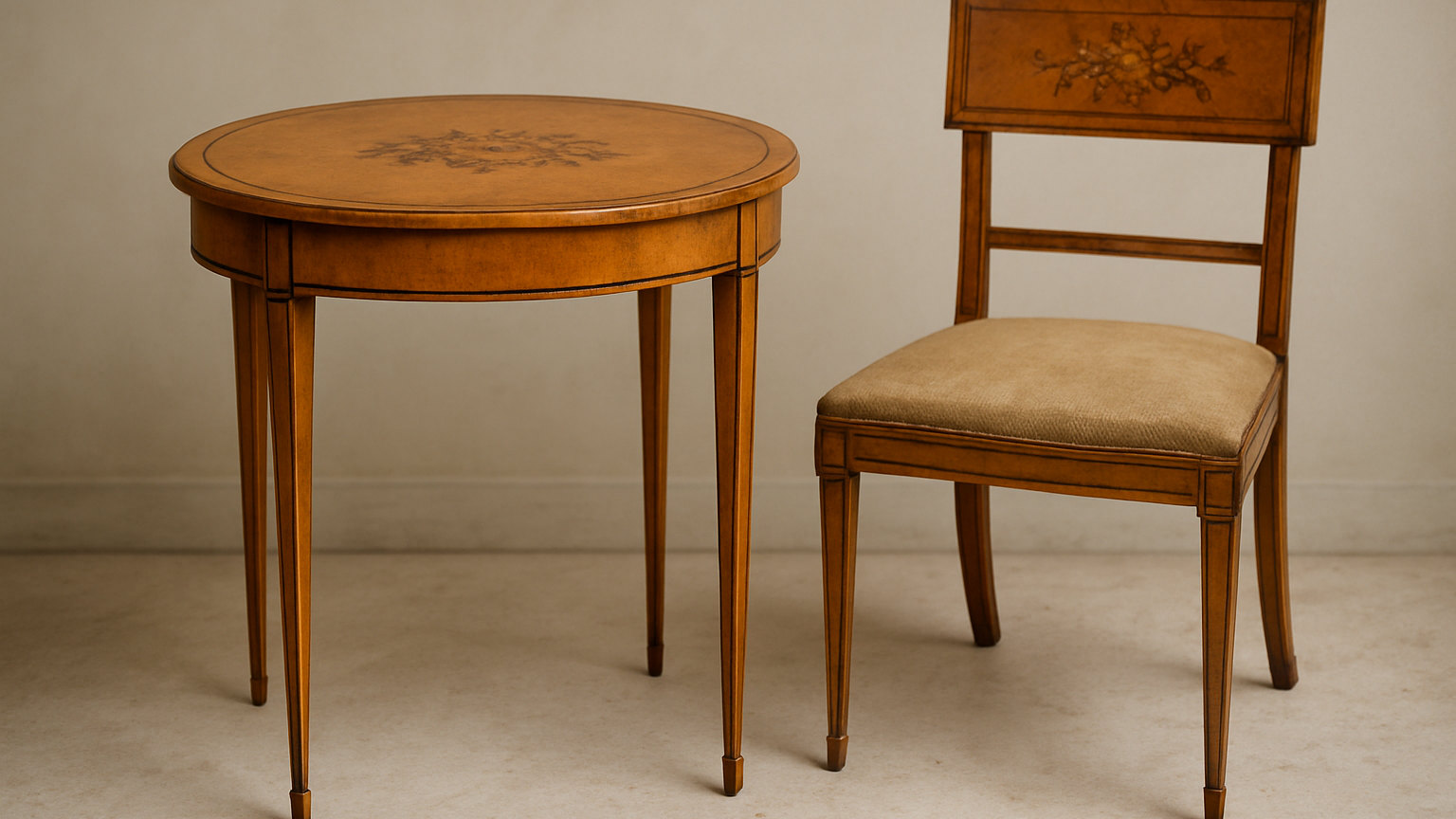
Lightness, in every sense. Slender proportions, thinner sections, tapered legs and pale timbers replace the dark heavily carved furniture of the preceding decades.
Decoration moves from carving to inlay and painting, which is flatter and less assertive. The overall effect is delicate rather than imposing, and a room furnished in it feels considerably less crowded than a Victorian equivalent.
Which timbers were used?
Mahogany still, but frequently in lighter tones, alongside satinwood and other pale timbers used both solid and as veneer. Rosewood appears for contrast.
Inlays use boxwood, ebony, sycamore and stained veneers to produce fine line stringing and marquetry panels. Painted finishes on light timber were fashionable, with decoration applied directly to the surface rather than inlaid, and these are worth recognising since they are frequently overpainted later.
What are the characteristic legs?
Slender and tapering, frequently square in section and reducing towards the foot, sometimes ending in a small spade foot. Turned legs are lighter than Victorian equivalents.
Look at the ratio between leg thickness and the mass of the piece above. Edwardian makers used thinner sections than would have been thought safe fifty years earlier, which produces the visual lightness and also means these legs are more prone to damage.
What is stringing and banding?
Stringing is a very fine line of contrasting timber inlaid along an edge or around a panel. Banding is a wider border, sometimes laid at an angle to produce a crossbanded effect.
Both are highly characteristic of the period and both are vulnerable. Check for missing sections, which are common, and for lifting where the inlay has separated from the ground. Replacement is fiddly and expensive to do well, so losses should be reflected in the price.
Why is so much of it revival?
Because the period looked back deliberately, reviving eighteenth century forms and decoration with genuine enthusiasm. A great deal of Edwardian furniture is made in the manner of earlier styles.
That is not deception, it was openly what customers wanted, and the quality is frequently high. It does mean that style cannot date these pieces, so check construction: machine cut dovetails, circular saw marks and thin machine cut veneers all indicate the later date whatever the design suggests.
What construction evidence should you check?
Veneer thickness above all, since Edwardian veneers are noticeably thinner than eighteenth century hand sawn ones. Look at an edge or a chip where the thickness is visible.
Machine cut dovetails, identical and evenly spaced with pins the same width as the tails, are normal for the period. Screws have perfectly regular threads and centred slots. None of this is a defect; it simply places the piece correctly.
What condition issues are typical?
Lifting veneer and lost inlay, since the veneers are thin and the glue is animal based and responds to damp. Check edges, corners and any curved surface.
Slender legs and stretchers break, so check for repairs at the joints. Painted surfaces are frequently overpainted or stripped, both of which reduce value considerably, so look for original decoration under a good light and be sceptical of anything that looks too fresh.
Is it worth buying?
It is arguably the best value in antique furniture. The proportions suit small modern rooms, the pale timbers suit current interiors, and prices remain low because the period is unfashionable among collectors.
Buy on quality of inlay, soundness of veneer and original surface. A well made Edwardian display cabinet or writing table costs a small fraction of an eighteenth century equivalent, fits a modern house considerably better, and is a genuine antique in its own right rather than a compromise.