Arts and Crafts furniture is unusually easy to identify once you understand what it was reacting against. Where earlier work concealed its construction beneath veneer, polish and applied ornament, this movement deliberately showed how a piece was put together and treated the joint itself as the decoration.
What was the movement reacting to?
Machine production and the ornament it made cheap. Industrial methods had put elaborately carved and moulded decoration within reach of ordinary households, and the response was a rejection of applied ornament in favour of visible craftsmanship.
The principle was that an object should be honest about its materials and its making. That is not simply an aesthetic position, it produces specific physical features that are straightforward to recognise on the furniture itself.
What construction features identify it?
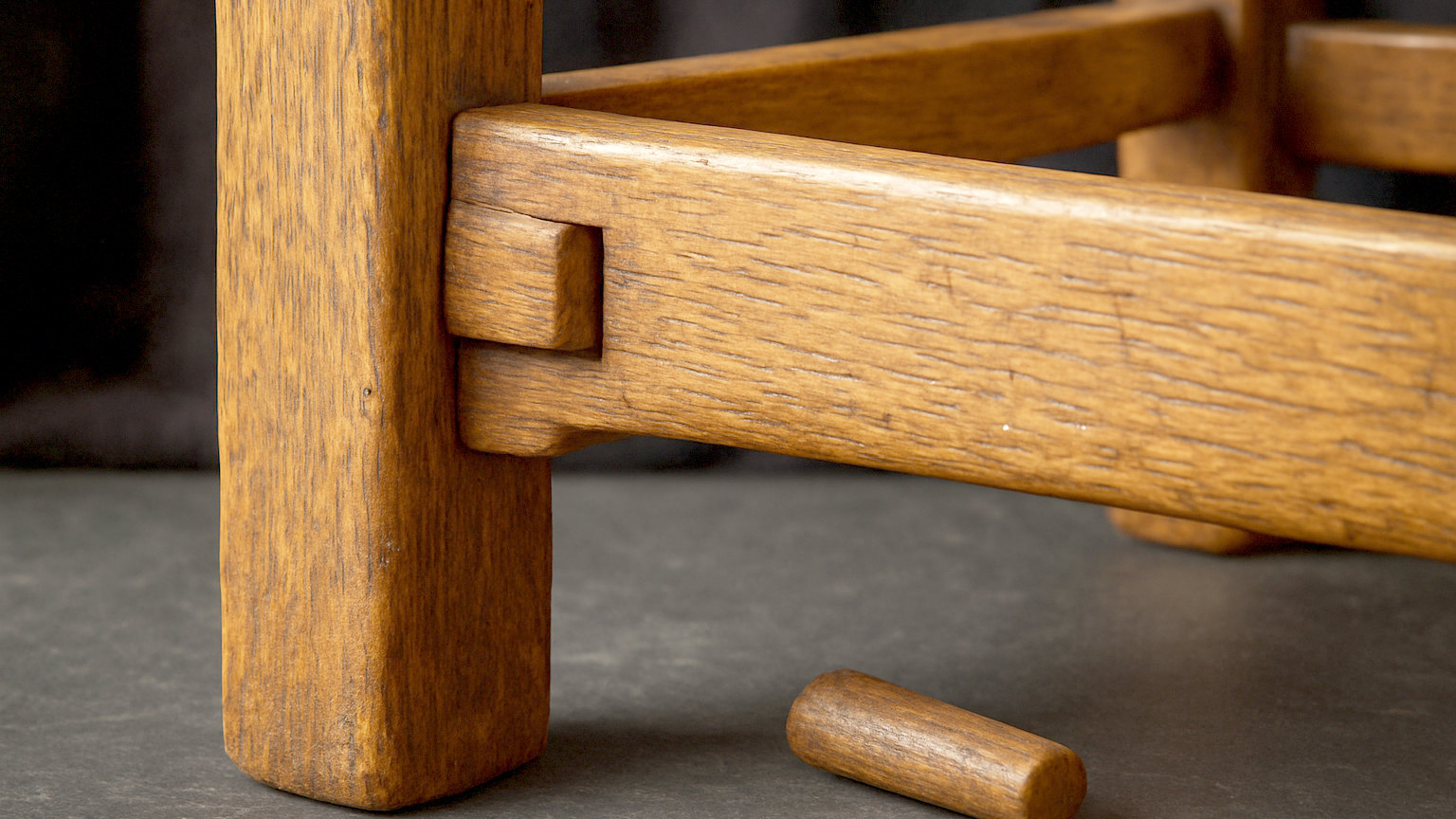
Exposed joints, above all. Look for through tenons, where a tenon passes right through a leg or an upright and projects visibly on the other side, frequently secured with a wedge or a peg that is also left showing.
Pegs and dowels appear on show surfaces rather than being hidden. Chamfered edges, where a corner has been planed off at an angle, are common. Hinges, handles and strap work are frequently oversized and left plainly visible rather than being let in flush.
Which timbers were used?
Oak overwhelmingly, and usually British oak rather than imported exotic timbers, because using local materials honestly was part of the point. Ash, elm and walnut appear as well.
Quartered oak, sawn so that the medullary rays show as a distinctive figure of silvery flecks and flashes across the surface, was particularly favoured because it demonstrates the character of the wood. Surfaces are usually finished with wax or a light stain rather than a high polish, so the grain remains visible and slightly textured.
What does the metalwork look like?
Hand worked and deliberately so. Hinges, handles, escutcheons and strap fittings were made in copper, brass or wrought iron, and hammer marks were left visible rather than being planished away.
Look for a slightly irregular hammered surface, hand cut shapes with minor asymmetry, and fixings that are part of the design rather than concealed. Repoussé decoration, worked from the back to raise a design, appears frequently on copper panels and fire surrounds.
How is the decoration different?
Restrained and stylised. Where ornament appears it is usually drawn from nature and simplified into flat pattern rather than modelled in three dimensions.
Common motifs include stylised plant forms, hearts, birds and simple geometric patterns, often executed as shallow carving, inlay in contrasting timbers, or pierced work. Inlay in pewter, mother of pearl and coloured woods appears on better pieces. The overall effect is quieter than anything from the preceding decades.
What about later copies?
Enormous quantities of commercial furniture were made in the style once it became fashionable, and much of it imitates the appearance without the substance. This is where care is needed.
Check whether the through tenons actually pass through and carry load, or whether they are short blocks glued on to look as though they do. Look at whether the pegs are real or dowel ends inserted decoratively. Machine cut joints, thin sections and applied ornament all indicate commercial production rather than workshop craftsmanship.
Is it worth collecting now?
The best of it is expensive and has been for a long time, since named designers and identified workshops attract serious international competition. Pieces with a documented attribution sell very well.
Ordinary commercial furniture in the style is far more affordable and often extremely well made in solid oak, which makes it excellent value for use. Look for quality of timber, genuine construction and original surface, and check the underside and the back of a piece where commercial shortcuts always show most clearly. A commercial maker finished what the customer would see and hurried everything else, so the concealed surfaces are where the real quality of the workshop declares itself.