Art Nouveau is among the most recognisable of all period styles because it is built on one visual idea carried through with real consistency. Everything curves, nothing meets at a right angle if it can be avoided, and the source of every form is something that grows. Once you have that in mind the style identifies itself.
What defines the style?
The line. Art Nouveau uses long flowing asymmetric curves derived from plant stems, tendrils, flowing water and hair, and it avoids straight lines and sharp corners wherever possible.
The characteristic form is often called the whiplash curve: a line that swells, tapers and doubles back on itself. Look for it in the outline of an object, in applied decoration and in the shape of handles and supports. Where you find it repeatedly, you are in the right period.
Which motifs recur?
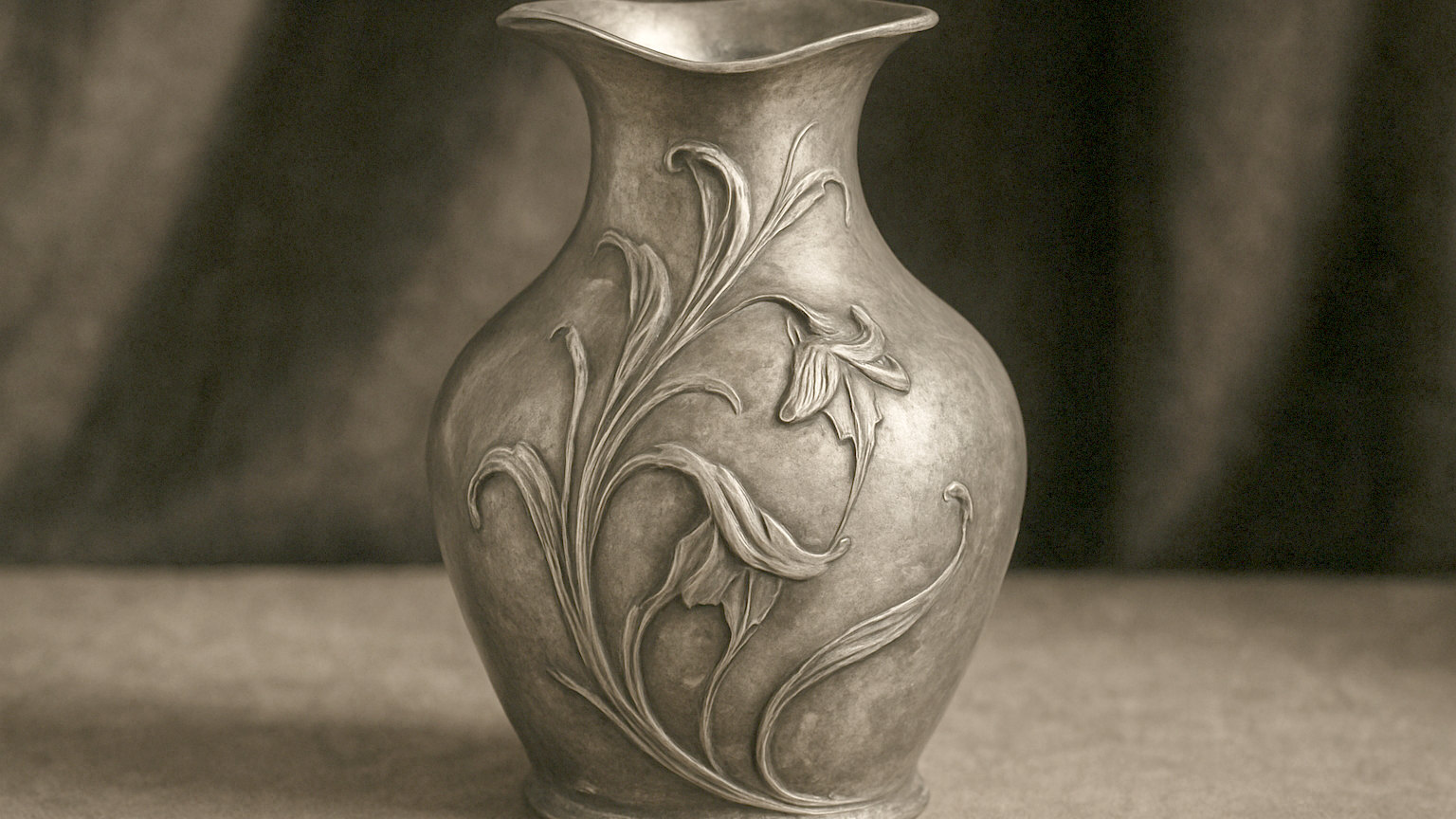
Stylised natural forms rather than naturalistic ones. Irises, lilies, poppies, waterlilies and thistles appear constantly, simplified into flowing shapes rather than botanically accurate drawings.
Insects are common, particularly dragonflies and moths, and peacocks appear frequently for their feathers. Female figures with long flowing hair are perhaps the most characteristic motif of all, used on everything from lamp bases to jewellery to poster design.
Which materials suited it best?
Those that could be shaped freely. Glass above all, where the material could be blown and worked into flowing organic forms, and where iridescent surface treatments produced colours nothing else could.
Metalwork in silver, pewter and bronze suited it well, since casting allowed the curves to be modelled. Ceramics took the forms readily. Furniture is the weakest area, because the curves are difficult and expensive to produce in timber, so large Art Nouveau furniture is relatively scarce.
What colours are typical?
Soft, muted and slightly murky. Greens, ambers, mauves, dusty pinks and browns predominate, quite unlike the bold contrasts of the movement that followed.
In glass, look for iridescence, a surface treatment producing shifting metallic colours that change as the piece is turned. In ceramics, look for matt or lustre glazes rather than high gloss. The overall palette is atmospheric rather than confident.
How does jewellery differ from what came before?
By valuing design over materials, which was genuinely radical. Art Nouveau jewellers used horn, glass, enamel and semiprecious stones freely, choosing them for colour and effect rather than for intrinsic worth.
Plique a jour enamel, where translucent enamel sits in a frame with no backing so light passes through like a stained glass window, is highly characteristic and technically demanding. Look also for carved horn, moulded glass and irregular baroque pearls used deliberately for their asymmetry.
How does it differ from Art Deco?
Almost completely, which is why confusing the two is unnecessary. Art Nouveau curves; Art Deco uses straight lines and angles. Nouveau draws from plants; Deco draws from machinery and architecture.
Nouveau is asymmetric and atmospheric; Deco is symmetrical and confident. Nouveau uses soft muted colour; Deco uses strong contrast. If a piece could be drawn with a ruler and compass it is Deco, and if it could not it is probably Nouveau.
Is it worth collecting?
The best of it commands serious prices and has for a long time, particularly named glass makers, jewellers and metalworkers, whose work is followed internationally.
Commercial pieces made in the style are far more affordable and frequently attractive, though quality varies enormously since the style was applied to a great deal of mass produced ware. Judge by the quality of the line and the execution rather than by the presence of a curve, since the movement was imitated cheaply on an industrial scale.
How long did the movement last?
Not long, which is useful for dating. It rose quickly, dominated fashionable design for a relatively short period, and was swept away by the very different geometry that followed.
That brevity means a genuine piece can be placed within a fairly narrow window, unlike styles that were revived repeatedly over a century. Be aware, though, that commercial manufacturers continued producing in the manner for years after fashionable taste had moved on, so construction and materials should still be checked.