The single most common mistake in dating antiques is trusting the way something looks. Workshops revived earlier styles constantly, not to deceive anyone but because customers wanted them, and some of those revival pieces are now old enough to be genuine antiques in their own right while looking a hundred years older than they are.
Why were earlier styles revived at all?
Because fashion looked backwards as often as forwards. Successive generations decided that an earlier era represented better taste, better craftsmanship or a more appealing national tradition, and furnished accordingly.
Industrialisation made this cheap. Machinery could produce carved ornament that had previously required a skilled hand, so decoration that once signalled expense became affordable, and heavily ornamented furniture in older styles was made in enormous quantities for ordinary households.
Which styles were revived most?
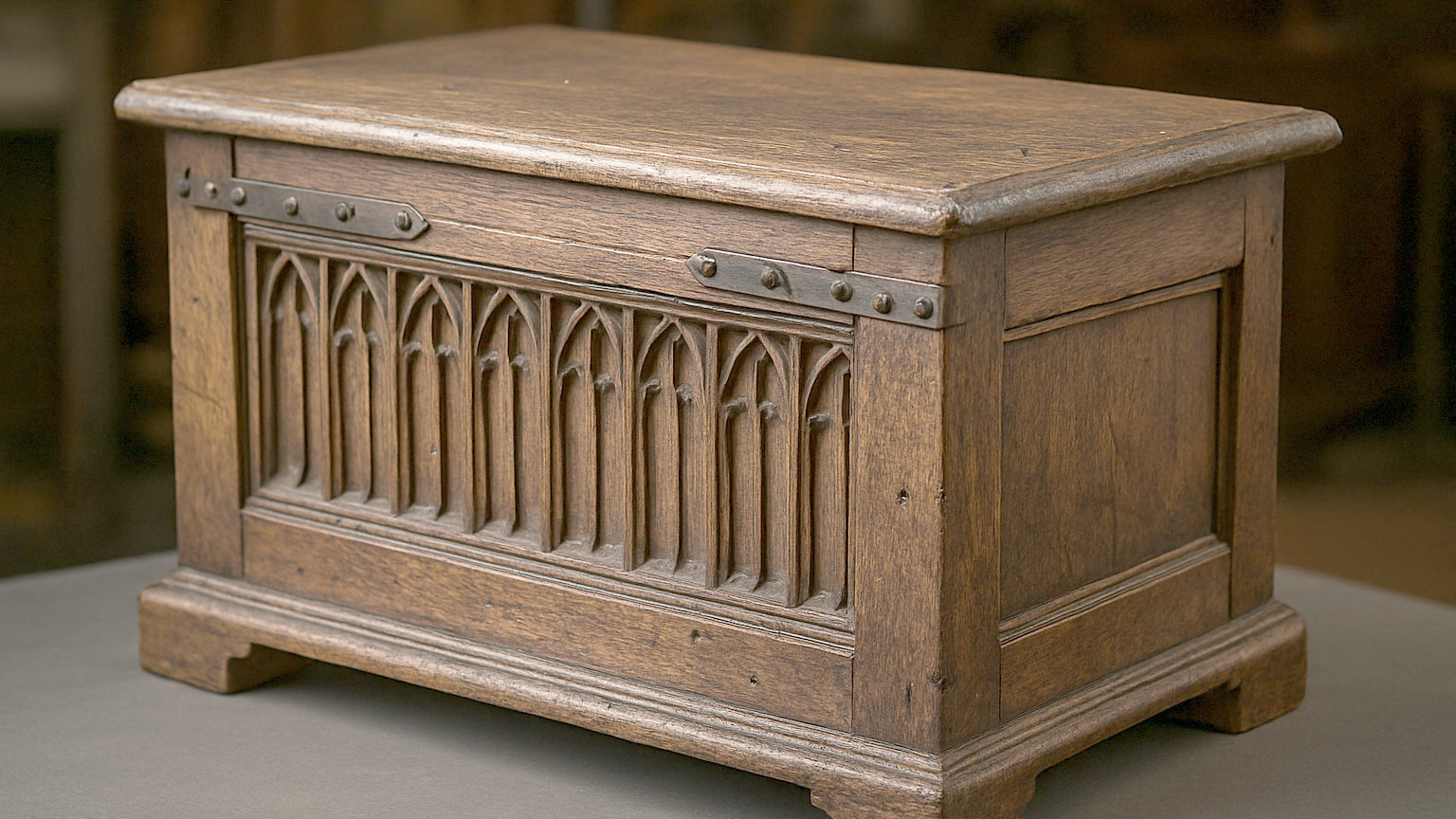
Almost all of them, and frequently several at once. Classical forms were revived repeatedly. Gothic detailing, with pointed arches, tracery and quatrefoils, was applied to furniture forms that had never existed in the medieval period.
Elaborate rococo scrollwork and shell motifs were revived enthusiastically, and eighteenth century designs were reproduced continuously from the moment they went out of fashion. A drawing room could contain four different centuries of style, all made in the same decade.
Why does construction date a piece when style cannot?
Because a maker copying an outline had no reason to copy the workshop methods behind it, and every reason not to. Hand cutting joints when a machine was available would have made no commercial sense.
So a revival piece wears an old face on a modern body. The carving may be convincing while the dovetails are machine cut, the saw marks are circular arcs and the screws have perfectly regular threads. Check the joints, the fixings and the tool marks first, and treat the style as information about intent rather than date.
What construction clues matter most?
Dovetails, saw marks and fixings, in that order. Machine cut dovetails are numerous, identical and evenly spaced, with pins the same width as the tails. Circular saw marks appear as curved arcs on unfinished surfaces and cannot be produced by hand.
Screws with perfectly even threads, a centred slot and a pointed tip indicate machine manufacture. Look also at the secondary timber used for drawer linings and backboards, since revival pieces frequently use a different and cheaper species than the period they imitate.
Is the decoration itself a clue?
Often. Machine carved ornament repeats identically across a piece, because it came from the same cutter. Hand carving varies subtly between repeats, since no carver produces two identical results.
Look at a row of repeated motifs and compare them closely. Identical depth, identical spacing and identical tool marks indicate machine work. Applied ornament glued onto a flat surface, rather than carved from the solid, is another strong indicator of later production, since the earlier approach planned the decoration into the timber thickness.
Are revival pieces worth buying?
Frequently, and they represent some of the better value available. Many are well made from solid timber, they are a century or more old themselves, and they cost a fraction of the period originals they imitate.
The problem is never the revival piece. It is paying a period price for one. Bought knowingly at the right money, a good revival piece will serve as well as an original and can be used without the anxiety that comes with something far more valuable.
What should you ask before buying?
Ask directly what date the seller believes the piece to be and ask for that date in writing on the receipt. A dealer confident in an attribution will put it in writing without hesitation.
Then look underneath yourself. Pull out a drawer, turn the piece over and check the evidence rather than the description. Where the style and the construction disagree, the construction is telling the truth, because a workshop could copy an outline in an afternoon and had no reason whatever to copy obsolete tools.