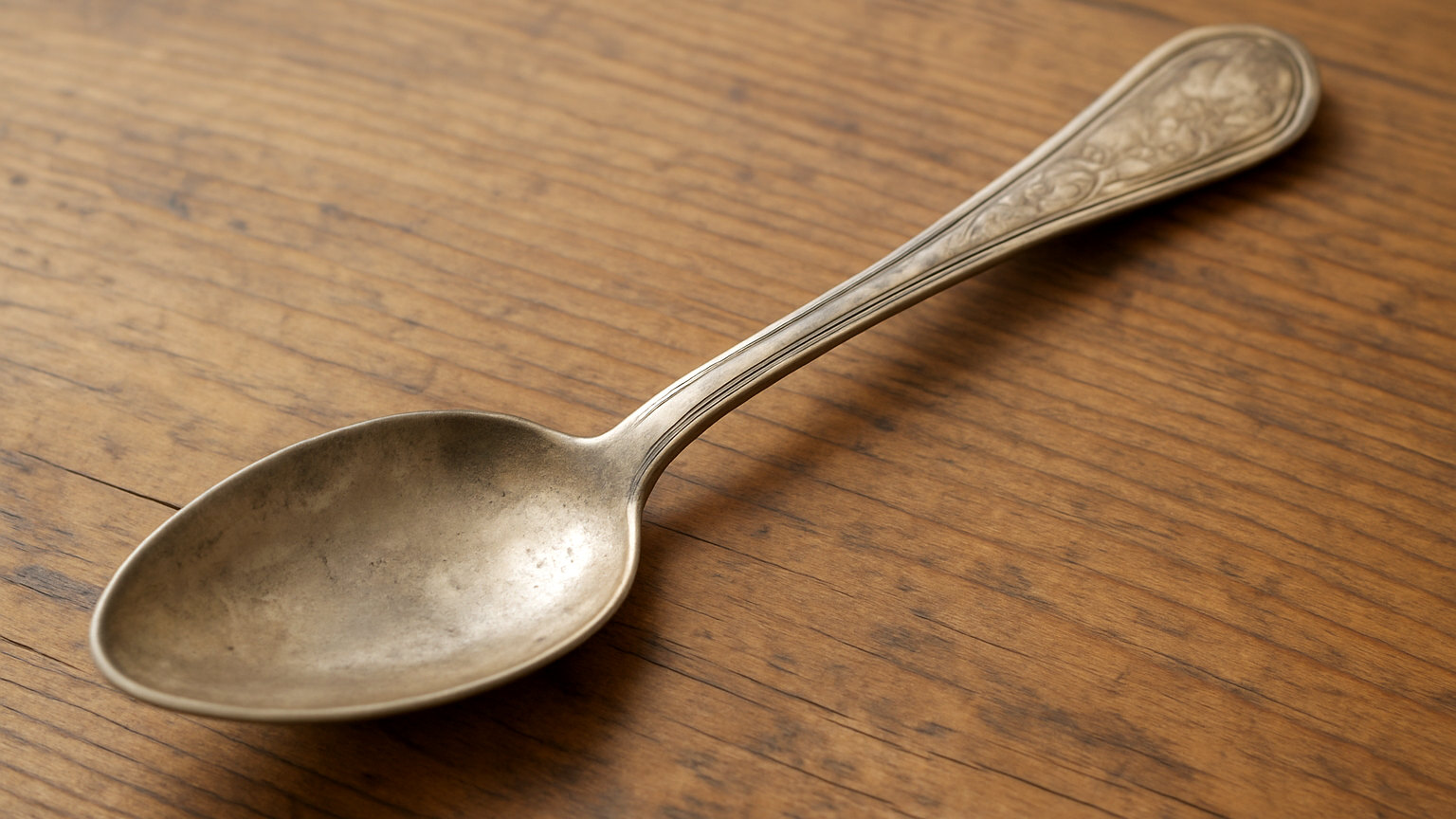
Finding no hallmark on something that looks and feels like silver causes immediate suspicion, and that suspicion is frequently misplaced. There are several entirely innocent reasons a genuine piece carries no marks, and knowing them prevents both unnecessary alarm and the opposite error of assuming an unmarked object must be base metal.
What items were exempt?
Articles below defined weight thresholds, which excluded a great deal of small work. Fine chains, small mounts, tiny spoons, delicate settings and lightweight jewellery all fall below the point at which marking was compulsory.
Exemption was practical as well as legal, since striking a punch into thin or fragile work would have damaged it. A great deal of genuine antique gold and silver jewellery has therefore never carried a mark at all.
What else was excluded?
Certain categories were exempted for their own reasons, including some items intended for particular trades and some articles where marking would have interfered with function.
Very early pieces predate systematic marking in some places, and provincial work from areas without a nearby assay office was frequently sent unmarked because the journey was impractical. None of these indicate anything improper about the object.
Can marks simply wear away?
Entirely, and this is the commonest explanation of all. Punches are shallow, and every polish removes a microscopic layer of metal, so two centuries of enthusiastic cleaning will erase a hallmark completely.
Look for a slight depression or a faint ghost where marks would normally sit, since a worn mark frequently leaves a shadow before it disappears entirely. Use raking light and magnification, and check every likely position rather than the obvious one.
What about deliberate removal?
Marks are occasionally removed, usually as a side effect of something else rather than as an aim in itself. Erasing an engraved crest can take the marks with it, and heavy repair or reshaping can obliterate them.
Look for evidence of the surface having been worked: an area thinner than the surrounding metal, slightly dished, or with a different texture. Where marks appear to have been removed on purpose, the piece should be treated with more caution, since that is the one situation where concealment may be the motive.
What if the marks are on a missing part?
A common situation. If a piece has lost its lid, its base, its liner or a detachable mount, it may have lost the only marked component with it.
Check every surface including the interior and the underside of any fitting. On assembled objects, one part may be marked and another not, which is normal since only separately assayed components carry their own punches.
Does foreign origin explain it?
Frequently. Many countries never adopted a pictorial marking system, using numeric standards instead, and some marked far less consistently than Britain did.
An unfamiliar mark or an absent one on a piece whose style is not British is more likely to indicate origin than deception. Colonial and export silver was frequently marked with pseudo hallmarks or not at all, which was conventional in those markets rather than fraudulent.
How should you test an unmarked piece?
Electronically, by a jeweller or an assay office, which is quick and does no damage. This is the sensible route for anything where the answer matters.
Weight and feel help as supporting evidence, since silver is dense and warms readily in the hand. Look at wear points for base metal showing through, which indicates plating. Avoid acid testing kits, which damage the surface permanently to obtain information available without marking the piece.
Does an absent mark reduce value?
Yes, though less than people expect, and for a specific reason: what you lose is certainty rather than metal. An unmarked piece cannot be dated exactly or attributed with confidence.
Where quality is evident and the form is right, an unmarked piece still sells, particularly if tested. Have it tested and say so when selling, since a buyer offered an unmarked item with documented test results is in a very different position from one asked to take it on trust.