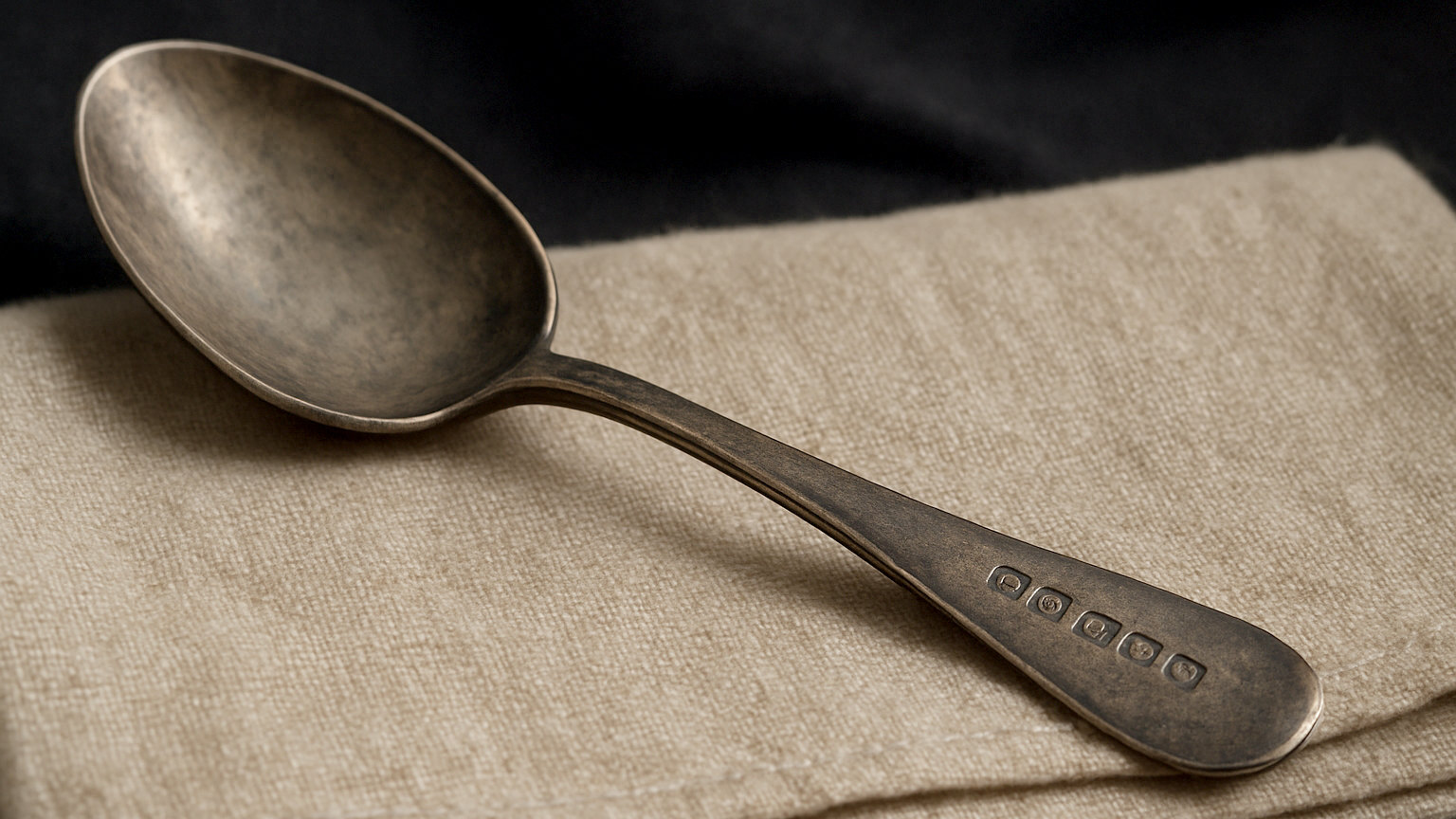
British silver carries something no other antique material offers: a legally enforced record of what it is and when it was tested, running back to the fourteenth century. A full hallmark tells you the metal standard, the town where it was assayed, the year, and the workshop that submitted it. Learning to read that row of punches is the single most useful skill in the whole field.
What are the symbols in a hallmark?
A traditional British hallmark has four elements struck in a line. The standard mark states the purity of the metal, and for sterling in England this is a walking lion, known as the lion passant. The town mark identifies the assay office that tested the piece, with a leopard head for London, an anchor for Birmingham and a crown historically used for Sheffield.
The date letter is a single letter in a shaped shield giving the assay year. The makers mark is the initials of the person or firm who submitted the item. Older pieces may also carry a monarch head duty mark, showing that a tax was paid, which was in use for a defined period and is therefore a dating clue in itself.
How does the date letter give an exact year?
Each assay office ran through an alphabet, changing the letter every year, then started again with a new typeface and a differently shaped shield. That means the letter alone is ambiguous, because the same letter recurs every twenty years or so, but the combination of letter, typeface and shield shape is unique.
This is why you must identify the town mark before you look up the date letter. The cycles were not synchronised between offices, so a letter used in one year in London may correspond to a different year in Birmingham. Read the town first, then find that office table, then match the letter and its shield.
How can you tell sterling from silver plate?
The presence of a genuine hallmark is the answer, and the difference in value is substantial. Sterling carries the standard mark and the town mark. Electroplated wares carry neither, because they are base metal with a thin silver coating and cannot legally be hallmarked.
Plated items usually carry letters indicating electroplated nickel silver, or a brand name, or numbers that look superficially like a hallmark but contain no lion and no town symbol. Old Sheffield plate, which is a different and earlier process of fusing silver sheet to copper, sometimes shows a thin line of copper at a worn edge or rim. If you see warm pink metal coming through where the surface has rubbed, the piece is plated.
Why are some parts marked and others not?
Each separately made component was meant to be assayed and marked in its own right, so a teapot may carry a full mark on the base and a smaller partial mark on the lid. When a lid carries a different date or a different makers mark from the body, the two have probably been paired later.
That is worth knowing before you buy, because a matched original is worth considerably more than an assembled one. Check every detachable part rather than accepting the mark on the largest piece as proof for the whole object.
Which marks are not hallmarks?
Several things sit alongside a hallmark and get mistaken for one. A pattern number or a catalogue number is a factory reference. Scratch weights, which are lightly engraved numbers on the base, record the original weight for inventory purposes and are genuinely useful evidence of age, but they are not assay marks.
Continental silver used different systems, often with numeric standards rather than symbols, so an unfamiliar mark is more likely foreign than fake. Import marks appear on foreign silver legally brought into Britain and tested here, and are perfectly legitimate.
When should you have a mark checked professionally?
If the marks are worn to the point where the shield shape is unclear, if the piece is heavy enough that the difference between sterling and plate matters financially, or if the mark suggests an early date, it is worth paying for an opinion. Assay offices themselves can test and advise, and a specialist silver dealer will read a mark in seconds.
Never clean a piece before it is examined. Polishing removes metal, softens the punch edges, and can reduce a legible hallmark to a smear. The dark residue in a mark is what makes it readable.