The timber in a piece of furniture carries a date in two ways: which species the maker chose, and how the material was prepared. Fashions in wood moved in a broad and reasonably documented sequence, and veneer cutting changed with technology, so the woods themselves are evidence before you look at a single joint.
What is the broad sequence of timbers?
Oak dominated early furniture, being strong, durable and locally available. Walnut succeeded it for fashionable work, prized for its figure and colour. Mahogany then became the timber of choice for quality furniture, being stable, strong and available in wide boards.
Later, rosewood and other dark exotic timbers appear alongside mahogany, and satinwood for lighter work. Then a broad revival period uses everything at once. This sequence gives you a general steer rather than a date, since country workshops continued using oak throughout.
What is secondary timber and why does it matter?
The wood used where it will not be seen: drawer linings, backboards, dust boards and internal framing. Makers used cheaper local timber for these while reserving the expensive show wood for visible surfaces.
Secondary timber is genuinely informative because it varied by region and period. Oak linings generally indicate earlier or better work; pine linings indicate later or cheaper production. A piece with a fine mahogany exterior and pine drawer linings tells you something different from one with oak linings.
How does veneer thickness date a piece?
Veneer was originally cut by hand with a saw, which is slow and wasteful, so early veneer is comparatively thick. Later mechanical cutting produced progressively thinner sheets, and modern veneer is thinner again.
Look at an edge, a chip or a lifted corner where the veneer thickness is visible. Substantial thickness that you can clearly see and feel indicates early hand cut work. Paper thin veneer over a manufactured board is modern. Measure at a damaged edge rather than guessing from the surface.
What can you tell from how veneer is laid?
Skill and intent. Book matched veneer, where consecutive sheets are opened like a book to make a symmetrical pattern, indicates a maker thinking about the figure. Quartered and oyster veneers show the same care.
Look at whether the pattern resolves properly across a drawer front and whether the grain runs sensibly across a whole facade. Cheap later work frequently uses a single plain sheet with no attempt at figure. Cross banding, a border of veneer laid at an angle around a panel, is a quality indicator.
Does shrinkage help?
Considerably, and it is one of the more reliable checks. Timber shrinks across the grain and barely at all along it, so solid components change shape slowly over a long life.
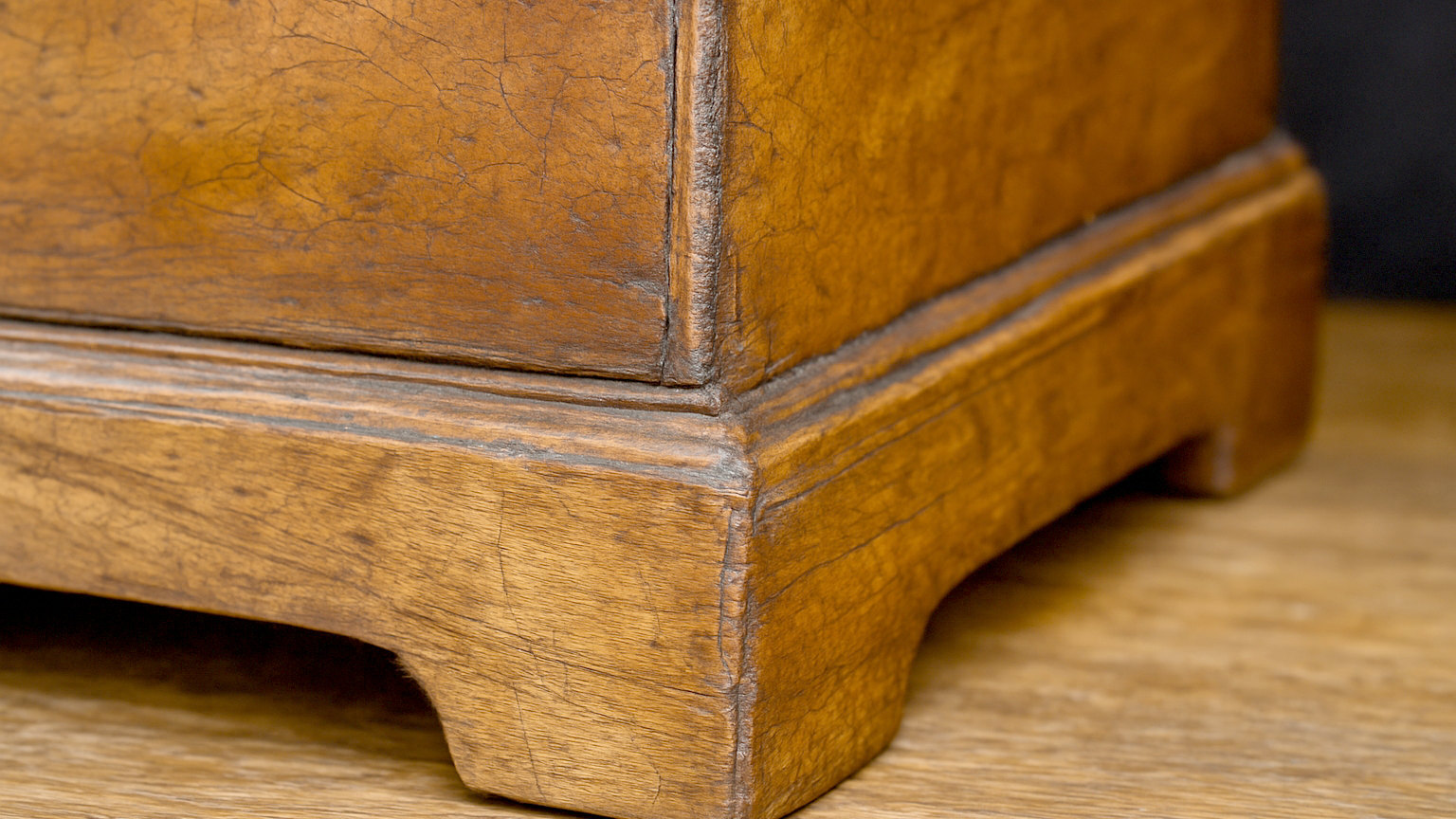
A circular top becomes slightly oval; measure across the grain and along it and compare. Panels shrink within their frames, leaving a narrow strip of unfaded timber at the edge where the panel pulled away from the moulding. That strip is excellent evidence of genuine slow movement and is difficult to fake.
What does colour reveal?
Where light and air have reached. Timber oxidises on exposed surfaces and stays pale where it never did, so there should be a marked difference between the outside of a drawer front and its interior.
Compare the exterior back of a carcass with the interior. On an untouched piece the difference is clear and developed gradually. Uniform colour throughout suggests stripping, since dipping tanks colour everything equally, or a piece that is simply not as old as it appears.
How should you weigh timber evidence?
As one strand among several rather than a verdict. Timber gives a broad period, veneer thickness gives a technological bracket, and shrinkage confirms genuine age, but none of them alone settles a date.
Repairs complicate the picture, since replaced components in different wood are entirely normal on old furniture. Combine what the timbers tell you with the fixings, the saw marks, the joints and the wear, and look for a story that agrees. Where most indicators point one way and one does not, the odd one out is usually a repair.