If you can only check one thing on a piece of furniture, check the fixings. Nails and screws were manufactured goods, their production changed as machinery improved, and those changes are documented well enough to give useful date brackets. Better still, they sit in places nobody thought to disguise.
What does a hand forged nail look like?
Irregular in every dimension. A blacksmith made each one individually, drawing it out on an anvil, so it tapers on all four sides towards a blunt rather than sharp point, and the section is roughly square but never exactly so.
The head is the clearest tell. It was formed by hammering the top over, so it is uneven, often off centre, and shows facets from the hammer blows rather than a smooth round profile. No two are alike, which is the opposite of everything that came later.
How is a cut nail different?
It was sheared from a sheet of iron rather than forged, so it is rectangular in section and tapers on only two opposing sides while the other two remain parallel.
That combination of a taper on two faces and parallel on the other two is diagnostic and easy to check by eye. Cut nails represent the first stage of mechanisation and sit between hand forged work and modern production. Heads are more regular than forged ones but still show variation.
What about round wire nails?
Perfectly round in section, uniform along their length, with a neat round head and a sharp point. These are machine drawn from wire and are the modern nail we all recognise.
A wire nail in a structural position means the work is comparatively recent, or that a repair has been carried out. Since repairs are entirely normal on old furniture, one wire nail proves nothing on its own. What matters is whether the original fixings throughout the piece are consistent with each other.
How do you read an old screw?
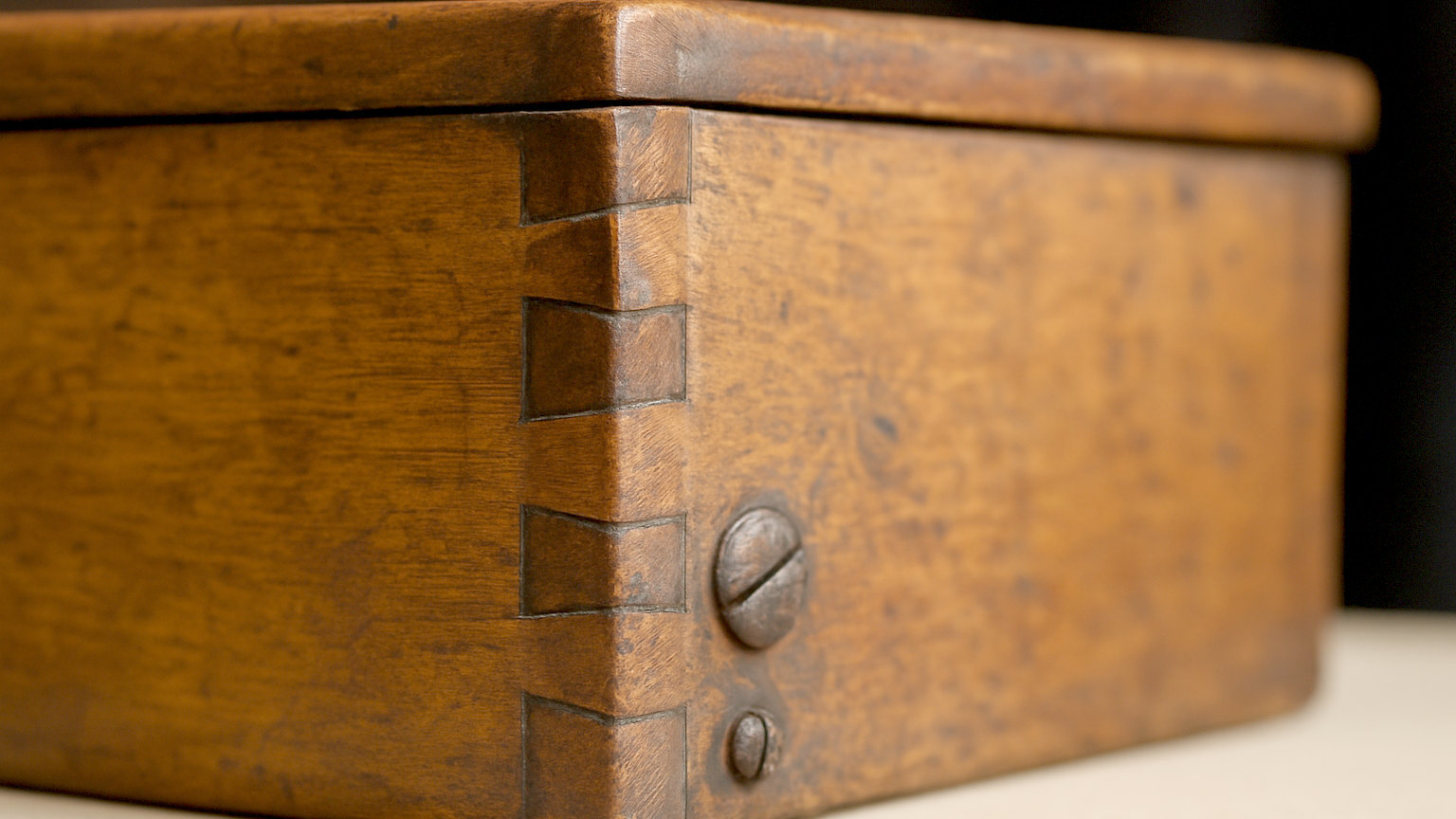
Look at three things: the thread, the slot and the tip. A hand made screw has an uneven thread with variable pitch, often with file marks visible on the shank where it was finished by hand.
The slot in the head was cut with a hacksaw, so it is frequently off centre, not quite straight, and does not always run the full diameter of the head. The tip is blunt, because early screws were designed to go into a hole drilled first rather than to cut their own way in.
What indicates a machine made screw?
Regularity. The thread is perfectly even in pitch and depth all the way along, the slot is precisely centred and runs the full width, and the head is symmetrical.
A sharp gimlet point, which allows a screw to cut its own thread, indicates later manufacture, since earlier screws had blunt ends. Modern crosshead screws are unmistakably recent. Look also at the metal itself: hand made screws are usually iron and corrode differently from later steel.
Where should you look for the original fixings?
In the places nobody reaches. Inside the carcass, behind drawer runners, on the underside of a seat rail, at the back of a moulding and where blocks are glued into corners.
Accessible fixings get replaced during repairs, so a chest may have modern screws holding its top and original forged nails securing the backboards. The concealed ones tell you about the original construction, and the accessible ones tell you about its repair history.
How much weight should you give this evidence?
A good deal, but never on its own. Fixings give you a firm earliest possible date, since a piece cannot predate the technology holding it together, and that is genuinely valuable.
They do not give a latest date, because hand made fixings remained in use in country workshops long after machinery arrived, and because old fixings were reused. Combine what the fixings tell you with saw marks, dovetails, timber shrinkage and wear, and look for a story that agrees across all of them.