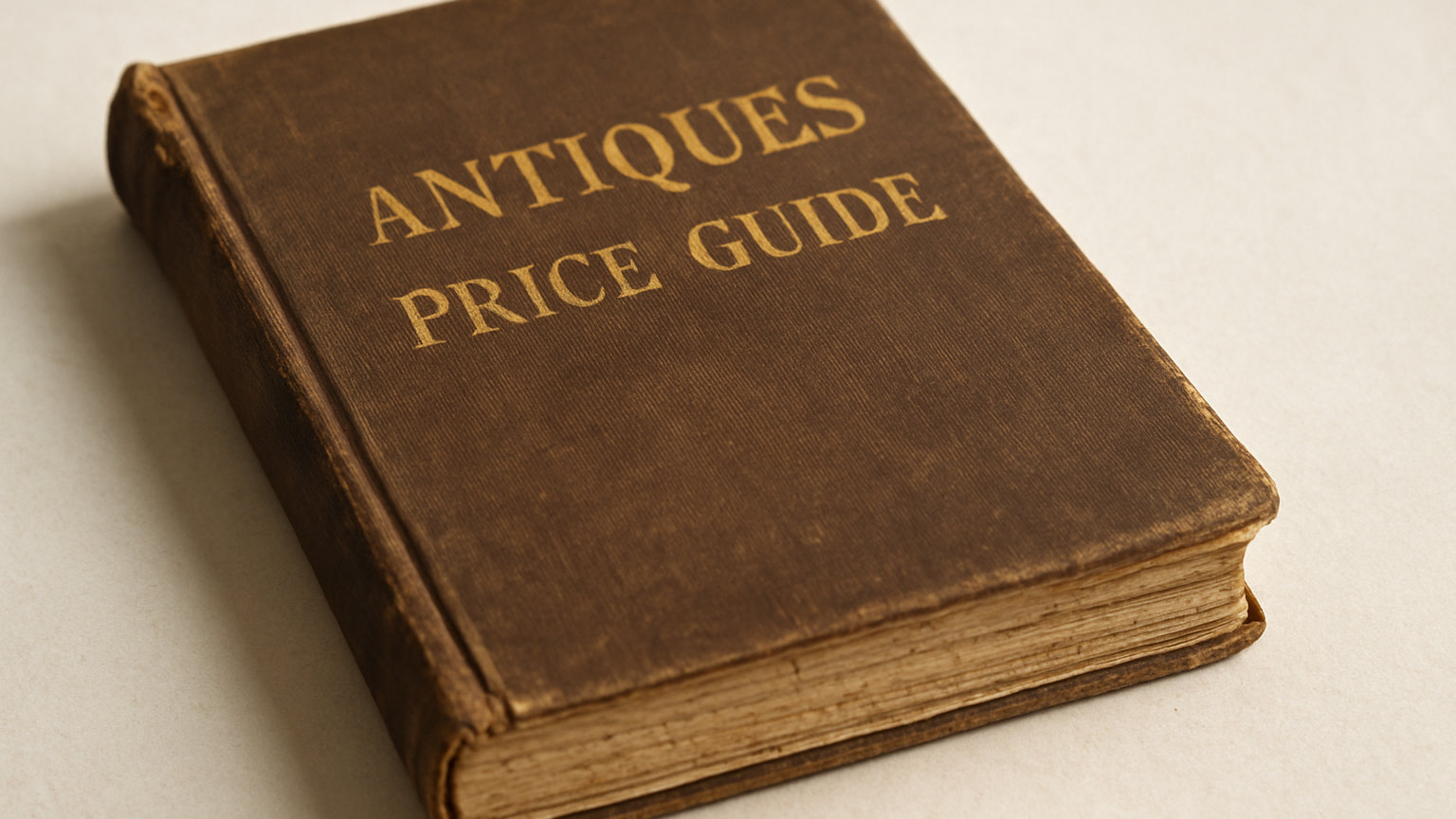
Price guides are the first thing most people reach for and among the least reliable sources available. That does not make them useless, but it does mean they need reading as historical documents rather than as current statements, and knowing what they are good for prevents a great deal of disappointment.
Why do guides date so quickly?
Because they record a snapshot and the market keeps moving. A guide compiled three years ago went to press with figures gathered before that, so it describes conditions from several years back at minimum.
In categories that have fallen heavily, that gap is enormous. Large furniture, formal tableware and display ceramics are worth a fraction of what guides from a generation ago show, and quoting those figures produces expectations nobody will meet.
What are guides actually good for?
Relative values within a category, which change far more slowly than absolute prices. A guide showing that one form is worth several times another is usually still right about that ranking even where both figures are stale.
They are also excellent for identification, since a good guide illustrates forms, marks and variations systematically. Use the pictures and the descriptions, and treat the numbers as indicating rank rather than amount.
Where do guide figures come from?
Usually a mixture of auction results and dealer asking prices, and the two are not equivalent. An asking price records a hope; a realised auction price records a completed transaction.
Check whether the guide says which it uses. Where retail asking prices are included, the figures will sit well above what an item would fetch if sold, which is the number a seller actually needs.
What should you use instead?
Completed sales. Auction result archives record what buyers actually paid across many salerooms over many years, and they are the strongest evidence available publicly.
Completed listings on marketplace sites work for smaller items. In both cases collect at least five comparables, discard the highest and lowest, and work from the middle. That is a current figure rather than a historical one.
How do you adjust a guide figure?
By checking recent results for the same thing and seeing how far the guide has drifted. If several current sales come in consistently below the guide, apply that same proportion across the category.
That is rough and it is better than using the printed number unadjusted. Note that the drift is not uniform: within one guide, some categories will have fallen and others risen, so a single correction factor across everything will mislead.
What do guides never capture?
Condition, which moves prices further than almost anything else. A guide figure assumes a reasonable example, and your item may be considerably better or worse.
They also miss provenance, completeness and regional demand. Two identical objects where one retains its original case, or documented history, or sits in the region that collects it, are not comparable however identical the guide entry.
Are online guides better?
Sometimes, and they carry their own problems. Databases of realised prices are excellent. Sites showing current asking prices are not, since unsold listings persist indefinitely at optimistic figures.
Check what any online source is actually recording before trusting it. A page showing what things sold for is evidence; a page showing what people want for things is not, however professionally presented.
When is a guide the wrong tool entirely?
For anything unusual, anything where condition is the dominant factor, and anything you intend to sell or insure. In those cases the figure needs to be current and specific rather than general.
Use guides to learn a category, identify an object and understand what drives value within it. Then research completed sales for the actual number, and get a professional opinion where the sums justify it.
Are old guides worth keeping?
Yes, for the identification content. Illustrations of forms, marks and variations remain accurate indefinitely, and second hand copies cost very little.
Keep them for the pictures and ignore the prices entirely. A guide from decades ago is frequently better illustrated than a recent one, since publishers had more space before online images competed with print.