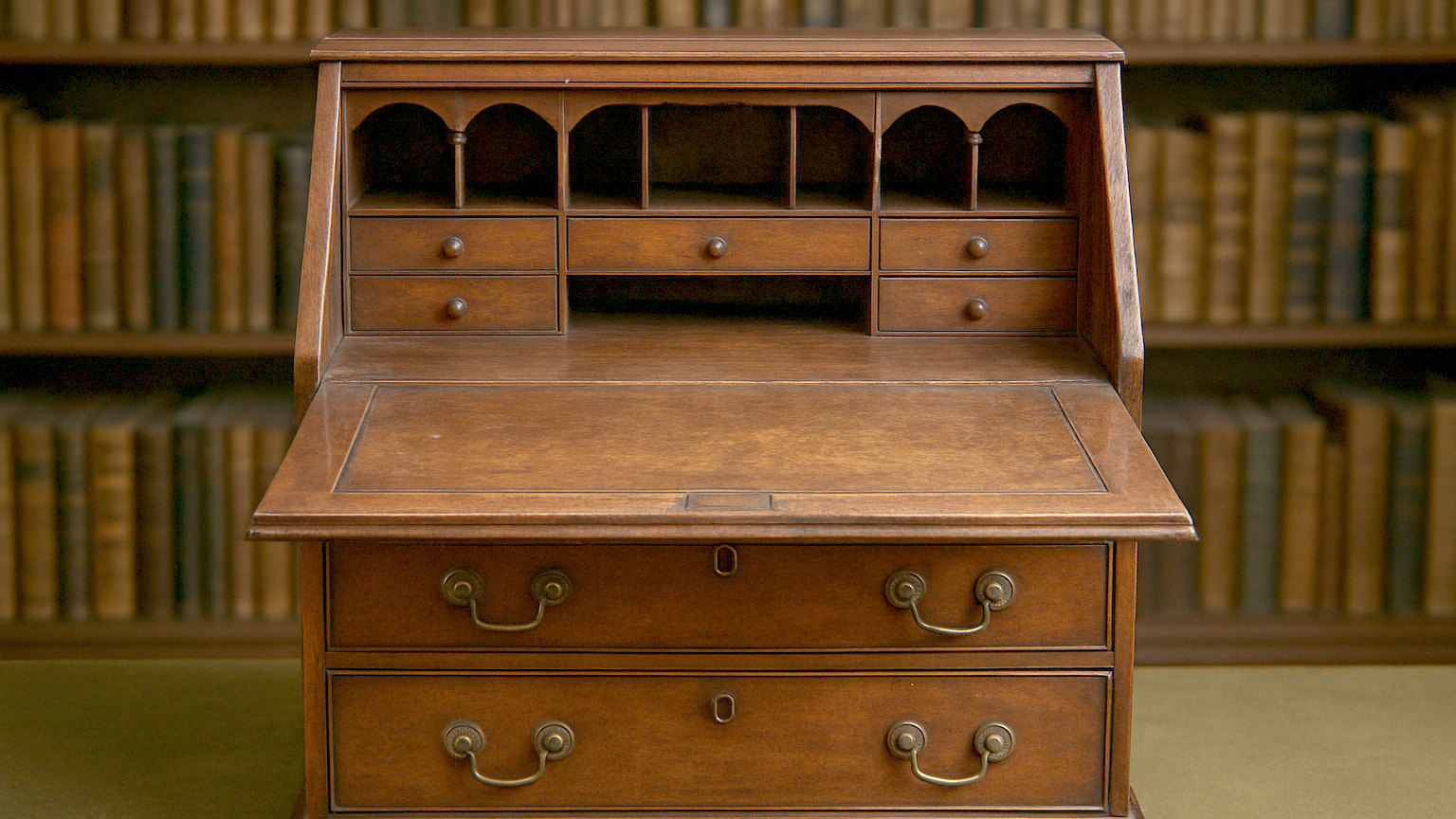
A bureau is a writing desk with a sloping fall front that drops down to make a writing surface, revealing a fitted interior of small drawers and compartments behind. That interior is where much of the value sits and where most of the losses occur, because small components disappear over two centuries and few buyers think to count them.
What should the interior contain?
Typically a bank of small drawers, a row of open pigeon holes, and a central section which may be a small cupboard flanked by document slides. Arrangements vary considerably, but they are almost always symmetrical.
Symmetry is the key to checking completeness. Count the drawers on the left and compare with the right, and do the same for pigeon holes and any decorative pilasters. An asymmetrical interior is either a rare original arrangement or, far more often, evidence that something has been lost and the gap disguised.
How do you check for missing fittings?
Look for empty spaces where a component obviously belonged. Runners with no drawer on them, a slot with nothing in it, or an area of paler unweathered timber where a divider once stood.
Pull out each small drawer and look at the recess behind it. The interior of a bureau was rarely finished as carefully as the exterior, so original surfaces are dusty and oxidised. Fresh clean timber, modern glue or new pins indicate replacement. Document slides that pull out beside the central cupboard are frequently missing entirely.
Are secret drawers genuine?
Often, and they were a normal feature rather than a novelty. Concealed compartments were usually hidden behind the central cupboard, inside the pilasters flanking it, or beneath the base of an interior drawer.
Remove the central cupboard section if it slides out, and check whether the pilasters either side pull forward as narrow drawers. Look for a false back. Be gentle rather than forceful, because these mechanisms are lightly made. A bureau with intact secret compartments is more desirable, though their presence is not by itself evidence of great age.
What supports the fall front?
Two pull out arms called loper slides, one on each side, which draw forward from the carcass. These take the entire weight of the writing surface plus whatever rests on it, and they are among the most heavily worn parts of the piece.
Check both slides pull out smoothly and support the fall level. Wear on the top surface of a loper is expected and reassuring. Replaced lopers are common; compare their timber and colour with the surrounding carcass. Never lower a fall front without drawing the lopers out first, since that is how hinges get torn from the timber.
What condition problems matter most?
Damage to the fall front and its hinges, because that component takes constant stress. Look at the hinges from underneath for splits in the timber around the screws, and check that the fall closes flush without a gap at the top.
Veneer losses along the edges of the fall are extremely common, since that edge takes knocks every time the desk is used. Check the writing surface itself, which may be timber or covered in leather. Replaced leather is normal and acceptable. Look also at the feet, which sat on damp floors and are often renewed.
What is a bureau bookcase?
A bureau with a glazed or panelled cabinet section standing on top, made as a single piece. These are considerably more valuable than a plain bureau when top and base are original to each other.
They are also among the most frequently married pieces in the trade, because combining a bureau with an unrelated bookcase creates a more saleable object. Check that the timber, colour and quality of construction match across the join, that the base is wider than the top by a sensible margin, and that the mouldings align properly where the two meet.
Are bureaux good value now?
Unusually so. They fell heavily with the rest of brown furniture, and ordinary examples can be bought for very little compared with what they cost to make.
They remain genuinely useful, since the fall front closes on paperwork and the interior organises small items well. Buy on completeness and condition rather than on age, and check the interior carefully before agreeing a price, since a missing set of drawers is much harder to remedy than a scratched surface.