Card tables are among the more ingenious pieces of period furniture: a side table that opens into a games surface, supported by a leg or a frame that swings out from the base. That mechanism is what makes them interesting and also what breaks, so assessment concentrates on how the table opens and what happens when it does.
How does a card table work?
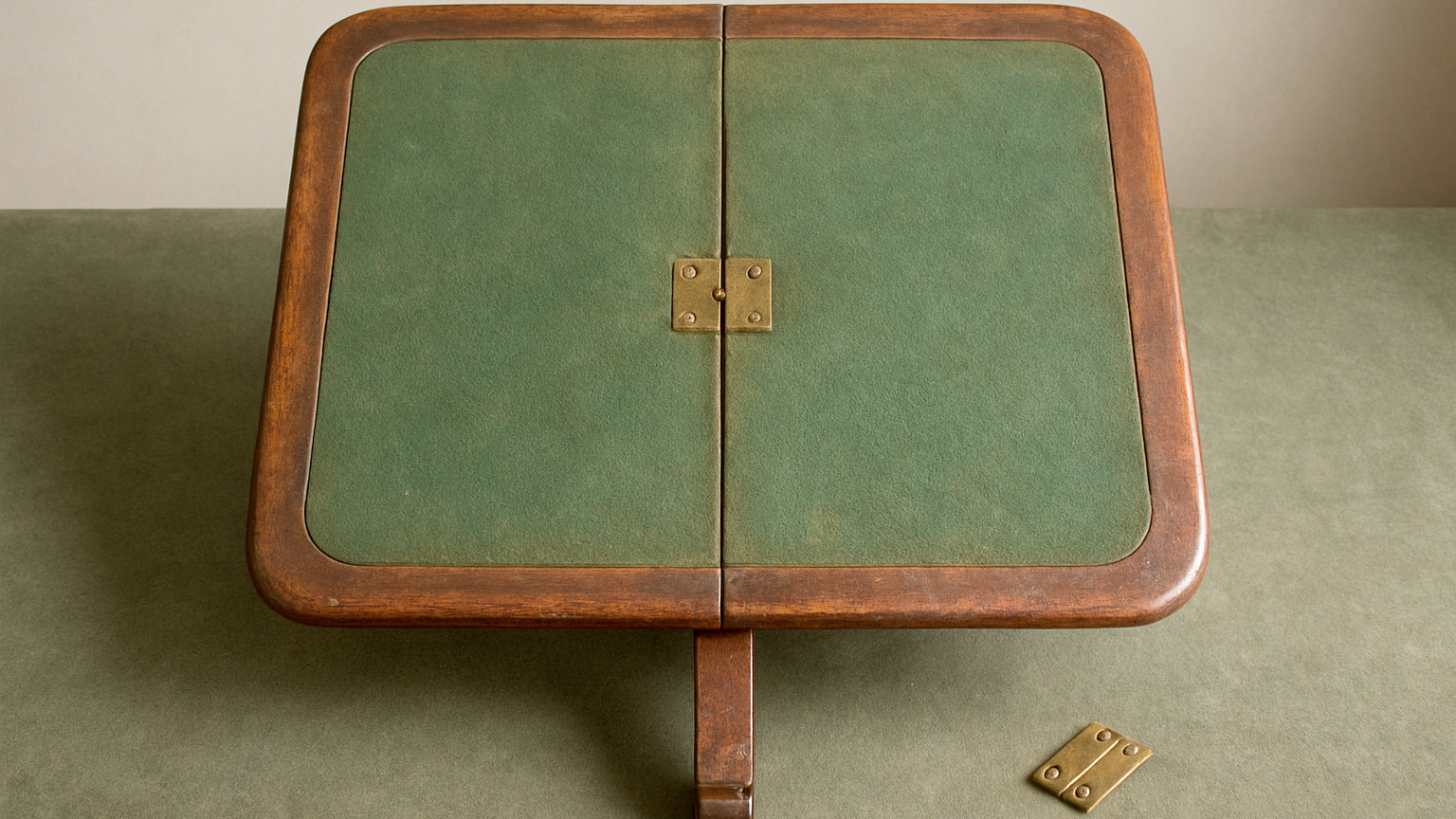
The top is in two leaves hinged at the back. Closed, it sits as a side table against a wall. Opened, the upper leaf folds back and the whole top rotates or slides to sit centrally over the frame.
Support for the opened top comes from either a swing leg, which pivots out from the frame, or a concertina action, where the whole frame expands. The concertina arrangement is more sophisticated and generally indicates a better table.
What should you check on the hinges?
That they are original, sound and let the top close flush. Hinges take the full weight of a leaf every time the table is opened, and the screws pull out of the timber over time.
Look underneath at the hinge plates for splits radiating from the screw holes, for filled holes indicating a hinge has been moved, and for modern replacements. Open and close the top several times, feeling whether the action is smooth or whether the leaf binds.
What is inside?
Frequently a baize lined playing surface, and on better tables shallow wells at the corners for counters and money, sometimes with dished recesses for candlesticks.
Those wells are a quality indicator and their presence adds value. Check whether they are original by looking at the timber and the wear inside them. Baize is consumable and almost always replaced, which is entirely acceptable, but check the recess it sits in has not been damaged by repeated relining.
How do you assess the swing leg?
By the pivot and the wear. The leg swings on a knuckle joint or a pivot pin in the frame, and that joint carries the weight of the opened top.
Open the table and press down on the unsupported corner, feeling for movement. Look at the pivot for wear, repair and replacement. Check the leg matches the other three in timber, colour and turning, since a replaced swing leg is common given how hard it works.
What about the top itself?
Check both leaves match in timber and figure, since replaced tops and replaced leaves are both frequent. Compare the outer surface of each leaf, which should have aged identically.
Look at whether the top is solid or veneered, and on veneered tops check for lifting at the edges. Measure across the grain and along it, since a genuinely old solid top has shrunk measurably in one direction and will no longer be exactly square or circular.
What are the common alterations?
Conversion of a broken card table into a fixed side table by screwing the top shut, and the reverse, where a plain table has been given a folding top.
Look underneath for redundant fixings, filled pivot holes and a frame that has been altered. Cut down height is also common. Check the proportions look right for the form, and be suspicious of a table that seems low or whose leg taper stops abruptly at the foot.
What condition problems matter most?
Warping of the leaves, which is common on veneered tops and prevents the table closing properly. Place the closed table on a flat surface and check the two leaves meet along their whole length.
Check the frame joints by racking the table gently, and look at the feet for damp damage and replacement. Splits in the top, particularly along a joint between boards, are a serious fault on the surface everybody looks at.
Are they worth buying?
Considerably better value than most furniture, because they work as a modest side table when closed and take almost no floor space. Good examples with concertina actions and counter wells sell well.
Buy on the soundness of the mechanism above all, since a table that will not open properly is a table you will never open. Operate it several times before agreeing a price, and check the top closes flush without a gap.