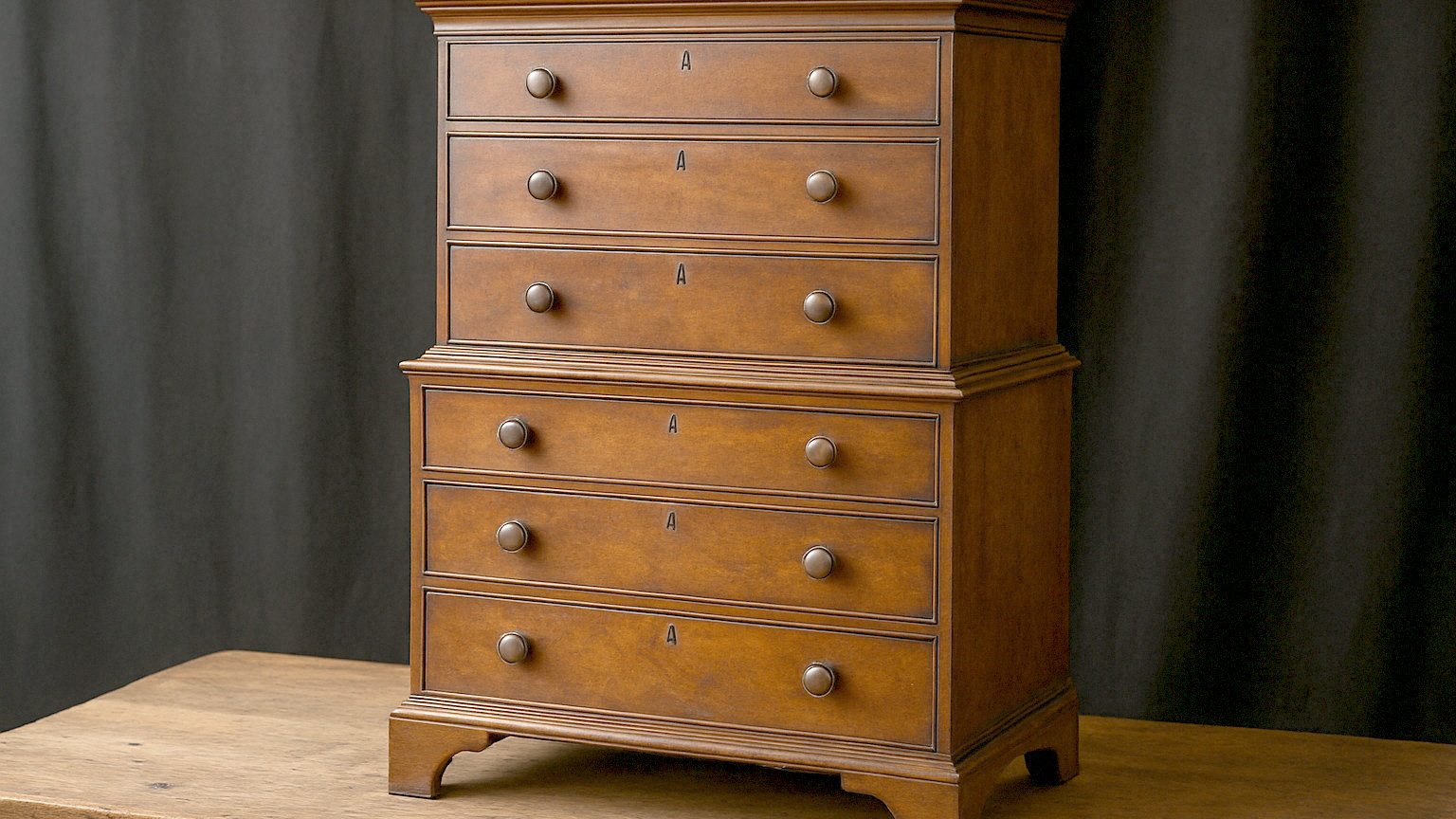
A chest on chest is exactly what the name says: two chests of drawers, one standing on the other, made as a matched pair and moved as two pieces. That construction makes them practical to carry upstairs and unfortunately just as practical to separate, which is why so many surviving examples are made up from two unrelated halves.
What does the form consist of?
A lower section, usually two or three long drawers, and an upper section that is slightly narrower and shallower, typically with a row of shorter drawers at the top above further long ones.
The upper section sits on the lower and is held by gravity and by a moulding, not fixed permanently. There is usually a projecting moulding at the join which conceals the meeting point and stops the top sliding. Some examples have a brushing slide, a pull out board just below the join.
Why are so many married?
Because either half survives perfectly well alone and neither is worth much on its own. An orphaned top is nearly unsaleable, and so is a base whose top has gone, so joining two orphans creates something with a buyer.
Much of this was done long ago and without dishonest intent. The problem arises only when the result is sold as an untouched original, since a marriage is worth considerably less than a genuine matched piece.
What should you check at the join?
Proportion first, from across the room. The upper section should be narrower and shallower than the lower by a consistent margin on both sides, so it sits comfortably within it. A top that overhangs, or that leaves an uneven reveal, is a warning.
Then look at whether the moulding at the join aligns properly all the way round. On an original the moulding was made to receive the top exactly. Cut down mouldings, packing pieces, or a gap at one side indicate the two were not made for each other.
What should you compare between the halves?
Pull one drawer from each section and put them side by side on the floor. Compare the dovetails, which should be cut in the same manner with similar spacing and pin width. Compare the drawer linings for timber species and thickness.
Look at the colour of the unpolished interior surfaces, which should match, since both halves oxidised in the same room for the same length of time. Check the handles and the pattern of any filled holes, since an original piece went through fashion changes as a unit and should show the same history in both sections.
Does the back tell you anything?
A great deal, and it is the part least likely to have been disguised. Look at the backboards on both sections: the timber, the width of the boards, how they are jointed and how they are fixed should all correspond.
Check the fixings themselves. Hand forged nails in one section and machine cut nails in the other is close to conclusive. Look at the dirt and oxidation on the exterior back, which should be consistent in colour and character across the join.
What condition issues matter most?
The feet, which sat on damp floors and are frequently replaced, and the top surface of the lower section where the upper stands, which sometimes shows damage from repeated placing.
Check the brushing slide if there is one, since these are often missing or replaced. Look at the drawer runners in both sections for wear and replacement, and check the sides of the carcass for splits, since a tall stacked piece takes stress when moved.
Are they good value now?
Unusually so, because they are large and tall and modern rooms struggle with them. Prices for ordinary examples have fallen a long way, and they offer an enormous amount of storage in a small floor area.
Measure your ceiling height before buying, since these are considerably taller than most people expect and the upper section must clear the ceiling while being lifted into place. Check the piece can get up your stairs in two parts, which is usually the reason the form exists at all.