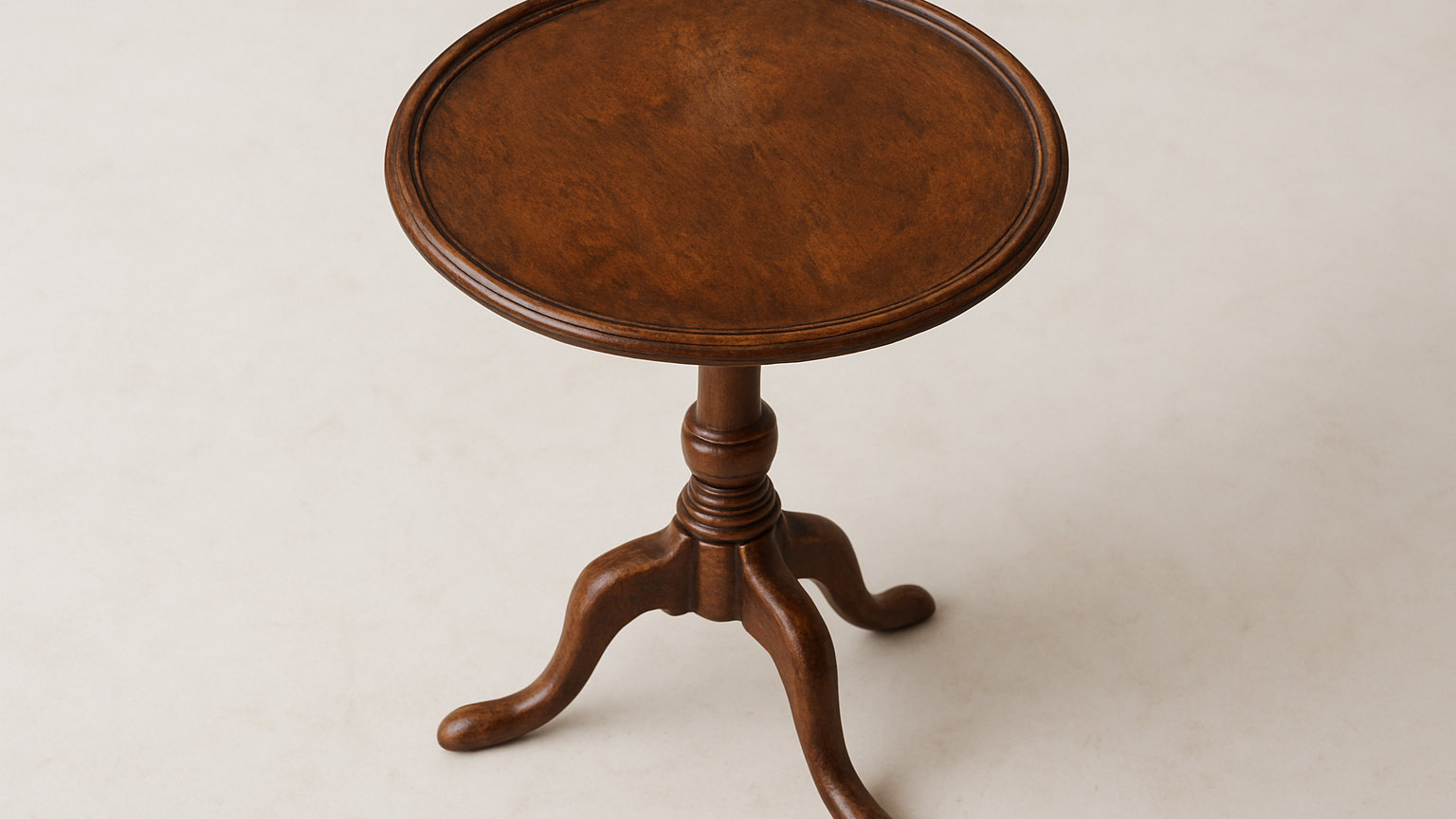
The tripod table, with a circular top on a turned column standing on three legs, is one of the most common survivals from the eighteenth century and one of the most frequently improved since. Tops have been replaced, plain tops carved, and small tables assembled from unrelated parts. Everything you need to check is underneath.
What are the parts?
A circular top, a turned column or pillar, and three legs let into the base of the column. Between top and column there is usually a block, and on better tables a birdcage.
The legs are frequently cabriole in form, curving out and then in, ending in a pad, claw or scroll foot. Each leg is joined to the column with a dovetail sliding into a socket, and on quality tables an iron plate underneath binds the three together.
What is a birdcage?
A small structure of two plates separated by four turned pillars, sitting between the column and the top. It allows the top both to tilt vertically and to revolve, which a plain block does not.
A birdcage indicates a better table and adds value. Check it is original by looking at whether the timber and colour match the column, and whether the wedge holding it is old. Missing or replaced birdcages are common, and a table converted from a plain block will show unexplained holes.
Why do the tops get replaced?
Because a top is a large single board that warps, splits and takes damage, while the base survives. An orphaned base is unsaleable, so fitting a new top is an obvious commercial repair.
Check the underside of the top for the marks left by the block or birdcage, which should correspond exactly to what is fitted. Extra sets of screw holes, a fresh unweathered surface, or timber whose colour does not match the base all indicate a replacement.
How does shrinkage help?
Considerably, and it is difficult to fake. Timber shrinks across the grain and barely along it, so a solid circular top made two centuries ago has become measurably oval.
Measure across the grain and then along it. A genuine old top will differ by a small but detectable amount. A perfectly circular top is either a later replacement or made from a modern stable board, and is worth checking further. The same logic applies to the column, which becomes slightly out of round.
What is a pie crust edge?
A raised and scalloped moulded rim carved from the solid, so that the top and its border are one piece of timber. It is a mark of quality and adds substantially to value.
The critical question is whether it was carved originally or added later to a plain top. Original work leaves the field of the top at a sensible thickness; later carving cuts down into an existing surface, leaving the centre unusually thin. Measure the thickness at the centre and at the edge, and look at whether the carved recesses are paler and cleaner than the surrounding patina.
What should you check on the legs?
The joints where they enter the column, since these take all the load and frequently fail. Look for splits radiating from each socket and for repairs using screws or metal plates.
Compare the three legs for matching timber, carving depth and wear at the feet. A replaced leg is common and usually detectable by colour. Turn the table over and check whether an iron strengthening plate is present, and whether it looks original or is a later addition covering a repair.
Are they worth buying?
Small ones are extremely useful and remain affordable, since they fit anywhere and tilt out of the way. Large examples suffer the usual size problem and cost less.
Buy on originality and colour rather than on decoration. An untouched plain table with good surface and a matching top is worth more than a carved one that has been improved, and it will hold its value far better. Check the tilt mechanism works and the catch holds before agreeing a price.