Samplers are the exception in antique textiles: instead of leaving you to deduce a date from materials and technique, most of them simply tell you. A name, an age and a year worked into the stitching turns an anonymous piece of needlework into a documented object connected to a real person, which is exactly why they are collected so seriously.
What is a sampler?
A piece of needlework made to demonstrate and practise stitching, traditionally worked by girls as part of their education. The name comes from the idea of a sample of what the maker could do.
Early examples are records of stitches and patterns for reference. Later ones became formal exercises, worked to be framed and displayed as evidence of accomplishment, which is why so many survive in reasonable condition rather than being used and worn out.
What do they typically contain?
Alphabets and numerals almost always, since the practical purpose was learning to mark household linen. Beyond that, a verse, frequently religious or moral, and decorative motifs.
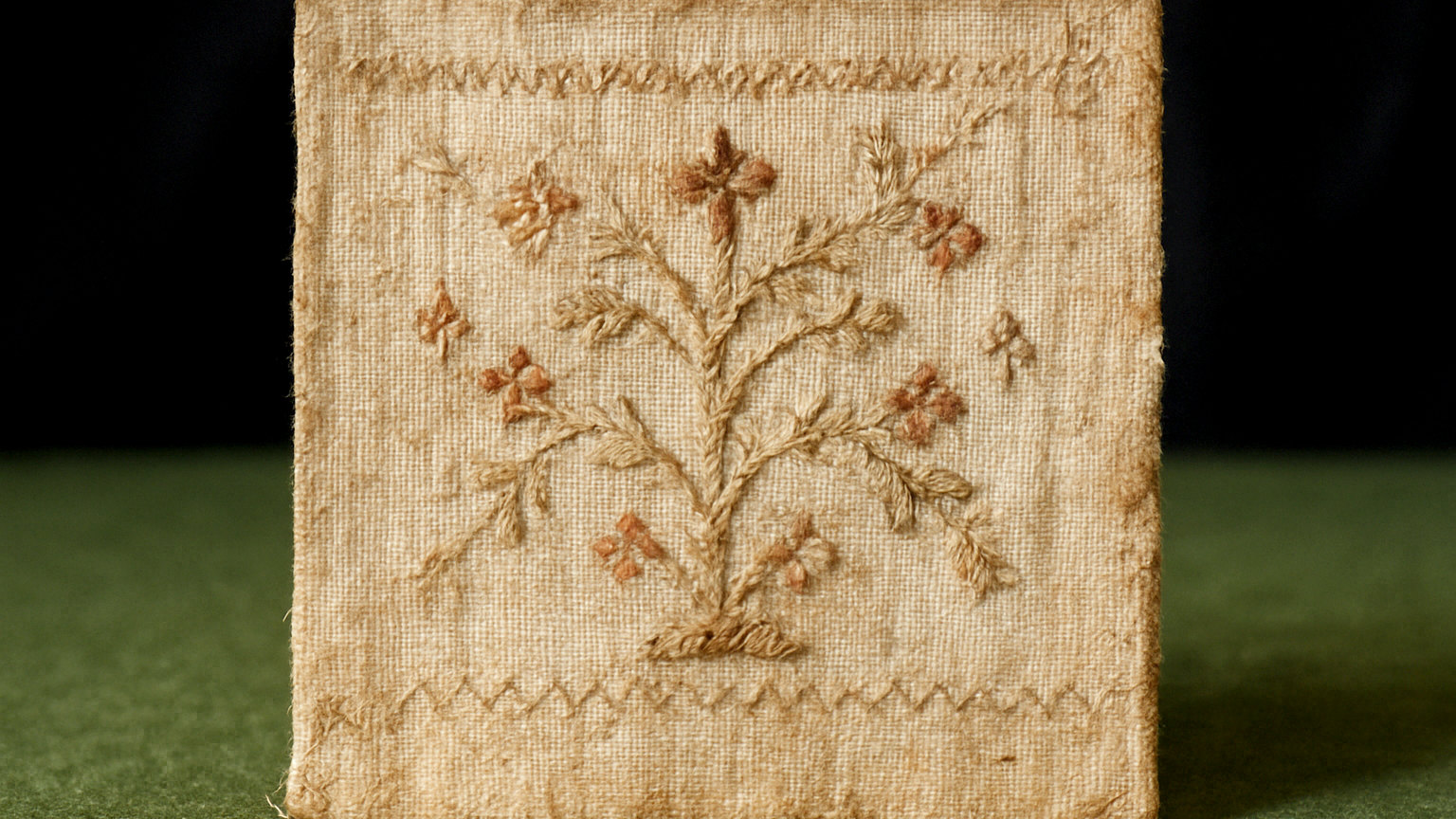
Common motifs include a house, trees, birds, animals, flowering plants and figures. Some include a family record listing births and deaths, which is genuinely valuable genealogically. Look for a border framing the whole, since the sophistication of the border often indicates the maker skill level.
How are they dated?
By the inscription, which usually gives the maker name, her age and the year, worked into the lower section. That is an exact date and it is the maker own record rather than an inference.
Where no date appears, judge by the style of the verse, the motifs, the ground fabric and the stitches used. Alphabet arrangements and the presence or absence of certain letters also help, since some alphabets historically omitted particular characters.
What are they worked on?
Usually linen, hand woven and comparatively coarse on earlier pieces, with the thread count visible. Later examples may use a finer or machine woven ground, and some use woollen canvas.
The thread is generally silk or wool. Silk gives a lustre that survives well but is vulnerable to light, while wool is more robust but attracts moth. Look at the reverse where the frame allows, since the back shows the original unfaded colours and reveals the quality of the work.
What drives the value?
The inscription, the complexity and the condition, roughly in that order. A dated sampler naming its maker is worth substantially more than an anonymous one, and an early date more again.
Pictorial content adds considerably, so a sampler with a house, figures and animals outperforms one with alphabets alone. Family records add genealogical interest. Regional characteristics and identifiable schools attract specialist collectors who pay above the general market.
What condition problems matter?
Fading above all, since silk thread is extremely sensitive to light and colours can bleach to nothing within a few decades on a wall facing a window. Compare the front with the reverse to see how much colour has been lost.
Look for holes, foxing, staining, moth damage and areas where stitching has come away. Check whether the piece has been cut down, which shows as a border running off the edge. Old glue and acidic backing board cause brown staining that migrates through the fabric.
How should a sampler be framed and displayed?
With conservation materials throughout and away from light. Use acid free mounting board, and have the textile supported on a fabric covered board with stitching rather than glued or taped to anything.
Ultraviolet filtering glass is essential, and even then the piece should hang out of direct sunlight and away from a fireplace or radiator. Never trim a sampler to fit a frame, and never use adhesive of any kind. A textile conservator will remount an old sampler properly on a padded and covered board, and the cost is modest against the damage that bad framing does over a few decades. Acidic board left in contact with linen produces brown staining that migrates into the fabric and cannot be reversed.