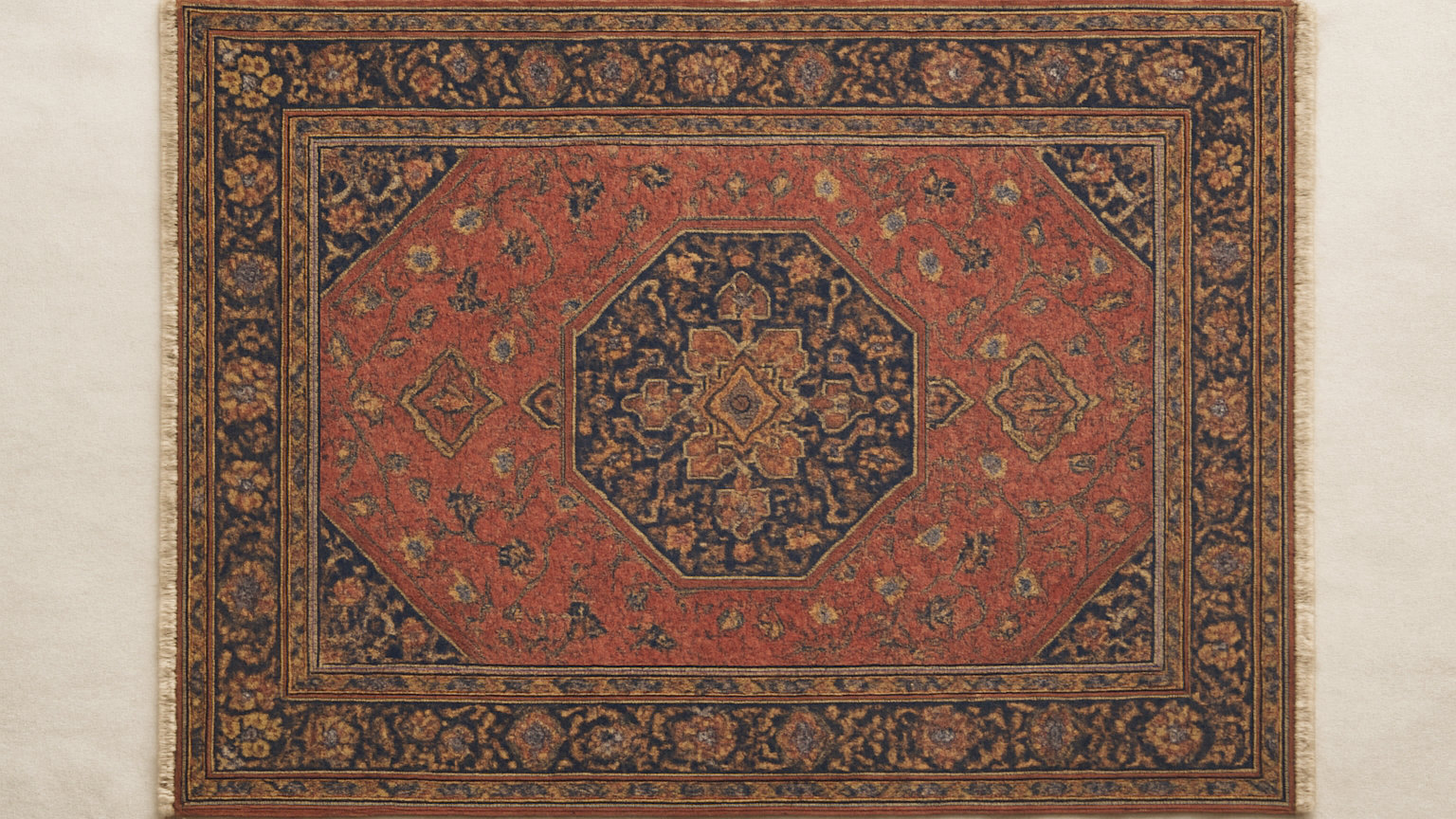
Rugs are difficult to date by appearance alone, because successful designs were woven for centuries with very little change. Dye chemistry is the exception, because the arrival of synthetic colours was a genuine break, and the two families age in visibly different ways. Learning to read colour is the most reliable skill in this field.
How do natural dyes age?
Gracefully and unevenly. Natural dyes come from plants, insects and minerals, and each batch varied slightly, so a colour that should be uniform shows subtle banding across the rug where the weaver moved from one dye lot to the next.
That banding is called abrash, and it is a quality indicator rather than a flaw. Natural colours also mellow rather than fade, softening into related tones that remain rich, and they age at different rates so the overall palette shifts gently rather than dropping out.
What do early synthetic dyes look like?
Flatter and more uniform when new, and considerably worse with age. The earliest synthetic colours were unstable, fading to grey or brown rather than mellowing, and some faded so severely that the design became indistinct.
The clearest tell is a colour that has faded on the pile surface while remaining strong at the base of the knot. Part the pile with your fingers and look down at the roots. A dramatic difference between tip and root indicates an unstable dye. Natural dyes show some difference too, but far less abrupt.
How can you check whether a colour runs?
Press a clean damp white cloth firmly against a strongly coloured area for a few seconds, then look at the cloth. Any transfer of colour means the dye is not fast, which affects both value and how the rug can be cleaned.
Do this discreetly at an edge, and only with the owners permission. Reds are the usual offenders. A rug with running dyes should never be wet cleaned at home, because the colour will bleed into adjacent pale areas permanently.
What does knot count actually tell you?
Density of weave, which correlates with the fineness of the design but not directly with value. Turn the rug over and count knots across a measured distance in both directions.
A high count allows finer detail and generally indicates more labour, but a coarsely woven tribal rug with great character can be worth far more than a finely woven commercial one. Use knot count to understand what kind of rug you have rather than as a score.
How do you tell a hand knotted rug from a machine made one?
Look at the back. A hand knotted rug shows the design clearly on the reverse, with slight irregularity in the knots and in the lines of the pattern. The fringe is a continuation of the warp threads running through the rug, not something attached afterwards.
Machine made rugs have a uniform mechanical back, often with a visible backing material, and the fringe is usually sewn or glued on as a separate strip. Bend the rug and look at the base of the pile: machine work shows perfectly regular rows in a way hand knotting never does.
What condition issues matter most?
Wear to the pile in traffic areas, damage to the ends and sides, moth damage and old repairs. Check the selvedges along the long sides and the ends where the fringe meets the pile, since these protect the structure and fail first.
Hold the rug up to a light. Thin areas glow through and reveal wear that is invisible from above. Look for patches, reweaving in a slightly different colour, and painted areas where someone has coloured worn pile to disguise it, which shows as colour sitting on the surface rather than in the fibre.
How should antique textiles be stored?
Rolled rather than folded, since creases weaken fibres permanently along the fold line. Roll pile outwards around a tube, interleave with acid free tissue, and wrap in cotton rather than plastic so moisture can escape.
Keep textiles away from direct sunlight, which fades even stable dyes, and from damp. Rotate rugs in use so wear spreads evenly, and vacuum gently without a beater bar. Never store anything in a loft, where temperature swings and insects do most of the damage this category suffers.