Rugs are difficult to date because successful designs were woven for centuries with little change, but they are much easier to place geographically. Weaving traditions developed distinct layouts, motifs and structural habits, and reading those tells you where a rug came from, which is usually the more useful question.
What is the field and how is it laid out?
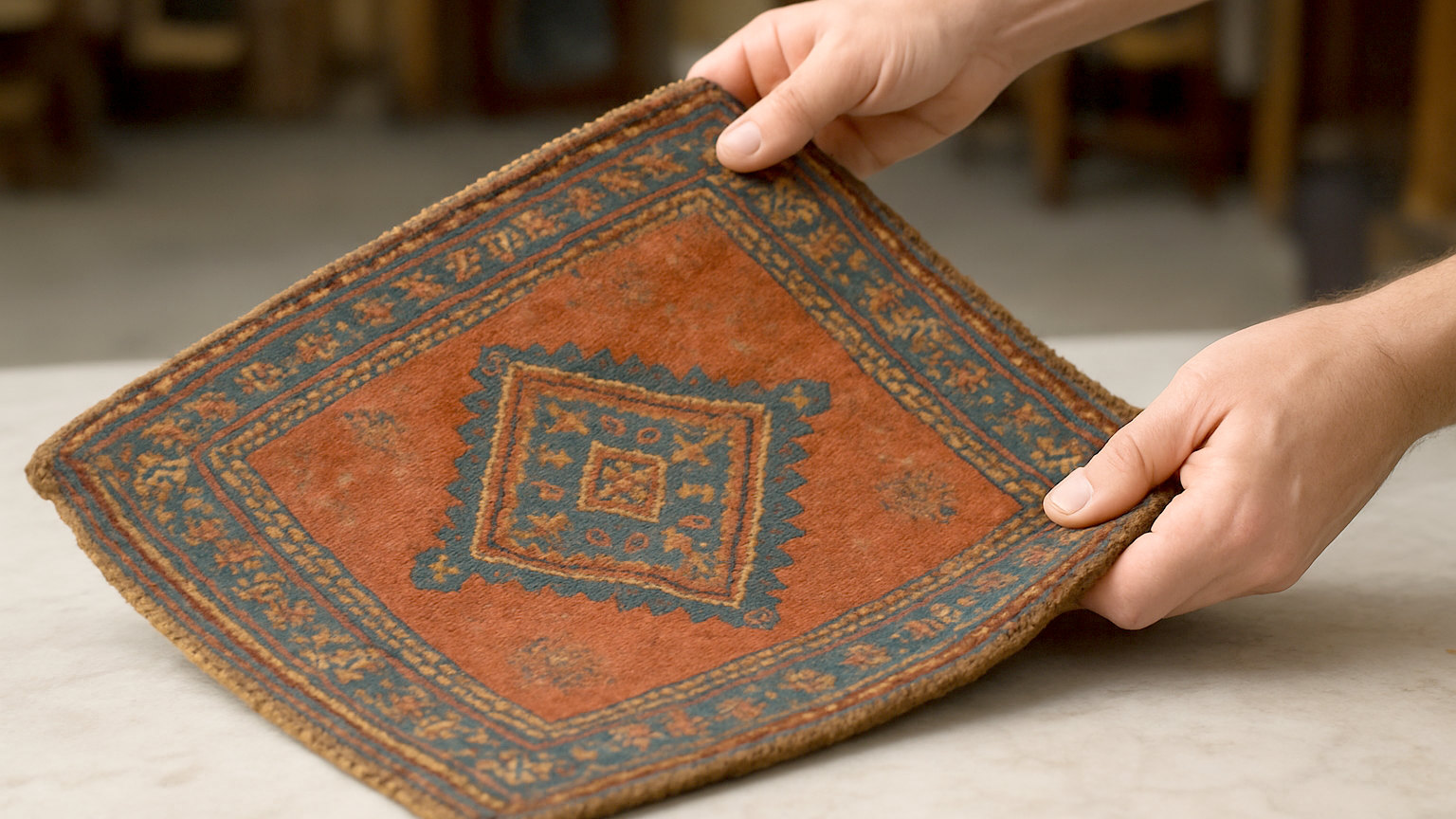
The field is the central area inside the borders, and its arrangement is the first thing to assess. Some rugs have a single large central medallion, often with matching quarter medallions in the corners.
Others have an all over repeating pattern with no focal point, or a directional design meant to be viewed from one end. Prayer rugs have an asymmetric arched shape at one end. Note which arrangement you have before looking at any individual motif, since layout is a stronger regional indicator than decoration.
What do the borders tell you?
Count them. Most rugs have a main border flanked by narrower guard borders on either side, and the number and proportion of these varies by tradition.
Look at how the border turns the corner. In finely planned rugs the pattern resolves neatly at each corner; in village and tribal work the weaver frequently ran the pattern until it met and simply stopped, producing a mismatch. That corner mismatch is a mark of hand planning rather than a fault, and it is good evidence of genuine village production.
Which motifs are worth recognising?
A handful recur across many traditions. The boteh, a curved teardrop shape with a bent tip, appears everywhere and is the ancestor of the paisley pattern. Stylised flowers, rosettes and palmettes fill formal designs.
Angular geometric motifs, latch hooks and stepped diamonds generally indicate village or tribal weaving, where designs were held in memory rather than drawn out. Curvilinear flowing designs indicate workshop production, where a designer prepared a cartoon for the weaver to follow.
How do you tell tribal from workshop weaving?
By regularity. Workshop rugs were woven from a prepared design with consistent tension, so the shape is true, the borders resolve cleanly and the pattern repeats exactly.
Tribal and village rugs show variation: a field that is slightly wider at one end, motifs that change size as the weaver worked, colours that shift where a dye batch ran out. None of this is a defect. Collectors frequently prefer it, because it is evidence of an individual hand rather than a production line.
What does the structure add?
Turn the rug over and look at the back, then examine the ends and sides. The way the warp threads are finished at each end, and the way the sides are wrapped, both vary by tradition.
Look at the knot itself where the pile has worn. There are two main knotting methods, distinguished by how the yarn wraps around the warp threads, and different regions favoured different ones. Combined with the wool quality and the dye palette, structure supports whatever the design suggested.
What do the colours indicate?
Both region and age. Certain traditions favoured particular palettes, with some regions producing deep madder reds and indigo blues and others working in softer tones.
Look for abrash, the subtle banding where the weaver moved between dye lots, which indicates natural dyes and hand production. Part the pile and compare the colour at the tip with the colour at the root, since a dramatic difference indicates an unstable early synthetic dye rather than natural colouring.
How much does size and format matter?
Considerably to value, and it is worth measuring properly. Room sized carpets in usable proportions sell better than very long narrow runners or awkward sizes that fit nowhere.
Small rugs and mats are frequently the finest weaving, since a weaver could afford to work at higher density on a small piece. Judge quality by knot density, wool lustre, dye quality and design coherence rather than by size, then let size inform what you expect it to be worth.