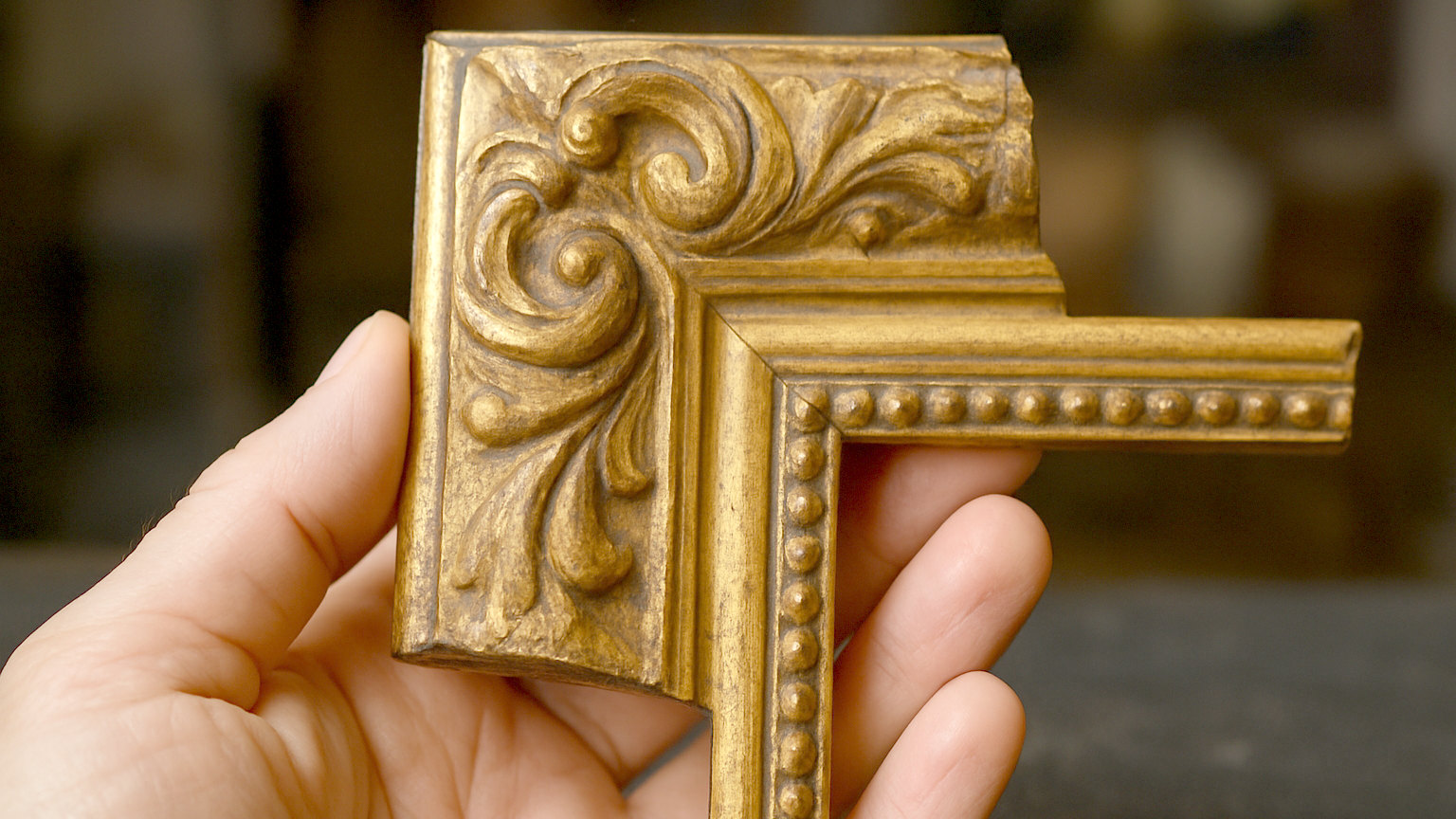
Most decorative gilt frames and mirrors are not solid carved timber and not solid gold. They are a timber carcass covered with gesso, a chalk and glue mixture that can be moulded or carved, with gilding applied on top. What that gilding actually is makes a substantial difference to value, and the difference is visible once you know what to look for.
What is water gilding?
The traditional method, in which gold leaf is laid onto a coloured clay layer called bole, applied over the gesso and moistened so the leaf adheres. The bole is usually a warm red, sometimes yellow or grey depending on the effect wanted.
Its defining property is that it can be burnished, meaning polished with a smooth stone to a brilliant mirror finish. Gilders burnished the high points and left the recesses matt, producing a contrast that gives the surface life. That deliberate variation between bright and matt is one of the clearest signs of quality work.
Why does the red show through?
Because gold leaf is astonishingly thin, and where it has worn on the high points that were handled and dusted, the bole beneath becomes visible as a warm reddish glow through and around the gold.
This is not damage. It is precisely what collectors and restorers look for, because it proves the surface is genuine leaf over bole rather than paint. Worn original gilding with red bole showing is more desirable than a uniformly regilded frame, and a great deal more desirable than one that has been painted.
How is oil gilding different?
Gold leaf is laid onto an oil based adhesive rather than onto bole, which is quicker, more durable outdoors and considerably cheaper. It was used widely, particularly on later and less expensive work.
The crucial difference is that oil gilding cannot be burnished, so the whole surface has a uniform matt or slightly satin appearance with no bright and dull contrast. It is still real gold leaf and still perfectly legitimate, but it lacks the depth of water gilding and is valued below it.
How do you spot modern gold paint?
By its evenness and its colour. Gold coloured paint contains bronze or brass powder rather than gold, and it has a flat brassy tone quite unlike leaf, which is warmer and has more depth.
Paint also goes everywhere. Leaf is difficult to apply into deep recesses, so on a genuinely gilded frame the deepest hollows are often thinly covered or show bole. Paint covers uniformly including in the deepest recesses, because it was brushed on. Bronze paint also tarnishes over time to a dull greenish brown, which gold never does.
What should you look at on the gesso itself?
The crispness of the detail. Original gesso ornament, whether moulded or carved, has sharp definition. Every subsequent recoating softens it, so a frame that has been regilded several times looks blurred and the pattern loses its edges.
Losses and chips are normal, since gesso is brittle. Small losses revealing the timber beneath are expected wear. Extensive replacement of moulded ornament, or a thick recoating that has drowned the detail, reduces value considerably.
Should a frame be regilded?
Rarely. Regilding removes the accumulated surface history and replaces it with something uniform and new, and it almost always reduces the value of a period frame.
Conservation is a different matter. Consolidating loose gesso, stabilising flaking and filling small losses in a way that can be reversed are all legitimate and preserve the object. Ask any restorer whether the proposed work is reversible before agreeing to it.
How should gilded surfaces be cleaned?
With almost nothing. Dust very gently with a soft brush, working with the direction of any carving rather than against it.
Never use water, solvents, detergent or any proprietary cleaner. Water dissolves the glue in gesso and lifts leaf immediately. Never rub a gilded surface with a cloth, since leaf is thin enough to be removed by pressure alone. If a frame is genuinely dirty and valuable, a gilding conservator is the only sensible answer.