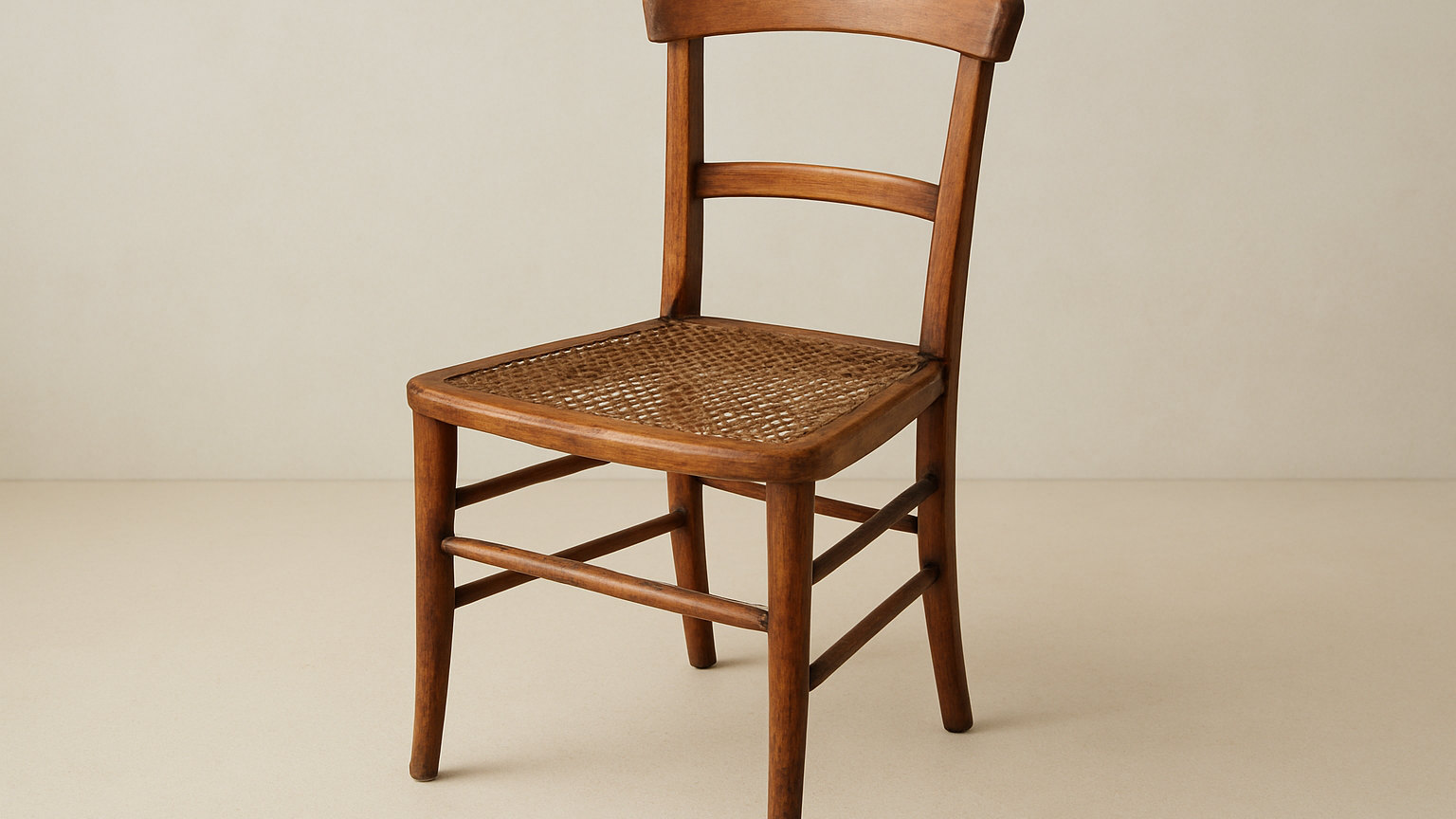
Caned seating turns up constantly with the seat sagging or broken, and owners assume the chair is finished. It is not. Caning was always a consumable surface intended to be renewed, and rewoven properly a chair returns to full use. What matters is which kind of caning it had, because the two methods are not interchangeable.
What is hand caning?
Cane woven individually through a series of small holes drilled around the edge of the seat frame, in a pattern built up strand by strand and pegged at each hole.
Look at the frame edge. If you see a ring of small drilled holes with cane passing through each one, the seat is hand caned. This is the earlier and better method, and it is what most antique caned chairs have.
What is pressed cane?
A pre woven sheet of cane, machine made, cut to shape and pressed into a continuous groove routed around the seat opening, then secured with a wedge of reed called a spline.
Look for a groove rather than holes. Pressed cane is quicker and cheaper to fit and it is a later development, so a chair with a grooved seat is generally later than one with drilled holes. The two cannot be substituted for one another without altering the frame.
Why does the distinction matter?
Because converting one to the other damages the chair. Routing a groove into a frame drilled for hand caning destroys the original holes permanently, and it is a significant alteration.
Some chairs have been converted this way, usually because pressed cane was cheaper to fit. Check for a groove cut through what were once drilled holes, which shows as a channel with the remains of holes visible in its floor. That reduces value and should be disclosed.
What is rush seating?
A quite different technique, using twisted natural rush or paper cord wound around the seat rails in a spiral pattern that builds up from the four corners towards the centre.
Rush seats have no holes or groove, since the material wraps the rails themselves. They are found on country chairs and ladderbacks. Like caning, rush is consumable and was always expected to be renewed, and a chair with a failed rush seat is a repair job rather than a loss.
Does replacing the seat reduce value?
Not materially, provided the correct method is used. Caning and rushwork are surfaces rather than structure, and almost no antique chair retains its original seat.
What does reduce value is the wrong method, a machine sheet where hand caning belongs, or damage to the frame during fitting. Ask any restorer which method they will use and confirm it matches what the chair was made for.
What does it cost?
Hand caning is charged by the hole, since the labour is proportional to the number of holes to be worked, and a seat may have a hundred or more. It is slow skilled work and correspondingly not cheap.
Pressed cane is considerably quicker and cheaper. Rush seating is charged by the seat and varies with size. Get a quote before buying a chair needing work, since on an inexpensive chair the caning frequently costs more than the chair did.
What should you check on the frame?
The holes themselves, since they are close to the edge and the timber between them is thin. Look for splits running between holes and for previous repairs.
Check the corners particularly, where several holes converge and the timber is weakest. A frame with broken sections between holes needs repair before recaning, which adds cost. Press gently around the seat opening feeling for movement or flexing.
How should caned seats be looked after?
Kept out of direct sunlight and away from radiators, since cane dries and becomes brittle. A little humidity keeps it flexible.
Do not kneel or stand on a caned seat, and do not use one with a broken strand, since the damage spreads quickly under load. Clean with a barely damp cloth rather than soaking. Cane that has dried and sagged can sometimes be tightened by sponging the underside lightly and letting it dry naturally.