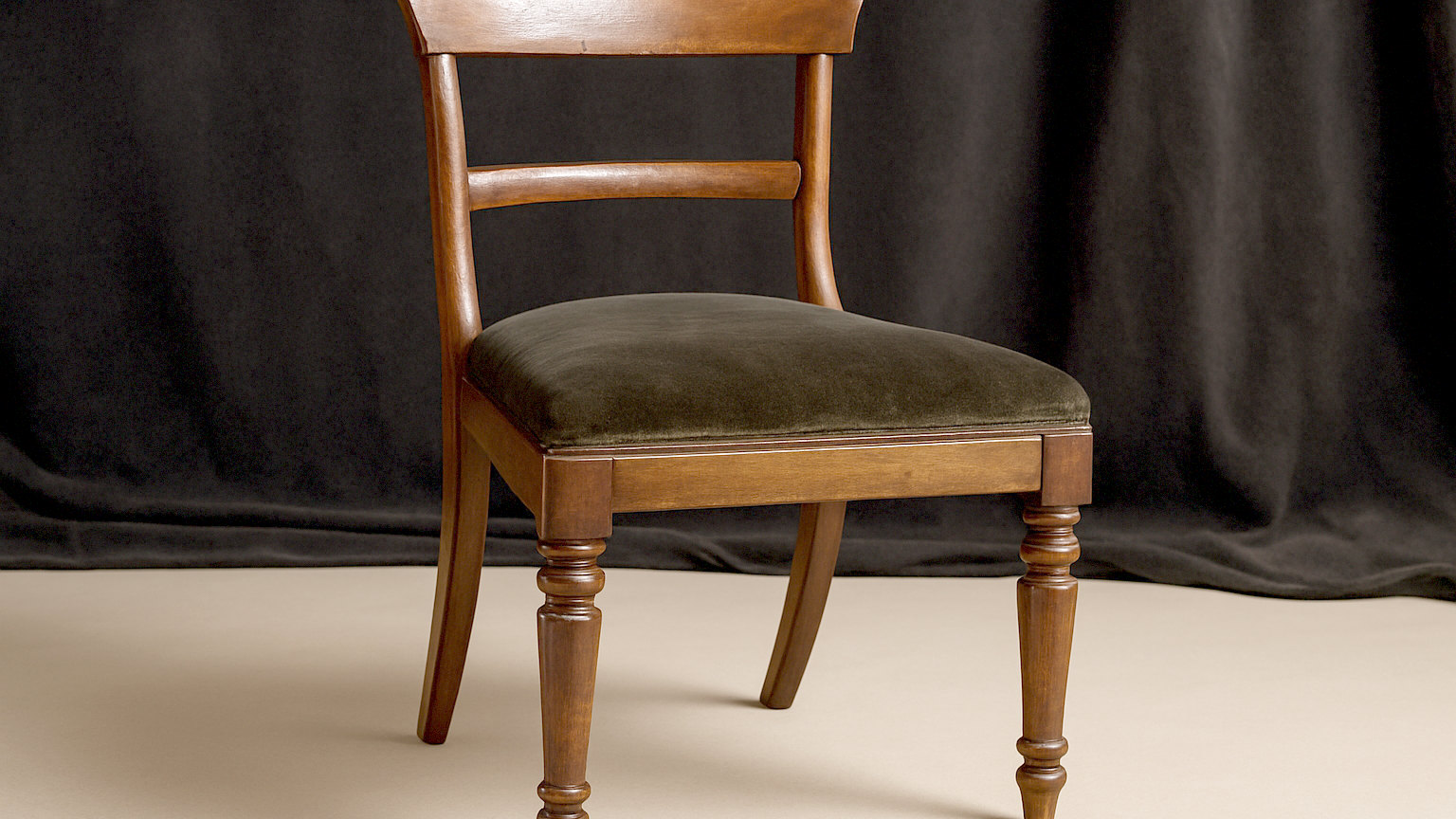
Chairs take more punishment than any other furniture. They get tipped back on, dragged across floors, sat on by people heavier than the maker imagined, and reupholstered repeatedly. Almost every antique chair has been repaired at some point, and most of those repairs are entirely acceptable. The skill is telling routine maintenance from something that affects value or safety.
Where do chairs fail first?
At the joints between the back legs and the seat rails, because that is where the leverage is greatest when someone leans back. The back legs themselves often crack just below the seat for the same reason.
Stretchers between the legs are next, since feet rest on them and they take constant knocks. Arms work loose where they meet the back. Check these four areas before anything else, and check them by feel as well as by eye.
How do you test a chair for looseness?
Place it on a flat floor, hold the back with one hand and the seat with the other, and try to rack it gently sideways. Then try twisting the seat against the back. Any movement or creaking indicates joints that have opened.
Loose joints are ordinary and repairable. Old animal glue eventually gives up, and a restorer knocks the frame apart, cleans the joints and reglues it, which is routine work. What you should not do is keep using a chair in that state, since a loose joint wears the timber and turns a simple repair into a difficult one.
How do you spot a replaced leg or rail?
Compare the four legs against each other in colour, in the depth and crispness of any turning or carving, and in the pattern of wear at the foot. A replacement is rarely a perfect match, and the difference usually shows most in the timber figure.
Look underneath at unpolished surfaces, where the original colour is undisguised by polish. A leg that is paler or a different tone underneath has probably been replaced. Check the feet particularly, since chairs stood on damp floors and feet were frequently cut off and renewed.
What do the repair materials tell you?
Modern screws, metal brackets, glue blocks in new timber and any sign of a strong modern adhesive all indicate recent work. Modern glue is effectively irreversible, which is a genuine problem, because a joint repaired that way cannot easily be taken apart for a proper repair later.
Older repairs using hide glue, hand cut blocks and matching timber are more sympathetic and are generally regarded as part of the chairs history. Metal plates screwed across a broken joint are the crudest solution and should be reflected in the price.
What does upholstery hide?
A great deal, which is why a drop in seat is worth lifting out. Look at the seat rails underneath for splits radiating from tack holes, since a rail perforated by repeated reupholstery over a century can be structurally weak.
Rows of modern staples indicate recent work. A rail that has been strengthened with a new inner piece is a common and acceptable repair. If the upholstery is fixed and cannot be lifted, press firmly on the seat and listen for creaking, and accept that you are buying with less information.
Does repair always reduce value?
Not in proportion to how visible it is. Regluing, replaced upholstery and repairs to stretchers barely register. Replaced legs, replaced back rails and a replaced seat frame matter considerably more, because they affect how much of the original chair survives.
Honest old repairs are frequently preferable to invisible modern ones, because they are reversible and they are part of the object history. What buyers object to is undisclosed structural replacement presented as original.
Is the chair safe to use?
Test it properly before it goes in a dining room. Press down hard on the seat, rock it gently, and look at whether any joint opens under load. Sit in it yourself before offering it to a guest.
Have anything loose repaired before use rather than after a failure, since a joint that gives way under someone usually breaks timber as well. A competent restorer will reglue a frame for a modest sum, and a sound period chair will then serve for decades more.