Chairs survive centuries of being sat on and then get broken during a house move. The damage is almost always caused by the same few habits: lifting by the wrong part, stacking, and storing somewhere with fluctuating humidity. All three are easily avoided.
How should a chair be lifted?
By the seat rails, with both hands, never by the back and never by the arms. The back is joined to the seat by the weakest joints in the chair, and lifting there applies force in exactly the direction those joints cannot take.
Arms are worse still, since they are frequently attached with a single joint at each end. A chair carried by one arm concentrates the whole weight into that joint, which is how arms come off during moves.
Why should chairs never be stacked?
Because the legs of the upper chair bear on the seat of the lower one, which is not a load either was designed for. The result is dented seats, split rails and marked surfaces.
Where chairs must be stored in quantity, stand them separately or place them seat to seat with padding between. Never stack more than two even then, and never stack upholstered chairs at all since the compression permanently distorts the stuffing.
How should they be wrapped for transport?
With padded protection at every projection: the top of the back, the arm terminals, and each foot. Those are the points that catch on doorframes and take knocks in a van.
Use blankets or padded wrap rather than plastic sheeting, which traps moisture against the surface. Secure the wrapping with tape onto itself rather than onto the chair, since adhesive pulls finish off old timber.
What should you do about loose joints?
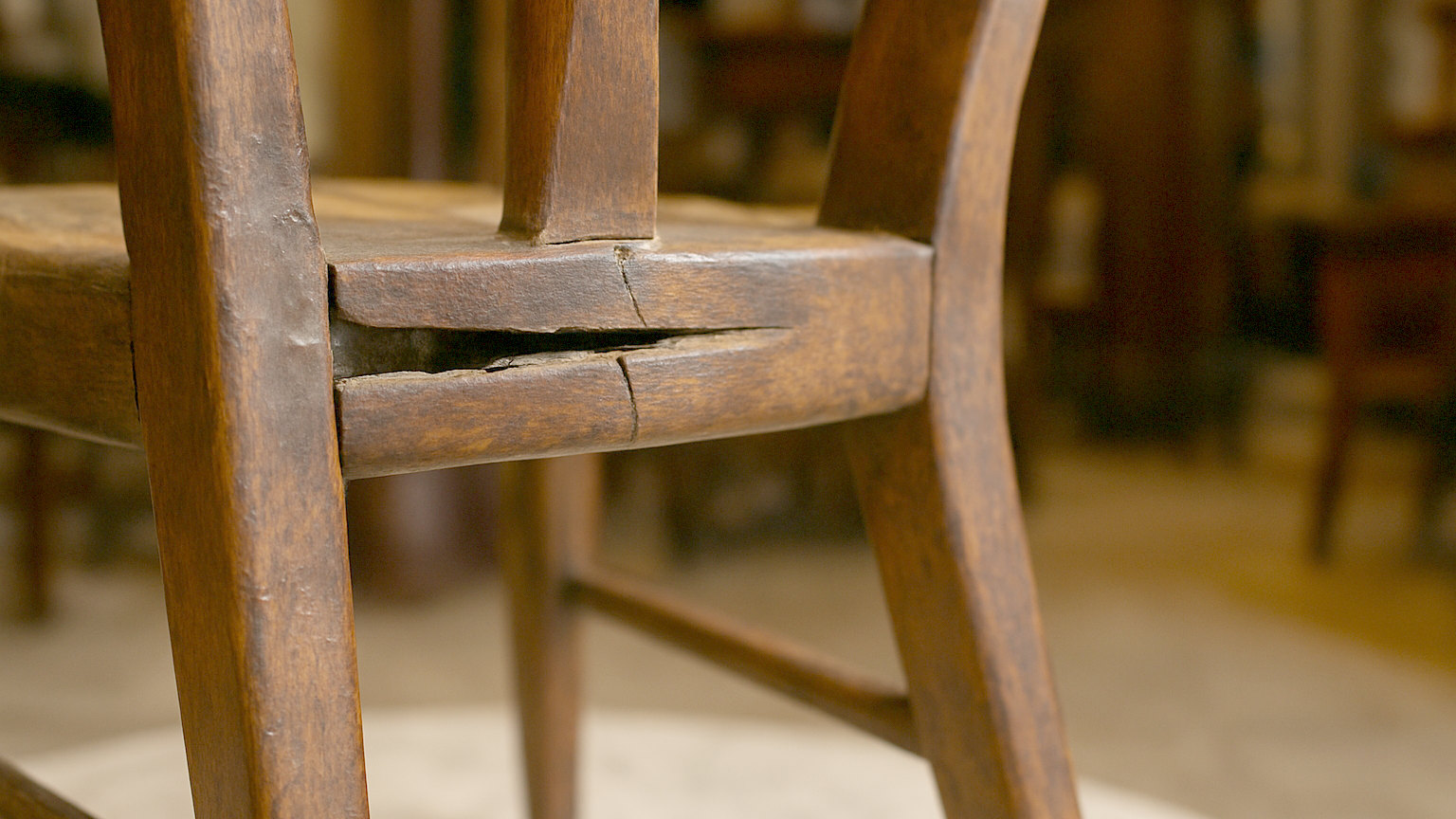
Have them repaired before moving rather than afterwards. A joint that is slightly loose in use will open completely under the leverage of being carried and loaded.
If a repair is not possible first, support the chair so that no joint takes load during transit. Never tie a chair down by its back or arms, since strapping applies exactly the force that opens joints.
Where should chairs not be stored?
Lofts, garages, outbuildings and anywhere with fluctuating temperature and humidity. Timber moves with moisture, joints open and close, and old animal glue fails.
Damp causes rot at the feet and encourages woodworm. Dry heat shrinks timber and opens joints. An unheated but stable interior room is far better than any outbuilding, and a chair stored in a loft for a decade frequently comes out needing complete reassembly.
What about upholstered chairs?
Keep them dry above all, since damp affects the stuffing and the webbing as much as the frame. Moth is the other risk, and it feeds on wool and horsehair.
Do not wrap upholstery in plastic for long term storage. Cover with a breathable cotton sheet instead, check periodically for moth, and avoid storing anything against an exterior wall where condensation forms.
How should they be positioned in a room?
Away from radiators, fireplaces and direct sunlight. Heat dries timber and opens joints; sunlight fades finishes and upholstery unevenly.
Move chairs rather than dragging them, since dragging stresses the joints and damages feet. On hard floors, felt pads under the feet protect both the chair and the floor, and they should be checked periodically since they wear through.
What should you do before a house move?
Photograph every chair, note any existing damage, and tell the removers explicitly how they should be handled. Most damage happens because nobody said anything.
Consider moving valuable chairs yourself rather than with general furniture. Check the insurance position with the remover in advance, since standard cover frequently excludes antiques or caps them at a figure well below their value.
What should you check after a move?
Every joint, by racking each chair gently and listening for creaking. Movement that was not there before means a joint has opened in transit.
Deal with it promptly rather than continuing to use the chair, since a loose joint wears the timber and turns a simple regluing job into a difficult repair.