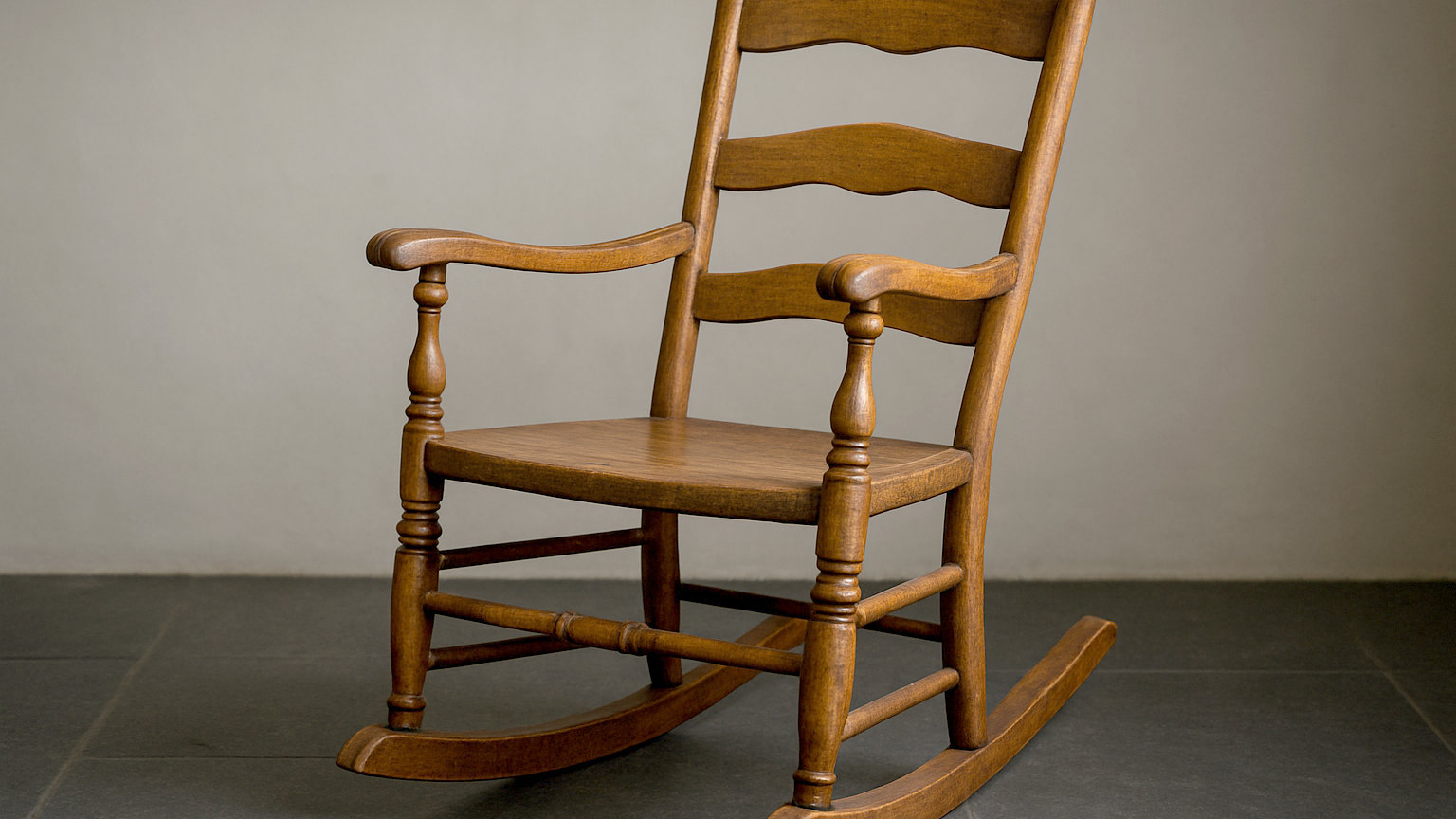
Rocking chairs raise a question that most seating does not: were the rockers there from the start? Adding rockers to an ordinary chair was a common workshop job, and a converted chair is worth considerably less than one designed as a rocker. The evidence is at the foot of each leg.
How were original rockers fitted?
Designed into the chair from the beginning, with the legs shaped and jointed to receive them. On a purpose built rocker the legs are cut to sit into a slot or socket in the rocker, and the whole assembly is proportioned around the rocking motion.
Look at how each leg meets its rocker. An original joint is neat, symmetrical and shows consistent age. The rocker itself should be a substantial shaped piece of timber matching the chair in species and colour.
What does a conversion look like?
Legs that have been shortened and then slotted or screwed into rockers added afterwards. The tell is usually at the cut: fresh timber, a saw line that does not match the chair, or a leg whose taper or turning stops abruptly.
Check whether the chair sits at a sensible height and angle, since a converted chair frequently ends up too low or tipped back too far. Look for modern screws, metal brackets and packing pieces where the legs meet the rockers.
Why does the seat height matter?
Because a purpose built rocker was designed with the rockers included, so the seat sits at a comfortable height when the chair is on them. A conversion adds height unless the legs were shortened, and shortening changes the proportions.
Measure the seat height and compare it against an ordinary chair. Sit in it. A converted chair frequently feels wrong in a way that is hard to articulate until you measure, because the geometry was never designed for it.
What about bentwood rockers?
These are a distinct manufactured type, made from steam bent components rather than jointed in the traditional way, and they were produced in enormous numbers.
Look for the characteristic continuous curves, screw fixings at the joints, and often a factory stamp or paper label under the seat. They are honest mass produced furniture rather than cabinetmaking, and they should be valued as such, though good examples in original condition sell steadily.
What is a nursing chair?
A low seated chair, sometimes on rockers, with a low back and often no arms, made for feeding an infant. The low seat is the defining feature and is frequently mistaken for a cut down chair.
Check whether the low height is original by looking at the legs for evidence of shortening, and at whether the proportions of back and seat suit each other. A genuine nursing chair is designed as a whole rather than reduced from something taller.
How do you check the rockers themselves?
For wear and for symmetry. The underside of each rocker should show wear along the curve where it has contacted the floor, and that wear should match on both sides.
Look for splits along the grain, which is where rockers fail, and for repairs. Check the two rockers are the same shape and length, since replacements are common and a mismatched pair makes the chair rock unevenly. Sit and rock it to test.
What condition issues matter most?
Joints at the leg and rocker junction, which take stress every time the chair is used, and the back joints where people push against them.
Grip the back and try to rack the chair gently, then rock it while listening for creaking. Loose joints are ordinary and repairable. Splits in the rockers or in a leg at the socket are more serious and should be assessed before buying, since a failure while somebody is sitting in it is a genuine hazard.
Are they worth buying?
Ordinary examples are inexpensive and genuinely useful, which makes them good value. Purpose built rockers by identifiable makers, and good bentwood examples in original condition, sell better.
Buy on comfort and soundness rather than on age, since a rocking chair is furniture you use rather than display. Check the frame carefully, sit in it properly before deciding, and expect a converted chair to be priced well below an original one.