Handles are the jewellery of case furniture, and like jewellery they were changed whenever taste moved on. A chest that has passed through several generations may be on its third or fourth set, and the evidence of every previous one is still inside the drawer front. Learning to read those holes tells you about the piece and about what you should pay.
Why does it matter what handles are fitted?
Because they are the most visible detail on the piece and they set its character entirely. The right handles make a chest look correct for its period; the wrong ones make it look confused, and buyers respond to that even when they cannot articulate why.
Original handles also demonstrate that the piece has not been comprehensively worked over. Where they survive complete on all drawers, that is a strong indicator of an undisturbed chest, and the price reflects it.
How do you check for previous handles?
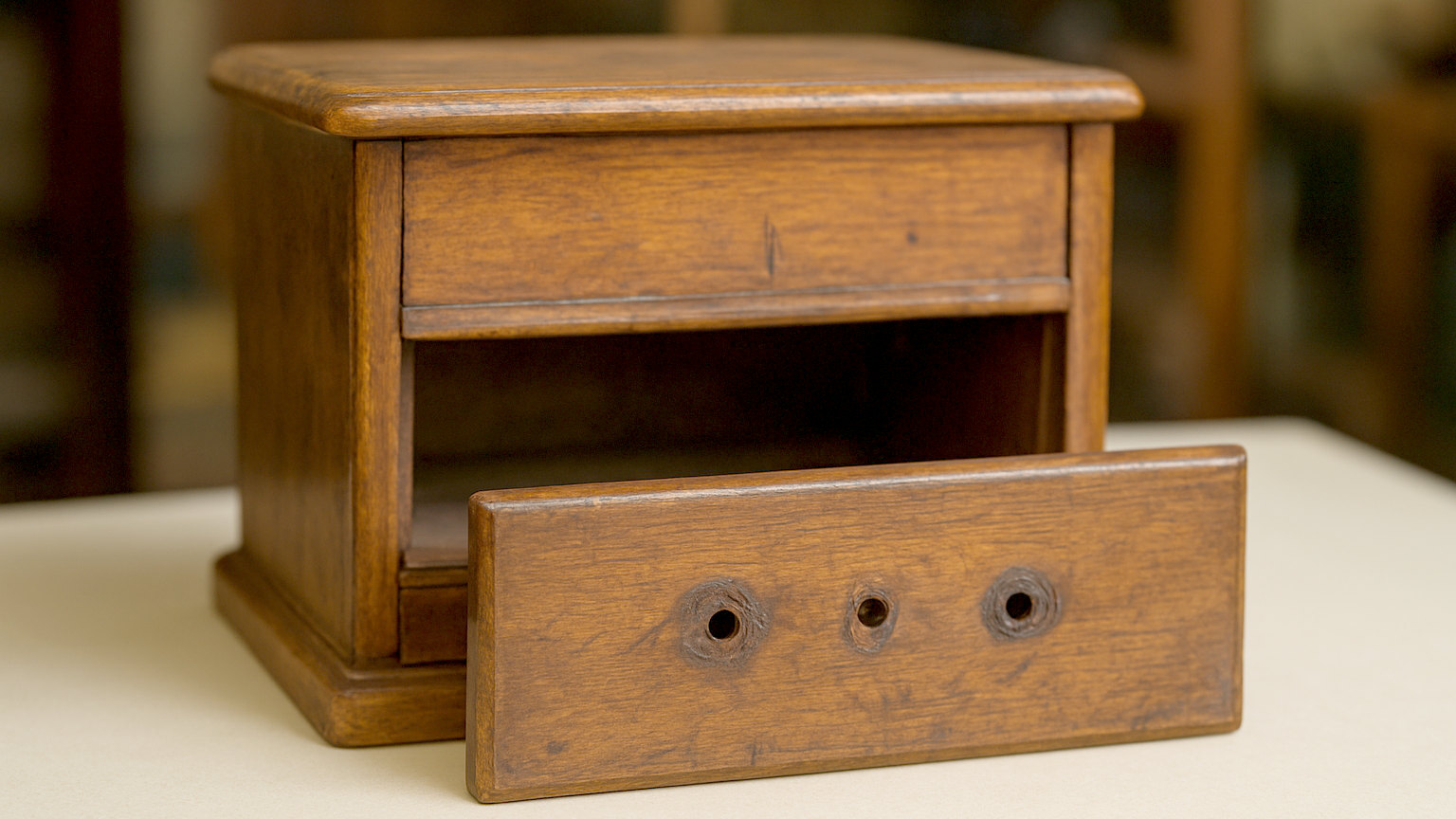
Take a drawer out and look at the inside of the front. Filled holes show as plugs of timber in slightly different colour or grain from the surrounding wood, and they are frequently visible even when the outer face has been perfectly disguised.
Count the sets. Two holes spaced for a bail handle, a single central hole for a knob, and a wider spacing for a later pattern each leave their own signature. A drawer front with three groups of filled holes has carried three different sets, which is entirely normal on a chest of real age.
What do the fixings themselves tell you?
Early handles were usually secured with a threaded post and a nut, or with split pins passed through and bent over on the inside. Later ones use a bolt through into a nut, and later still a wood screw from the front.
Look at the inside face of the drawer front around each fixing. Hand made nuts are irregular and often roughly square. Bent over split pins with a hammered flattening are early. A machine made bolt with a perfectly regular thread indicates a later fitting, though it may have replaced an earlier one on an old chest.
How can you tell a cast handle from a stamped one?
Turn it over. A cast handle has a slightly grainy back surface, some irregularity, and often a faint seam from the mould. It has weight to it and the detail on the front is softly modelled.
A stamped handle is pressed from sheet, so the back is a hollow negative of the front and the metal is thin and even. Stamped work is generally later and lighter. Modern reproduction handles are usually thin, uniformly bright and lack any wear in the places a hand would touch.
Where should wear appear on original handles?
On the underside of a bail where fingers hooked under it, and on the backplate where the bail rested when it dropped. That contact leaves a distinct bright wear mark and often a small groove.
The backplate should also show wear around its edges and a darker area beneath it where the timber was protected. Lift a handle and look at the timber underneath. Original handles leave an unfaded patch matching their exact outline, and if that shadow does not match the fitting currently in place, the handles have been changed.
How much does a replacement set cost in value?
Less than people fear, but not nothing. Sympathetic replacements of the correct pattern reduce value modestly and are extremely common, since original brass was frequently lost or broken.
Wrong period handles cost more, because they misrepresent the piece and usually have to be changed again by the next owner. The worst outcome is a set fitted with new holes drilled through original timber, which is irreversible damage rather than a simple swap.
Should you change handles yourself?
Only if the existing ones are wrong for the piece, and only using the existing holes. Never drill fresh holes in an original drawer front, because that permanently reduces value and cannot be undone.
Keep any handles you remove, wrapped and labelled, and pass them on with the chest. Reproduction handles in correct patterns are readily available and inexpensive, and choosing a pattern that matches an existing set of holes is usually possible with a little searching.