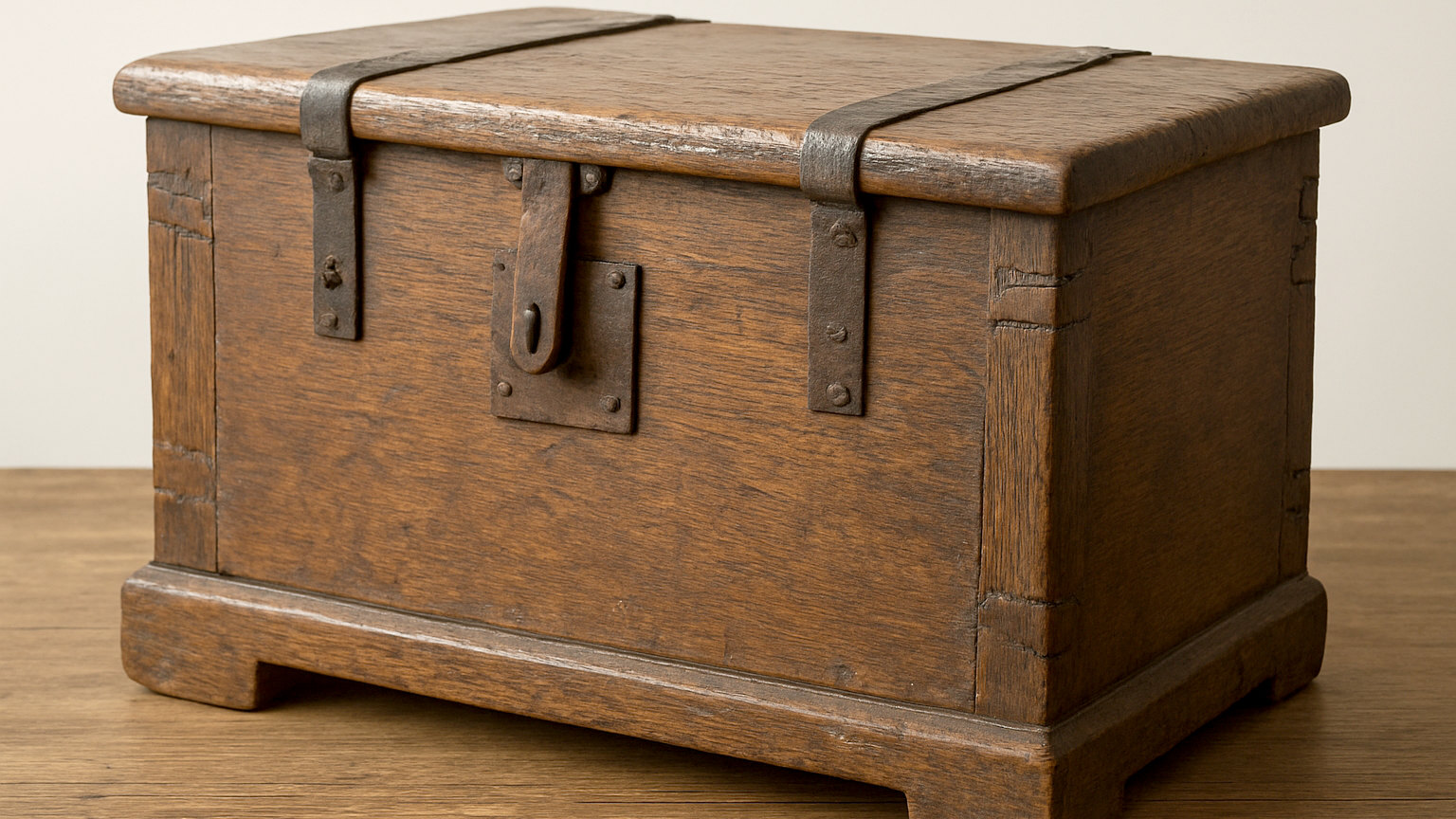
The chest is the oldest furniture form still in common use, and oak coffers survive in reasonable numbers from a genuinely early period. They have also been reproduced continuously for well over a century, and a great many pieces sold as early are considerably later. The construction settles it.
What are the main construction types?
Plank chests are built from wide boards nailed or pegged together, which is the simplest and earliest approach. They are heavy, and the boards split as the timber shrinks, which is normal rather than a fault.
Panelled chests use a frame of stiles and rails with panels floating in grooves, which allows the panels to move as the timber shrinks without splitting. This is more sophisticated construction and it dominated once workshops had the skill for it.
Why do floating panels matter?
Because they are evidence of understanding rather than decoration. A panel sitting loose in its groove can expand and contract, which is why panelled furniture survives where plank furniture splits.
Look at the panel edges. A genuinely old panel has shrunk within its frame over centuries, leaving a narrow strip of unfaded timber where it has pulled away from the moulding. That strip is excellent evidence of long slow movement and is difficult to fake.
What should you check on the lid?
The hinges and the underside. Early lids use wooden pin hinges or hand forged iron strap hinges, and the iron should show hammer marks and irregularity rather than machine uniformity.
Look underneath the lid for original tool marks and for the colour of unpolished timber. Lids take the most damage of any part, so replaced lids are common. Compare the timber, figure and colour against the carcass, and check whether the wear on the lid edge corresponds to the wear on the chest front.
Where should the wear be?
In places use would put it. The front should be worn where people leaned and where hands lifted the lid. The lid edge should be worn where fingers gripped it. The base and feet should show damp damage and abrasion from stone floors.
Inside, look for wear on the bottom boards and around any till, which is the small internal compartment fitted in one end. Uniform wear across every surface, including places nobody would touch, indicates artificial distressing rather than genuine use.
What about carved decoration?
Treat it with suspicion until checked, because plain early chests were carved decades later to make them more saleable, and this was done on a considerable scale.
Look at the depth of the carving relative to the panel. Original carving is planned into the timber thickness, so the panel remains a sensible depth. Later carving is cut into an existing surface, so the panel ends up thin and the cut recesses show a paler, cleaner colour than the surrounding patina.
How do you spot a reproduction?
Machine evidence and consistency. Look for circular saw marks on unfinished surfaces, machine cut joints, perfectly regular carving with identical repeats, and screws with even threads.
Check the interior, which reproductions frequently finish too neatly. Genuine chests have rough interior surfaces with hand tool marks and accumulated dirt in the corners. Smell it as well, since an old oak chest has a distinctive dry smell that new timber does not.
Are they good value now?
Ordinary panelled coffers are remarkably cheap for their age, because they are heavy, low and awkward to use in a modern house. Early examples in original condition with good colour remain sought after and priced accordingly.
Buy on colour and originality rather than on carving, since an untouched plain chest with a fine surface is worth more than a heavily carved one that has been stripped. Check the feet, which rotted on damp floors and are the most commonly replaced component.
What was the till for?
A small lidded compartment built into one end of the interior, used for keeping smaller valuables separate from the bulk stored below. Its presence is a good sign, since reproductions frequently omit it.
Check whether the till has its own lid, whether the lid is original, and whether the compartment shows genuine wear inside. Some have a concealed drawer beneath, which is worth looking for by pressing along the base of the till and feeling for movement.