Glass shades sat directly above a flame, were made thin, and were knocked constantly. The survival rate is correspondingly poor, and that scarcity has an obvious consequence: an original shade in good condition is frequently the most valuable component of an antique lamp, and sometimes worth more than everything below it.
Why are original shades so scarce?
Because they were consumable in practice. Heat stress from the flame beneath, cleaning, and simple knocks accounted for enormous numbers, and a broken shade was replaced with whatever fitted rather than with a matching one.
The result is that a great many antique lamps now carry later shades or none at all. A lamp retaining its original matching shade is genuinely uncommon and commands a real premium as a complete object.
How do shades attach?
By several different arrangements, and knowing which you need is essential before buying a replacement. Some sit on a gallery, a metal ring with upright fingers, resting on the rim.
Others have a fitter, a narrow neck of a specific diameter that drops into a holder and is secured by small thumbscrews. Some screw on, and some hang from a frame. Measure the fitter diameter precisely, since these were made to standard sizes and a few millimetres of difference means the shade will not fit.
What kinds of glass turn up?
Clear, frosted, etched, opaline, cased and coloured. Frosting and etching diffuse the light, which was the practical purpose, and etched patterns vary enormously in quality.
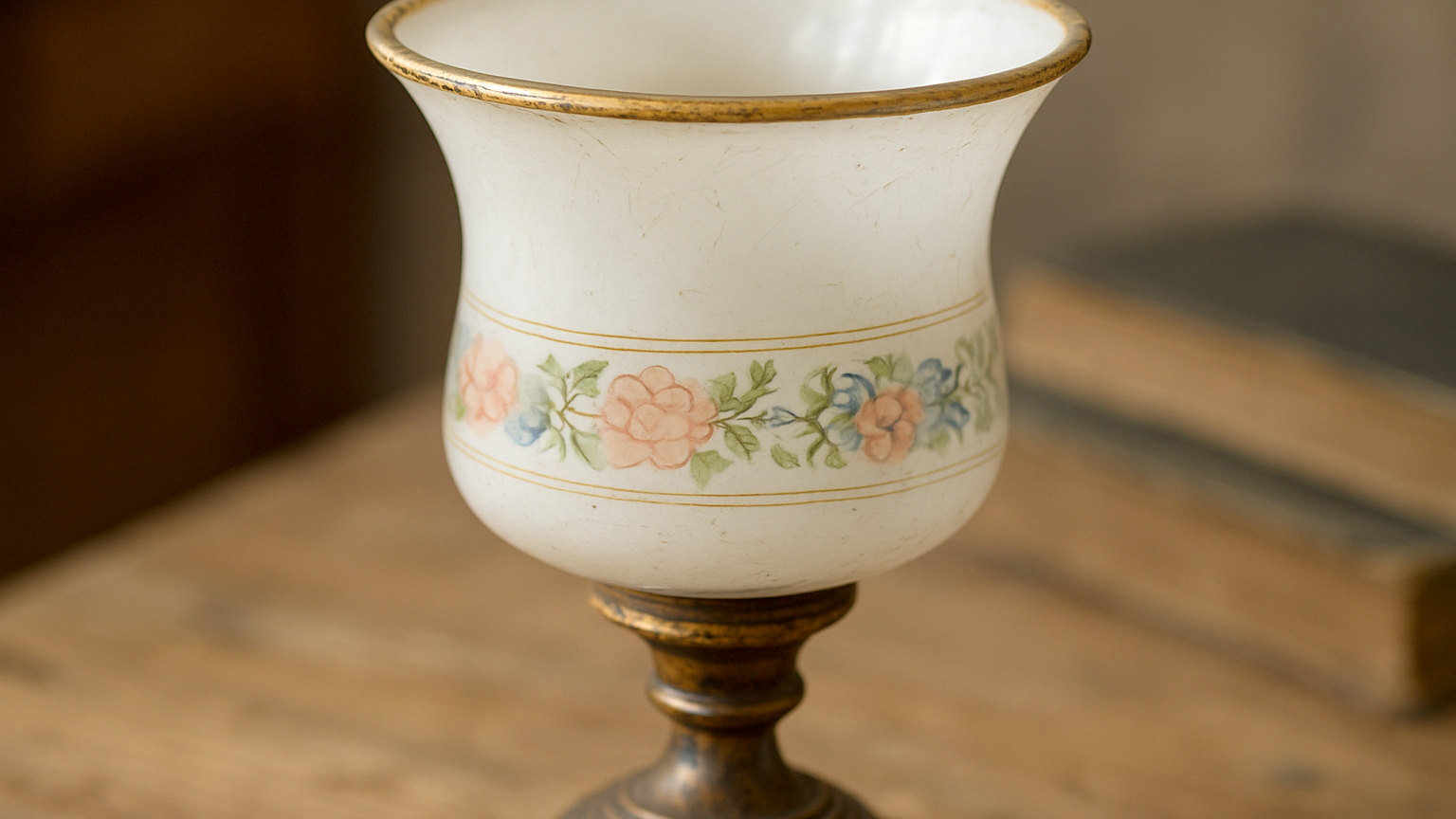
Vaseline or uranium glass, with its distinctive yellow green, appears in shades and fluoresces bright green under ultraviolet light, which identifies it instantly. Cased shades with one colour over another are more valuable, and hand painted or acid etched decoration adds considerably over a plain moulded shade.
How do you tell an old shade from a modern one?
By the glass and the finish. Older glass frequently carries a faint grey, green or straw tint from impurities, visible when you look through a thick section, while modern glass is water clear.
Look at the rim, which on older shades is often finished by hand and may be slightly uneven. Check for a mould seam and how crisply the pattern is defined. Genuine wear appears as fine scratches on the fitter where it sat in the holder, irregular and concentrated at the contact points.
What condition problems matter?
Chips to the fitter and to the rim, and internal cracks. Run a fingertip carefully around both edges, since fitter chips are common where thumbscrews were overtightened and are frequently hidden inside the holder.
Hold the shade to a strong light and turn it slowly, looking for cracks appearing as bright lines. Heat damage shows as fine crazing or a cloudy patch where a flame ran too high. A shade with a crack should not be used over a flame at all, since heat will complete the break.
How do you find a replacement?
By measuring first and searching by dimension rather than by appearance. Specialist suppliers hold antique and reproduction shades and can match by fitter size, height and shape.
Take the lamp or a precise measurement with you rather than working from memory. Be honest in any subsequent sale about whether a shade is original, since buyers who know the category can usually tell, and a correctly described later shade sells perfectly well.
How should shades be handled?
As the fragile things they are. Support a shade from underneath with both hands rather than gripping the rim, and never carry one by the fitter alone.
Remove shades before moving or transporting a lamp, wrap them individually, and never pack two shades touching. Wash gently in warm water with the shade supported, never in a dishwasher, and never subject an old shade to a sudden temperature change, since thermal shock is what breaks them.
Are reproduction shades acceptable?
Entirely, provided they are described as such and priced accordingly. A correct reproduction shade makes a lamp usable and looks far better than an ill fitting original from another design.