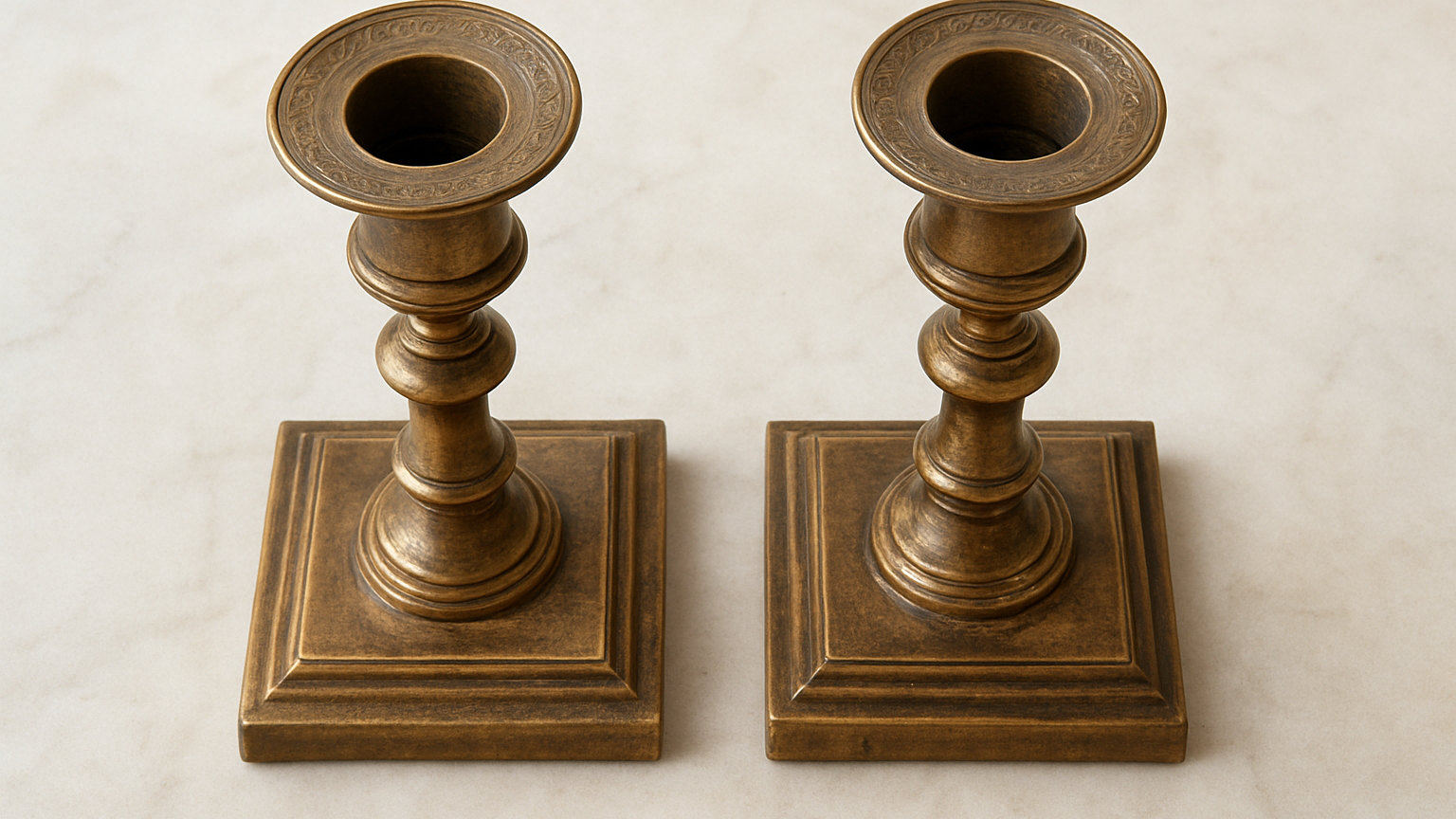
Candlesticks are among the most frequently encountered antiques and among the easiest to misjudge, because almost everything about their value depends on questions that take a minute to answer. Are they a genuine pair? Is anything missing? And what are they actually made of, since that determines how they should be valued at all.
Why do pairs matter so much?
Because candlesticks were made and used in pairs, and a genuine pair is worth substantially more than two comparable singles. They flanked a mantelpiece or a table centre.
Assembled pairs are extremely common, since one of a pair was broken or sold and a similar stick found later. The difference in value is large enough that checking should be routine before any purchase.
How do you check a pair is genuine?
Stand them side by side and compare systematically. Height first, measured rather than eyeballed, then base diameter, then the exact profile of any turning, knop or moulding.
Weigh them if you can, since a genuine pair cast or made together should be closely similar. Compare the colour, the pattern of wear and the depth of any casting detail. On silver, read the marks on both, since a genuine pair shares a maker, an office and a date letter.
What is missing most often?
Detachable nozzles, which are the small removable sockets that catch wax and protect the stick. They were lifted for cleaning and lost constantly.
A pair complete with matching original nozzles is worth noticeably more than one without. Check they match each other and the sticks in pattern and marks. Drip pans, where the design has them, are similarly prone to loss.
What is a loaded base?
A base made from thin sheet metal formed over a filling that provides weight and stability, closed underneath with a disc of baize or thin metal. Most silver candlesticks are made this way.
This matters because a loaded stick cannot be valued by weight, since the metal content is a small fraction of the total. Never sell loaded candlesticks to a buyer offering a price per gram, and never immerse one in water, since moisture enters the base and cannot escape.
What is a candelabrum?
A candlestick with branches carrying multiple lights, usually with a detachable branch section that lifts off so the base can be used as a plain stick.
Check the branches are original to the base by looking at the fit, the decoration and any marks. Count the sockets and check each has its nozzle. Branches are frequently married from other pieces or replaced, and a candelabrum with associated branches is worth considerably less.
How does the material change the assessment?
Completely. Solid silver is valued on maker, form and condition with a metal floor beneath it. Loaded silver is valued on form and condition alone. Sheffield plate and electroplate are decorative.
Brass and bronze are judged on casting quality, patina and age, and should never be polished bright. Spelter, which imitates bronze, is worth a fraction of it and reveals itself as dull grey metal under a light scratch in a concealed spot.
What condition issues matter?
Leaning stems, dents in thin metal, splits at seams and repairs in soft solder, which shows as dull grey deposits. Sight along each stem from the side to check it is straight.
On loaded pieces, check the base covering is intact and the filling has not shifted, since a stick that will not stand true needs a silversmith to open the base. On brass, check for splits and for holes drilled for later lamp conversion.
How should they be cleaned?
Sparingly, and according to the material. Silver should be polished rarely and gently, working around hallmarks rather than across them, and never immersed if loaded.
Brass and bronze should generally be left alone entirely, since patina is what collectors value and metal polish removes it along with cast detail. Remove wax by warming gently rather than scraping, and never use a knife or a metal tool on any candlestick surface.