Antique light fittings are among the few antiques that can genuinely hurt someone. Wiring standards have changed enormously, insulation from earlier decades perishes invisibly from the inside, and a great many old fittings have no provision for earthing at all. Rewiring is not optional before use, and it is one of the few areas where the right answer is to pay a professional.
Why is old wiring dangerous?
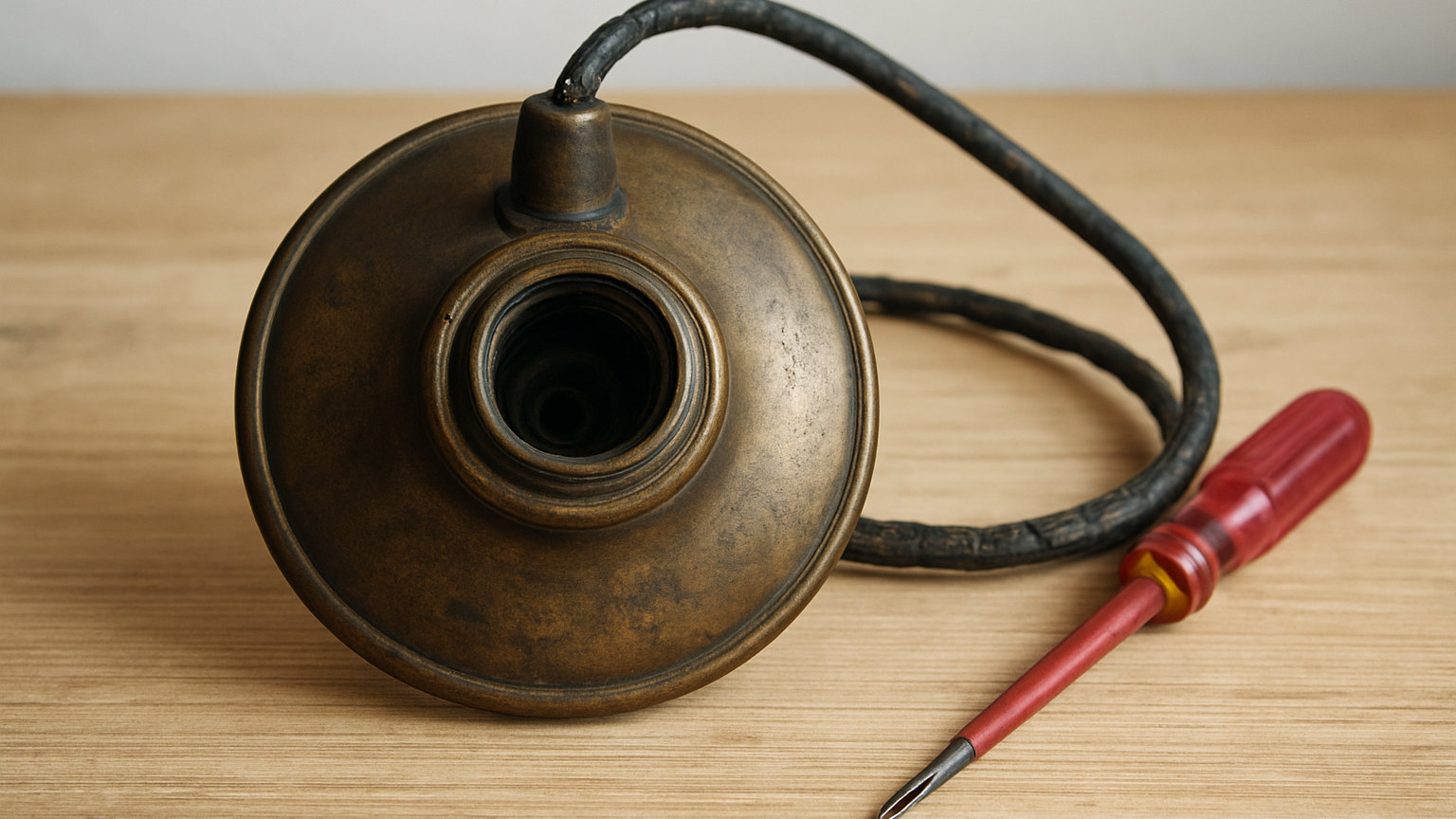
Because early flexible cable used rubber or fabric insulation that hardens, cracks and crumbles with age and heat. The damage happens inside the sheath where you cannot see it, so a flex that looks intact can have bare conductors within.
Heat from the lamp accelerates this, and the worst deterioration is usually closest to the lamp holder where it is least visible. Assume any flex more than a few decades old is unsafe regardless of appearance, and never plug in an untested antique fitting to see whether it works.
What does rewiring actually involve?
Removing the original cable entirely and replacing it with modern flex of the correct rating, fitting a new lamp holder if the original is damaged, and providing an earth connection to any exposed metal.
The route the cable takes through the fitting is often awkward, particularly on chandeliers where each arm carries its own cable back to a central junction. Old fittings frequently have sharp edges where the cable passes through metal, so grommets or sleeving are needed to prevent the new flex being cut.
Why does earthing matter so much?
Because most antique fittings are made of brass, copper or bronze, and any exposed metal that could become live must be connected to earth so that a fault trips the protection rather than energising the fitting.
Early fittings were made before earthing was standard and have no provision for it, so an earth point usually has to be added. This is a significant part of the work and a large part of why it should be done by someone qualified rather than improvised.
What should be preserved during the work?
Everything except the cable. Keep original switches, decorative ceiling roses, brass fittings and any maker marked components, even if they are no longer used, and pass them on with the fitting.
Original lamp holders can sometimes be retained if they are sound and can be safely earthed, and a sympathetic electrician will try. Where a holder must be replaced, choose one matching the original in size and finish rather than a modern white plastic component, which spoils the appearance and reduces value.
What about converted oil and gas fittings?
A great many antique lights began as oil or gas and were converted, sometimes more than once. Existing holes and channels from a previous conversion should be reused rather than drilling new ones.
Drilling fresh holes through a ceramic or glass font, or through original metalwork, is destructive and permanently reduces value. A good conversion is reversible, passes cable through existing openings, and leaves the original burner or gas fittings in place even when they no longer function.
What should you check before buying a fitting to rewire?
Completeness first, since missing glass shades and chandelier drops are expensive and difficult to match. Count arms, drops and pans, and check they match each other in casting quality and wear.
Check the structural integrity of any suspension point, because a heavy fitting hanging on a corroded chain or a cracked ceramic body is a genuine hazard. Look for splits at seams, previous crude repairs in soft solder, and corrosion inside hollow sections where a cable must pass.
Who should do the work?
A qualified electrician, ideally one who has handled antique fittings before, since the combination of old materials and modern regulations needs both skills. Some restorers specialise in exactly this and are worth seeking out.
Installation matters as much as the rewiring. A heavy chandelier needs proper structural fixing rather than an ordinary ceiling rose, and the weight should be checked against what the ceiling can carry. Have the finished installation tested rather than assuming that because the light comes on, the work is sound.