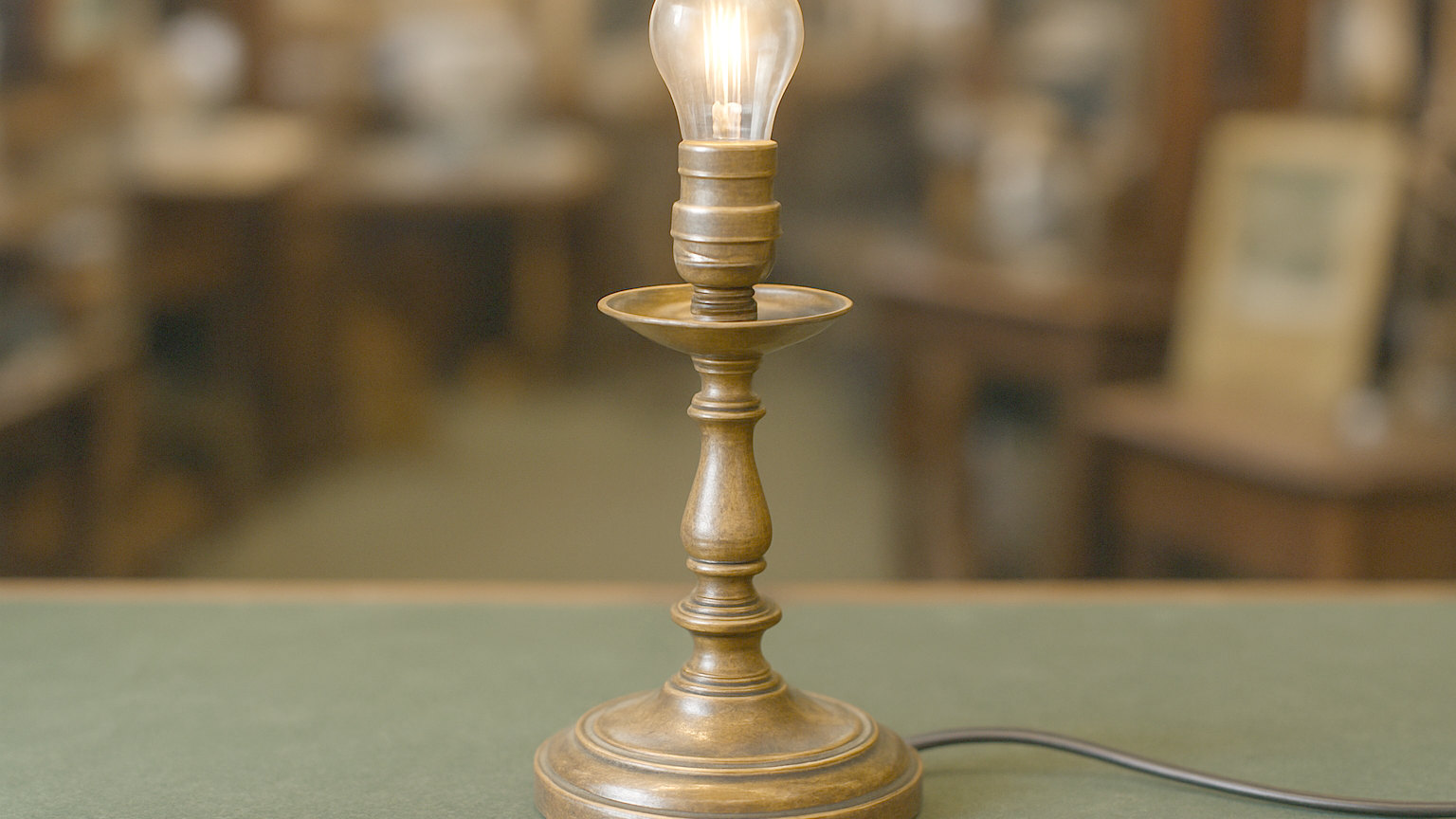
Table lamps present a question that other lighting does not: was this made as a lamp? A very large proportion of antique table lamps began as vases, urns, candlesticks or oil lamps and were converted, and a conversion that drilled through original material is a different proposition from one made as a lamp from the start.
How do you tell a purpose built lamp?
By where the cable runs and how the fitting sits. A lamp designed as a lamp has provision for the cable built into the casting or the base, with a channel or hole made at manufacture rather than added later.
Look at the underside. On a purpose built lamp the cable exit is neat, finished and integral. On a conversion it is frequently a drilled hole with chipping or roughness around it, or a cable brought over the edge of the base and secured with a clip.
What does a conversion cost in value?
It depends entirely on what was destroyed. A reversible conversion passing cable through an existing opening does little harm and may improve saleability.
A hole drilled through a ceramic or glass vase, through a marble base, or through original metalwork is irreversible damage, and it substantially reduces what the object would have been worth unconverted. Turn every lamp over and look before assuming anything.
Which objects were commonly converted?
Vases above all, since the shape suits a lamp base. Also urns, candlesticks, oil lamp fonts, spelter and bronze figures, and even architectural fragments.
The value question is what the object would be worth in its original state, which may be considerably more than as a lamp. A good vase drilled for a lamp has lost a great deal; an ordinary one has lost little and gained a use.
What are the main genuine lamp types?
Oil lamps converted at the time to electricity, which is contemporary conversion and generally acceptable. Purpose built electric lamps from the early electric period, with cast bases and integral fittings.
Desk lamps with adjustable arms and shades, and the low glass shaded reading lamps made for offices and libraries. These later types are collected in their own right, and original condition matters as much as in any category.
How do you assess the shade?
By whether it belongs. Shades broke constantly and were replaced with whatever fitted, so an original matching shade is uncommon and adds substantially.
Measure the fitter diameter, meaning the neck that sits in the holder, since these were made to standard sizes. Check the shade suits the base in scale, period and style. Glass shades should be checked for chips at the fitter and the rim, and for heat crazing from a flame or a hot bulb.
What should you check on the base?
Stability, condition and any weighting. Lamps are top heavy and were frequently weighted internally, so check the base covering is intact rather than torn or replaced.
Look for cracks in ceramic and marble bases, particularly radiating from any drilled hole, and for repairs. On metal bases check for splits at seams and for corrosion inside where a cable passes. Check the whole assembly stands square without rocking.
What about the wiring?
Assume it is unsafe regardless of appearance. Old insulation perishes invisibly from the inside, and the worst deterioration is usually closest to the lamp holder where it is hardest to see.
Rewiring must be done by a qualified electrician, and any exposed metal needs an earth connection that early fittings never had. Ask them to reuse existing routes rather than drilling anything new, and to retain original switches and fittings even if not used.
Are they worth buying?
Genuine early electric lamps and good desk lamps sell steadily and have risen with interest in early technology. Converted vases are worth what the vase is worth, less the damage.
Buy on the quality of the base object and the sympathy of any conversion. Budget for professional rewiring before use, and check the shade carefully, since replacing a missing or wrong one costs more than most people expect.