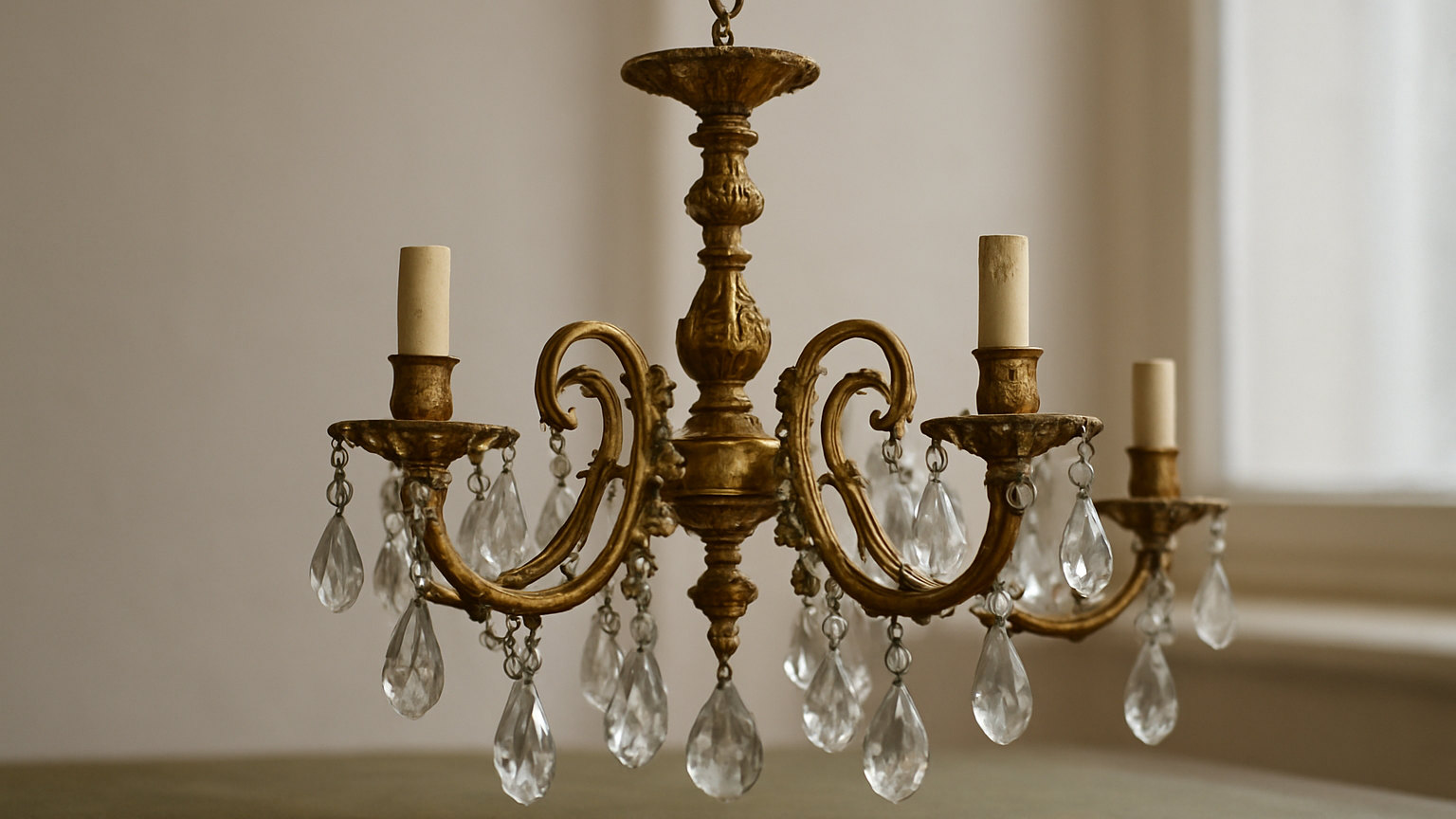
A chandelier is the most demanding antique light fitting to assess, because it consists of dozens or hundreds of separate components that can be lost, replaced or mismatched. Completeness drives the value more than age does, and a fitting missing a third of its drops is worth a fraction of the same piece intact.
What should you count first?
The arms, and whether they match each other. Every arm should be the same length and curve, made to the same pattern, with consistent casting quality and identical wear at the points where drops hang.
An arm that differs slightly in colour, curve or finish has been replaced. Count the pans and nozzles too, which are the small dishes and sockets at the end of each arm, since these are frequently missing or substituted.
How do you assess the glass?
By quality and by consistency. Cut lead crystal drops have crisp polished facets you can feel, refract light strongly, and give a clear ringing note when tapped gently. Moulded or pressed drops have rounder, softer edges and less brilliance.
Look through several drops from the same fitting and compare. Replacements are usually detectable by a difference in colour, since older glass often has a faint grey or straw tint while modern replacements are water clear. Count the drops on each arm and see whether the numbers agree.
What are the common types?
Cut glass chandeliers with a metal frame concealed behind glass arms and swags of drops, and gilt or bronze fittings where the metal is the visible structure and glass is decorative. Both were made across a long period.
Some have a central glass column and a receiver bowl gathering the arms. Others hang everything from a metal frame. Look at whether the arms are glass or metal, since glass arms are far more fragile and replacements are difficult and expensive to match.
What condition problems matter?
Chips to glass arms and to the receiver, which are the structural glass components. Check every arm where it enters the frame, since that join takes the load.
Look at the frame itself for corrosion, splits at seams and previous crude repairs in soft solder. Examine the suspension point, chain and canopy carefully, because a heavy fitting hanging from a corroded fixing is genuinely dangerous. Missing pins and wires holding drops are common and easily remedied.
Can missing drops be replaced?
Yes, and matching them well is the difficulty. Specialist suppliers hold enormous stocks of antique and reproduction drops, and a good match is often achievable if you take an original with you rather than working from a photograph.
Expect the cost to be significant on a fitting missing many. Budget for it before buying, because a chandelier that looks like a bargain frequently is not once the missing components are priced. A fitting with all original drops commands a real premium precisely because of this.
What about wiring and installation?
Assume any original wiring is unsafe regardless of appearance, since old insulation perishes invisibly. Rewiring must be done by a qualified electrician, and any exposed metalwork needs an earth connection that early fittings were never designed to accommodate.
Weight is the other serious issue. Chandeliers are far heavier than they look and need proper structural fixing into a joist rather than an ordinary ceiling rose. Have the ceiling assessed before installation, and never hang one from plasterboard alone.
How should one be moved?
Dismantled, and photographed obsessively first. Take images of the whole fitting and then of each section before removing anything, and photograph how the drops are arranged, since patterns vary between arms and reassembly is far harder than it looks.
Remove all drops and pack them in labelled compartments by position. Wrap arms individually. Reassembly with a full photographic record takes an afternoon. Without one it takes days, and the result is usually wrong in ways that are obvious to anyone who knows the pattern, because drops were graduated in size along each arm and putting them back in the wrong order spoils the whole fitting.