A clock that gains, loses or stops is usually suffering from something simple, and a surprising proportion of the time the fault is not inside the movement at all. Working through the ordinary causes in order will solve most problems without a workshop, and will also tell you when the answer is genuinely a service.
Is the clock level?
Start here, because it is the most common cause and the easiest to fix. A pendulum clock must be level for the pendulum to swing symmetrically, and a case sitting on an uneven floor or a sloping mantelpiece will stop within hours.
Use a spirit level on the case in both directions and pack the feet until it reads true. On a longcase, level the case and then secure it to the wall, since these are top heavy and settle over time. A clock that runs for a few hours then stops is almost always telling you about level or beat.
What does out of beat mean?
The tick and the tock are unevenly spaced. Set the pendulum swinging and listen carefully. A healthy clock produces an even, regular rhythm; a clock out of beat has a limping sound with a longer gap on one side than the other.
This happens when the escapement is not centred over the pendulum swing, so one side receives less impulse than the other. On many clocks it is corrected by moving the case very slightly to one side until the beat evens out. Some have an adjustable crutch designed for the purpose, which a clockmaker can set properly.
How do you regulate a clock that gains or loses?
By changing the effective length of the pendulum. A longer pendulum swings more slowly and the clock loses; a shorter one swings faster and the clock gains. The adjustment is usually a rating nut beneath the pendulum bob.
Turning the nut to raise the bob makes the clock go faster, and lowering it makes it go slower. Make very small adjustments, a fraction of a turn at a time, and then leave the clock for a full day before judging the result. Adjusting repeatedly over a few hours will simply confuse you.
Why does a clock stop after a day or two?
Often because the pendulum swing is too small to sustain itself. This indicates friction somewhere, and the usual cause is old lubricant. Clock oil dries and turns to a sticky varnish that holds dust and grips the pivots.
You cannot fix this by adding fresh oil on top, which is a common and damaging instinct. Fresh oil over old varnish makes matters worse, and oiling the wrong parts causes real harm. A movement in this state needs stripping and cleaning by a clockmaker.
What about a clock that stops at the same point?
A clock that reliably stops at the same time each day is usually catching on the strike mechanism, so check whether it stops just before an hour or half hour. Worn parts in the strike train, or hands that are touching, can halt the whole movement.
Look at whether the hands are catching on each other, on the dial, or on the glass. Bent hands are common after careless setting, and gently straightening the clearance between hands is often the whole answer. Check that nothing has fallen into the case, since a loose object interfering with the pendulum will stop a clock instantly.
Should you oil a clock yourself?
No. Clock oiling requires knowing which points take oil and which must be left dry, using the correct grade of oil in tiny quantities applied precisely. General purpose household oil is the worst possible choice, since it gums up and attracts dust.
Spraying penetrating oil into a movement is the fastest way to turn a serviceable clock into an expensive repair, because it washes remaining lubricant out of the pivots and leaves residue everywhere. If a clock needs oil, it needs a service.
When is a service actually needed?
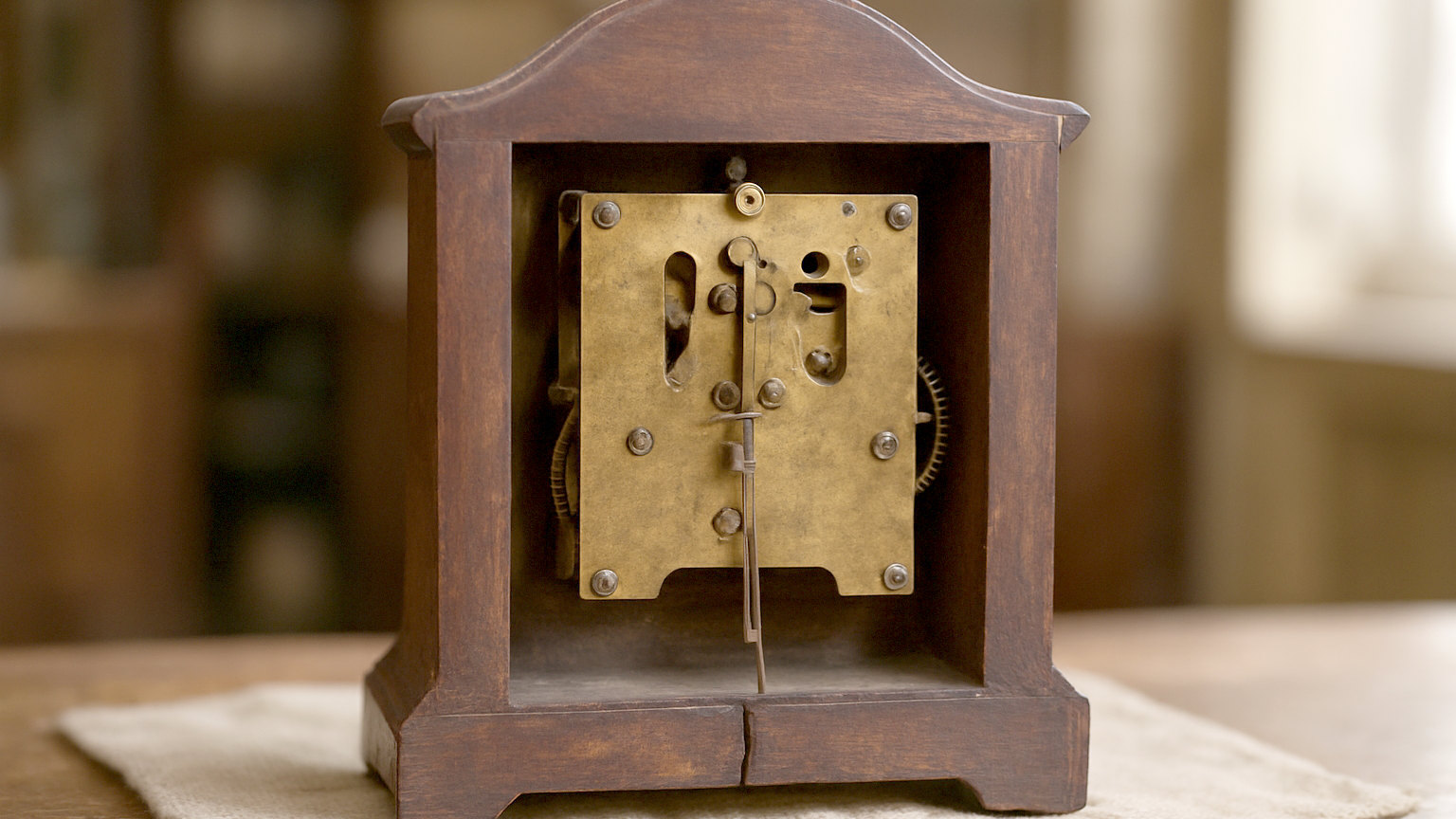
Every several years for a clock in regular use, and always before restarting one that has stood idle for a long period. A service means dismantling the movement, cleaning every part, checking for wear, correcting worn pivot holes and relubricating correctly.
Running a dry movement wears the pivots, and that wear costs far more to correct than the service would have. If a clock has stood in a loft for twenty years, have it looked at before winding it.