The escapement is the part of a clock that releases the driving power in measured steps and gives the pendulum or balance a push to keep it moving. It is the heart of the timekeeping, and its type is one of the most useful dating features available, because escapement design improved in a recognisable sequence.
What does an escapement do?
Two jobs at once. It lets the wheel train advance by a controlled amount for each swing of the pendulum or balance, which is what produces the tick, and it delivers a small impulse to keep the oscillation going against friction.
Without it a clock would simply run down in seconds as the weight or spring released all its energy at once. Every mechanical timepiece has one, and the type fitted determines both the accuracy achievable and roughly when the movement was made.
How do you recognise a verge?
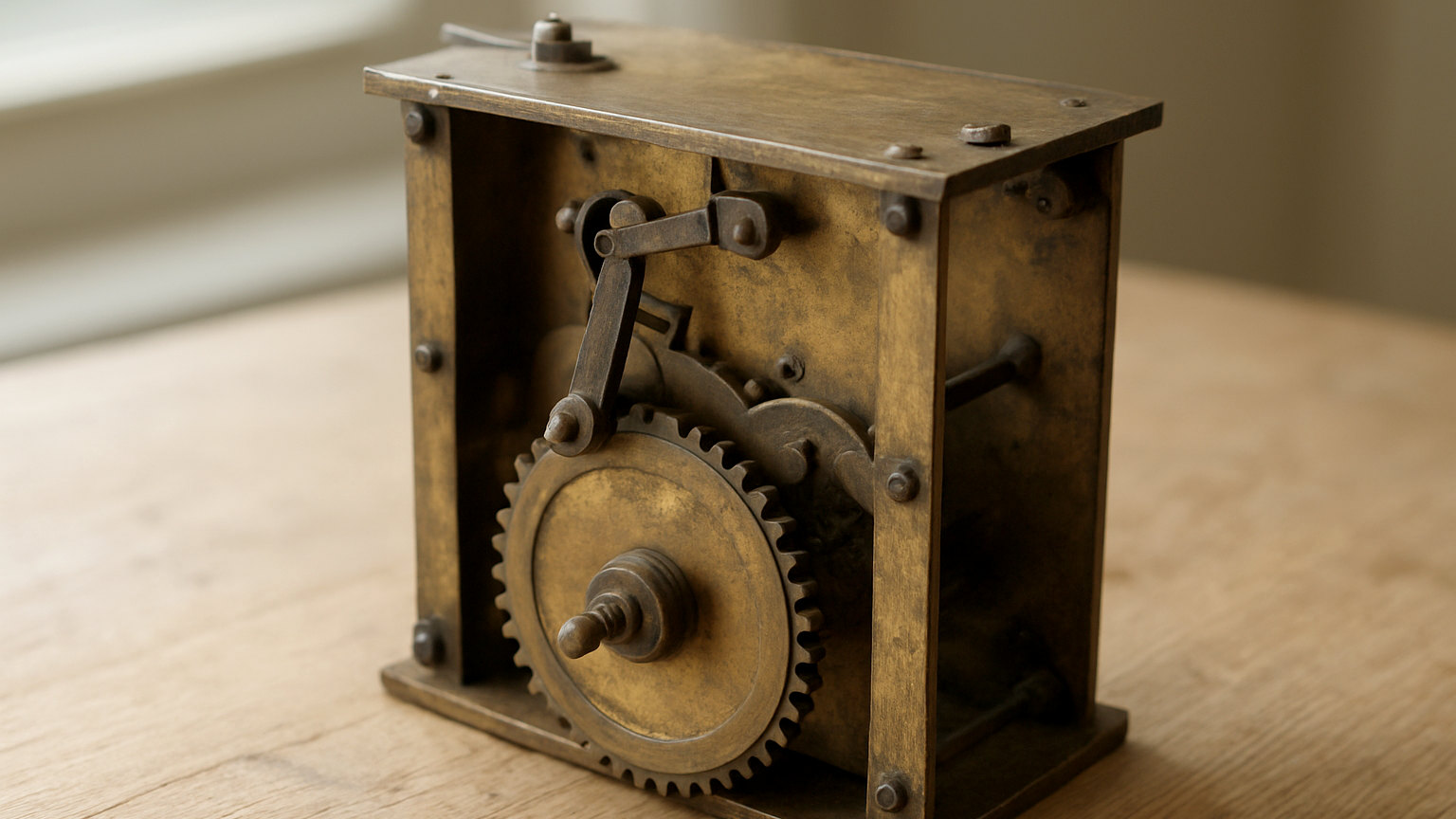
By the crown wheel. A verge escapement uses a wheel with saw shaped teeth standing up from its rim like a crown, mounted so that it turns in a vertical plane, with two small pallets on a vertical staff engaging it from either side.
In a watch, look for a balance wheel with no visible hairspring on early examples, sitting above a distinctly domed cock, and a movement that is noticeably deep front to back. In a clock, look for the crown wheel arrangement and, on longcase movements, a short pendulum with a wide swing.
Why does a verge swing so widely?
Because of how the pallets engage. A verge requires a large arc of swing to function, so a verge clock pendulum travels through a much wider angle than a later movement does, often visibly so.
That wide arc is one reason verge timekeeping is poor by later standards. It also means the clock is more sensitive to being out of level and to any interference with the pendulum, which is why verge clocks are particularly fussy about how they are set up.
What replaced it?
The anchor escapement in clocks, which allows a much narrower pendulum swing and therefore far better timekeeping, and which is what made the longcase clock practical. Its shape gives it away, resembling an anchor with two curved arms engaging a wheel from above.
In watches, the lever escapement eventually became standard, offering much better accuracy and reliability than the verge. Recognising which of these a movement uses places it in a broad period immediately, before you look at any mark.
What does a verge tell you about date?
That the movement is early relative to others of its kind, since the verge was the original arrangement and was superseded. It gives you a strong indication rather than a precise year.
Be careful, though, because verge movements continued to be made for cheaper work long after better escapements existed. Use it alongside other evidence: the case hallmarks on a watch will date the case precisely, and the style of the movement, dial and plates will narrow things considerably.
What is a verge conversion?
A movement originally built with a verge that was later altered to a more accurate escapement, which was done frequently because owners wanted better timekeeping.
These conversions reduce value, because collectors want original configuration. Look for filled or redundant holes in the plates, a top plate that has been cut or patched, and parts whose finish does not match the surrounding work. Conversion back to verge has also been done, so unexplained holes in either direction are worth examining.
Should you buy a verge movement?
If you want an early piece and understand what you are getting, yes. Original unconverted verge movements attract collectors specifically, and a watch or clock retaining its original escapement is worth considerably more than a converted one.
Do not expect accurate timekeeping. These were never precise by modern standards and no amount of servicing will change that. Have any verge movement serviced by someone experienced with the type, since unfamiliar hands cause damage to parts that are difficult to replace.