Setting up a longcase clock is straightforward if done in the right order and destructive if not. Almost all damage happens because somebody fitted the pendulum before the case was level, or hung the weights before the movement was secure. The sequence is the whole thing.
What comes first?
Position and level the empty case, before any component goes near it. Stand it where it will live, then check with a spirit level in both directions, front to back and side to side.
Pack the feet with thin timber or metal shims until it reads true. A longcase must be level for the pendulum to swing symmetrically, and adjusting afterwards means dismantling again. Do this properly and everything else follows.
Why must the case be secured?
Because a longcase is tall, narrow and top heavy, and it will fall. A clock with weights hanging inside has considerable mass high up, and floors are rarely as flat as they look.
Fix the case to the wall with a bracket or a strap at the top of the trunk, into masonry or a stud rather than plasterboard. This is a safety matter rather than a refinement, particularly in any house with children or animals.
What comes next?
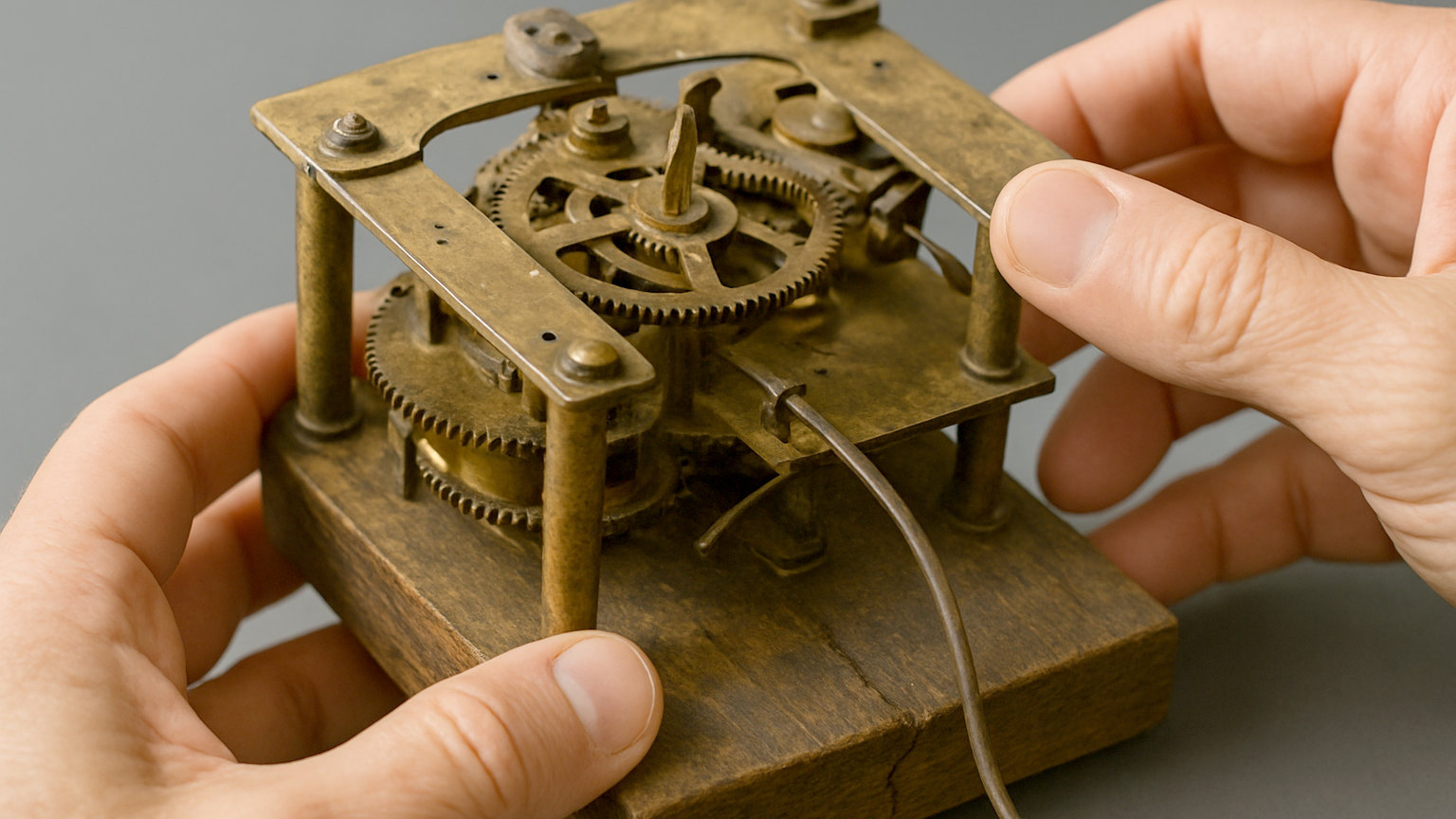
The movement, onto its seatboard. Lift it straight down keeping it upright, and check it sits square and stable on the board with no rocking.
The lines or chains should hang freely down the trunk without touching each other or the case sides. Check nothing is tangled before proceeding, since sorting out crossed lines with weights attached is far harder.
How do you fit the pendulum?
By hanging it from the suspension spring at the top of the movement, then engaging the rod into the crutch, which is the lever that transmits the impulse.
Support the pendulum with one hand throughout, since the suspension spring is thin steel and bends under any lateral force. Lower it gently rather than dropping it into place, and check the bob hangs clear of the case sides and the backboard.
When do the weights go on?
Last, and on the correct sides. Weights are frequently of different masses, with the striking side heavier, so note which hung where before dismantling and replace them accordingly.
Support each weight as you hook it on rather than letting it drop, since a falling weight will damage the movement or the case. Check the lines run smoothly over their pulleys and that nothing fouls as the weights descend.
How do you start it?
Fit the hood, then set the hands by moving them forwards only, pausing at each hour and half hour to let the strike complete fully before continuing.
Then start the pendulum with a gentle push to one side. Do not force the hands past a strike, and never move them backwards past a striking point, since the levers are designed to travel one way.
How do you set it in beat?
By listening. The tick and tock should be evenly spaced, giving a regular rhythm. An uneven limping beat means the clock is out of beat and it will stop within hours.
On many clocks the correction is to shift the whole case very slightly to one side until the beat evens out, then recheck the level. Some have an adjustable crutch designed for the purpose, which a clockmaker should set. Do not bend a crutch by hand.
How do you regulate it?
Through the rating nut beneath the pendulum bob. Raising the bob shortens the pendulum and speeds the clock; lowering it slows the clock.
Make very small adjustments, a fraction of a turn at a time, then leave it a full day before judging. Note the starting position so you can return if you overshoot. A well set longcase should keep good time once level, in beat and properly regulated.
What should you check after a week?
That the clock is still level, since floors settle and cases shift, and that the beat is still even. Both change slightly as a clock settles into a new position.
Recheck the timekeeping over several days before making any further adjustment to the rating nut, since a single day is not enough to judge.