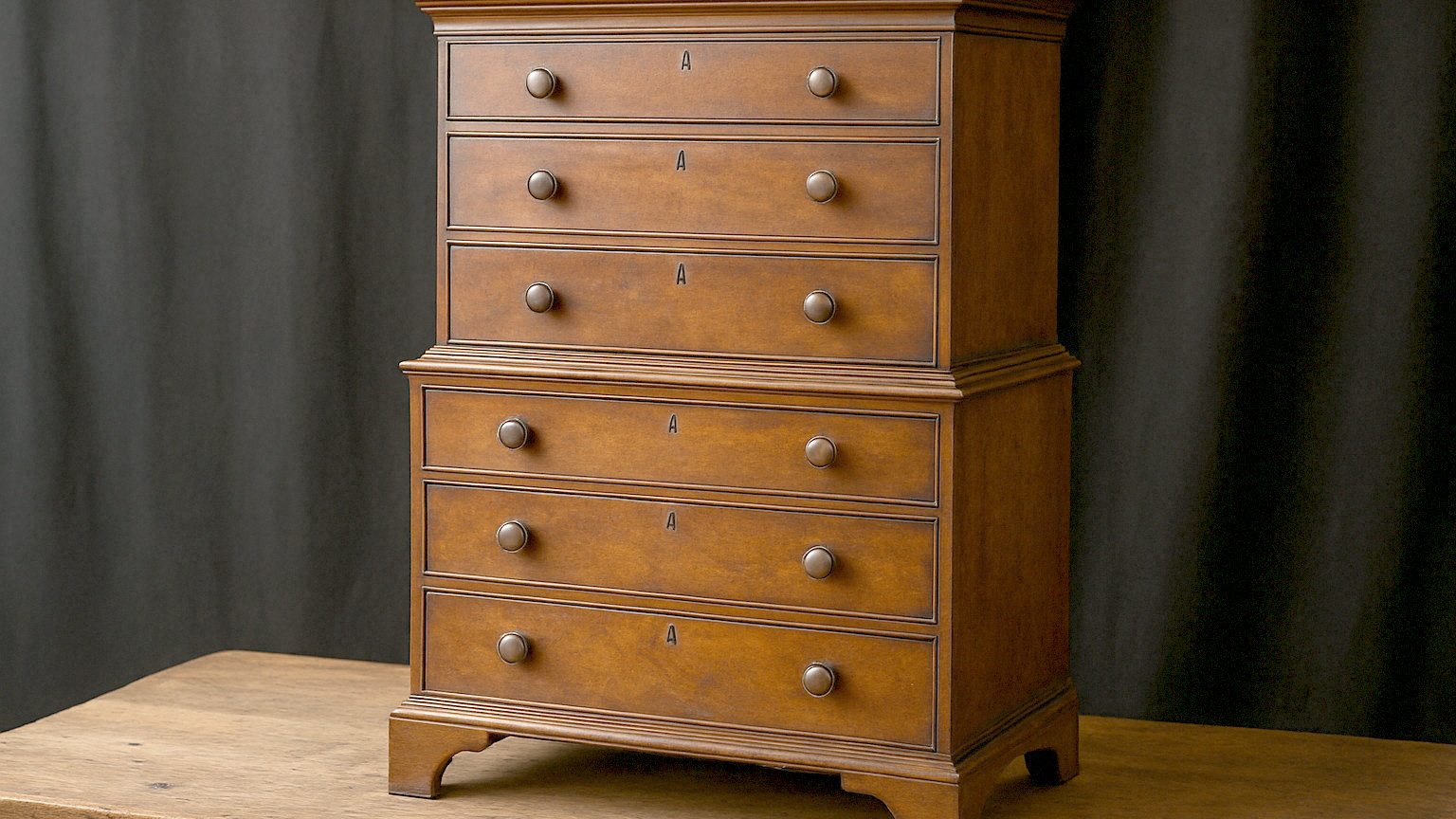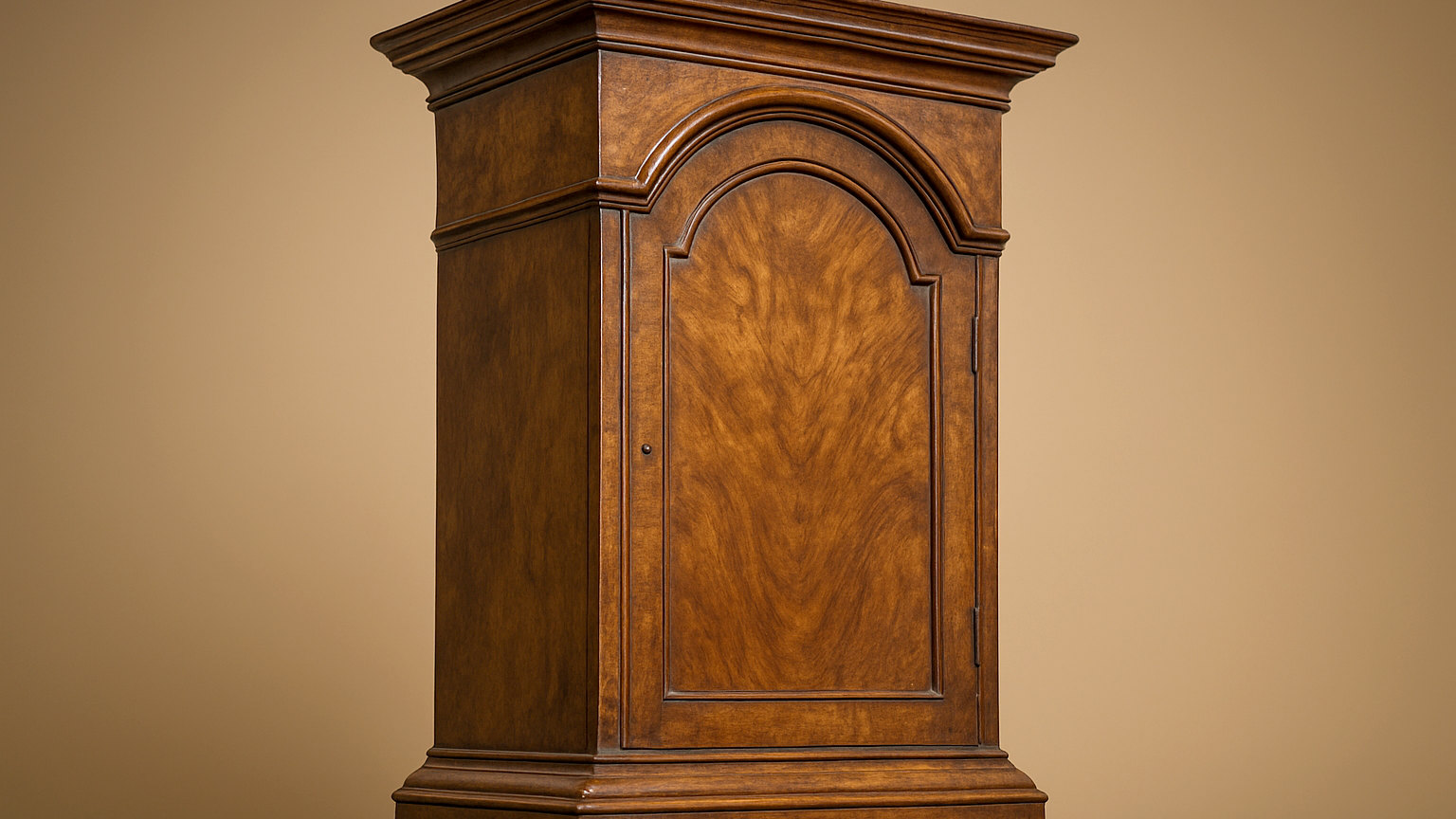
A clock case is a piece of furniture that happens to contain a movement, and it should be assessed the way any furniture is assessed. Since movements and cases were frequently made by different people and have often been separated since, reading the case independently is one of the more useful checks available.
Which timbers were used?
Oak for earlier and country cases, walnut for fashionable work of one period, then mahogany dominating quality production, with rosewood and other dark timbers appearing later alongside it.
That broad sequence gives a general steer rather than a date, since country workshops continued using oak throughout. What matters more is whether the timber is consistent with the movement date and with the quality of the movement inside.
How do you tell oak from mahogany?
By grain and by weight. Oak has a coarse open grain with visible pores running along it, and quartered oak shows the distinctive silvery flecks of the medullary rays.
Mahogany has a finer, more even grain, a warmer reddish tone and is generally heavier and denser. Look at an unfinished surface inside the case rather than at a polished exterior, since stain and polish disguise timber colour considerably. Walnut has a distinctive wavy figure and a warm mid brown tone.
What does ebonising mean?
Staining or painting a cheaper timber black to imitate ebony, which was expensive. Many clock cases described as ebony are ebonised fruitwood or beech.
Look at a chip or a worn edge, where the pale timber beneath will show through. Genuine ebony is extremely dense, heavy and has a very fine grain. Ebonising is not a defect, it was an accepted finish, but it should be described accurately and it affects value.
What does veneer thickness tell you?
Roughly when the case was made, since veneer was originally cut by hand saw and is comparatively thick, becoming progressively thinner as machinery improved.
Look at an edge, a chip or a lifting corner where the thickness is visible. Substantial thickness you can clearly see indicates early work; paper thin veneer over a manufactured board is modern. Check how the veneer is laid too, since book matched and cross banded work indicates a maker thinking about figure.
Where do cases get replaced?
Feet first, since they stood on damp floors and rotted. Then the base and the plinth, then any applied mouldings, finials and cresting, which break off and are lost.
Compare the timber, colour and construction of these components against the main carcass. Replacement feet are extremely common on longcase clocks and are acceptable when sympathetically done, but they should be disclosed and reflected in the price. Look underneath for fresh timber and modern fixings.
How do you check the case suits the movement?
By quality as well as by fit. A fine movement in a plain case is a normal and honest combination, since cases were frequently made locally to house a bought in movement.
What should concern you is a mismatch in date. Check the seatboard the movement rests on for wear and fixing marks corresponding to the movement currently on it, and check the dial fills the hood aperture cleanly. Extra holes, packing pieces or an enlarged opening all indicate a marriage.
What condition issues matter most?
Veneer losses, splits in solid components, woodworm and damage at the base. Check the back and inside, which nobody polished, for active worm indicated by fresh pale dust.
Original surface matters here as much as in any furniture. A case stripped and repolished to a uniform modern finish has lost patina that took two centuries to develop, and it is worth noticeably less than one with an untouched surface and honest wear.
How should a case be cleaned?
Gently and rarely. Dust with a soft cloth, clean sparingly with a barely damp one if necessary, dry immediately and apply a good quality wax occasionally, buffing well.
Never strip or repolish, and never use silicone based sprays, which build up and interfere with any future restoration. A tired original surface revives far more than most people expect with nothing more than careful waxing.