Carriage clocks are among the most recognisable antique clocks and among the most variable in value. Two that look almost identical on a mantelpiece can differ several fold in price, and the reasons are almost entirely internal. Learning where to look turns a confusing category into a readable one.
What is a carriage clock?
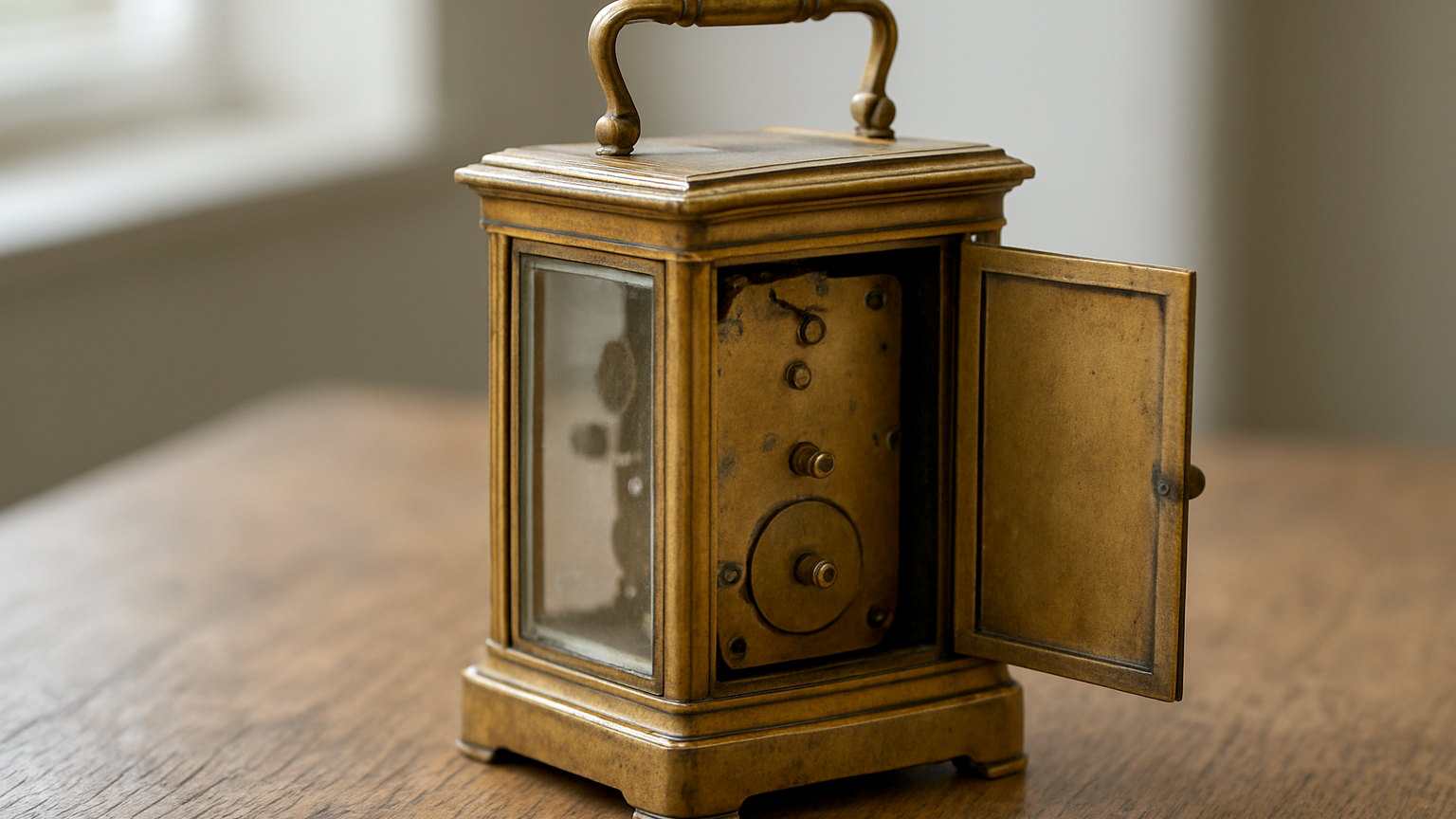
A small portable spring driven clock in a rectangular case with glazed panels and a handle on top, made to be carried while travelling. The case is usually brass or gilt brass, with glass to front, sides, back and frequently the top.
The glazed top panel is a defining feature and lets you see the escapement working. That visibility was part of the appeal, and it is also useful now, because it lets you assess the most important component without opening anything.
Where do you look for quality?
The back plate, reached by opening the rear door. It usually carries a makers name or trademark, a serial number, and sometimes a series of small punched marks from repairers over the years.
Assess the finish of the movement itself. Better examples show well finished plates, neatly cut wheels and jewelled bearings. Cruder movements have rougher finishing and fewer refinements. The difference in workmanship is visible even to someone with no horological training once two examples are compared side by side.
What does the escapement tell you?
A great deal. Most carriage clocks use a platform escapement mounted horizontally on top of the movement, visible through the glass top panel. A jewelled lever platform indicates better quality than a simpler arrangement.
Watch it running if you can. The balance should swing freely and evenly with a consistent beat. A platform that has been replaced with an ill fitting later one is common and reduces value, and it usually shows as a platform that does not sit neatly on the movement or has extra fixing holes beneath it.
Which complications add value?
A repeating mechanism, which strikes the last hour on demand when a button on the top is pressed, adds considerably. It was designed for travellers who wanted the time in a dark room, and it requires a more complex movement.
Striking on gongs at the hour and half hour adds value over a plain timepiece with no strike at all. An alarm adds a little. Calendar work and multiple subsidiary dials in the main dial indicate a more ambitious movement and a higher price, provided everything still functions.
How do you judge the case?
Look at the crispness of the mouldings and the quality of any engraving. Better cases have sharply defined edges and finely executed decoration, while later commercial examples are softer and more repetitive.
Check that all glass panels are present and original, since replacements are common and bevelled glass is expensive to match. Examine the gilding: original gilding wears through gradually on handled areas such as the handle and corners, while a regilded case has an even uniform brightness including in recesses. Enamel panels, where present, must be checked closely for hairline cracks and restoration.
What suggests a later reproduction?
A movement that is noticeably simpler than the case implies, a case assembled from parts with slightly mismatched finishes, and any battery movement fitted into an old case. Reproduction carriage clocks were made in quantity and many are now old enough to have acquired convincing wear.
Check the fit of the movement in the case, since an original pairing sits precisely with fixing points that align. Extra holes, packing, or a dial that does not quite fill the aperture all indicate that movement and case did not start life together.
Should you buy one that is not running?
Often yes, if the movement is complete and the price allows for servicing. Many stopped clocks simply need cleaning and fresh oil after decades of neglect, which is routine work.
Missing parts are the risk, particularly a missing or broken platform escapement, which is expensive to replace correctly. Have a clockmaker look before committing to anything described as needing attention, and never transport a carriage clock without checking that the platform is secure.