Vienna regulators are among the most attractive antique wall clocks and among the most variable in quality. The name covers everything from precision timekeepers of remarkable accuracy to cheap commercial production made to look similar, and the differences are almost entirely inside the case.
What is a Vienna regulator?
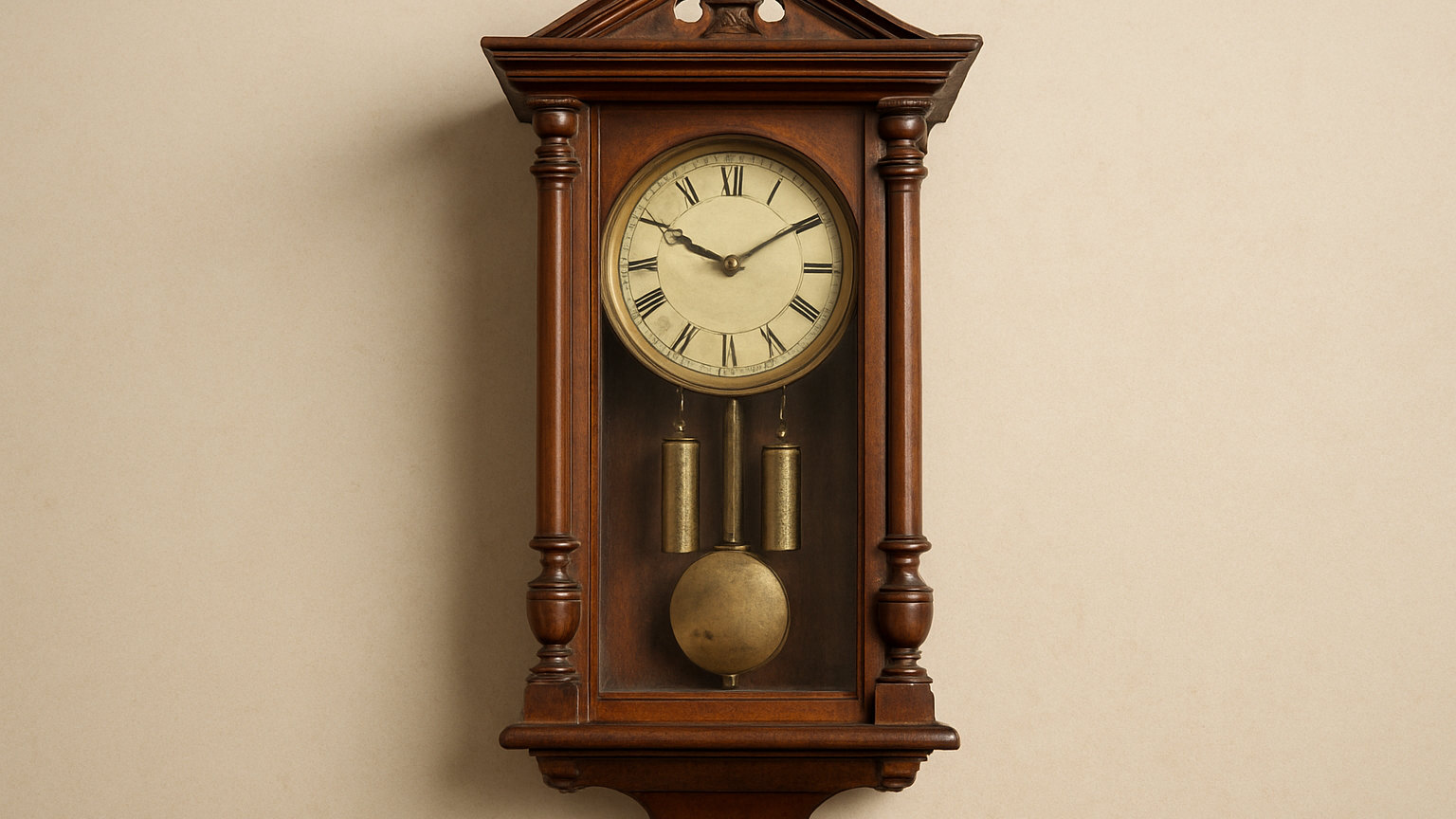
A weight driven wall clock in a tall glazed case, designed primarily for accurate timekeeping rather than for decoration. The glazing on the front and sides lets you see the pendulum and weights working.
The form developed as a domestic precision clock, and the best examples keep time to a standard that ordinary domestic clocks never approached. The name refers to the type rather than to a place of manufacture, since they were made widely.
Why are they weight driven?
Because a falling weight delivers constant force, unlike a mainspring which pushes hard when fully wound and weakens as it unwinds. Constant force means constant timekeeping.
Look through the glazed case: you should see one, two or three weights on lines or chains. One weight indicates a timepiece with no strike, two adds striking, three indicates additional complication. Weight driven movements need a case tall enough for the fall, which is why these clocks are long.
What indicates a quality movement?
The escapement and the finishing. Better regulators use a deadbeat escapement, which recoils less than a simple anchor and gives noticeably better accuracy, recognisable by its precise engagement with the escape wheel.
Look for jewelled pallets, a finely finished movement with well cut wheels, and a heavy pendulum with a rating nut for fine adjustment. Some have a wooden pendulum rod, which expands less with temperature than steel and therefore keeps better time, which is a genuine quality indicator.
What does the dial tell you?
Quality and period. Early and better examples have enamel dials, often in two pieces with a separate centre, or engine turned silvered brass. Later commercial clocks use printed dials on card or metal.
Look at whether the seconds are shown on a subsidiary dial, which indicates a clock intended for accurate use. Check for repainting, which shows as lettering slightly too crisp with spacing that does not quite sit right, and which reduces value substantially.
How do you assess the case?
By timber, proportion and completeness of the glazing. Cases were made in walnut, mahogany and ebonised finishes, with turned or carved decoration at the top and base.
Check all glass is present and original, since side glasses are frequently broken and replaced. Look at the door fit and the condition of any applied mouldings and finials, which are commonly lost. The backboard should show the marks and wear consistent with a clock that hung for a century.
What separates these from commercial imitations?
Movement quality above everything. A great many spring driven wall clocks were made in similar cases to look like regulators, and these are worth considerably less because they lack the constant force that made the type worth having.
Open the case and look for weights. No weights means no regulator, whatever the case suggests. Check also whether the movement is finely finished or roughly stamped, since commercial production is obvious once compared against good work.
What should you check before buying?
That the movement, dial, case and pendulum belong together. Look at whether the dial fills its aperture cleanly, whether the movement fits its seatboard without packing, and whether the pendulum length suits the case.
Never transport one with the weights and pendulum hanging, since that is how movements are damaged. Remove both, wrap them separately and photograph the arrangement first. Hang the clock absolutely level and secure it properly to the wall, since a weight driven clock is heavy and pulls forward as it runs down.
How do you regulate one?
Through the rating nut beneath the pendulum bob, which raises or lowers it and therefore changes the effective length. Raising the bob makes the clock run faster and lowering it slower.
Make very small adjustments, a fraction of a turn at a time, then leave the clock a full day before judging the result. A good regulator will keep time to within a minute or so a week once properly set, which is why the type was worth the extra cost in the first place.