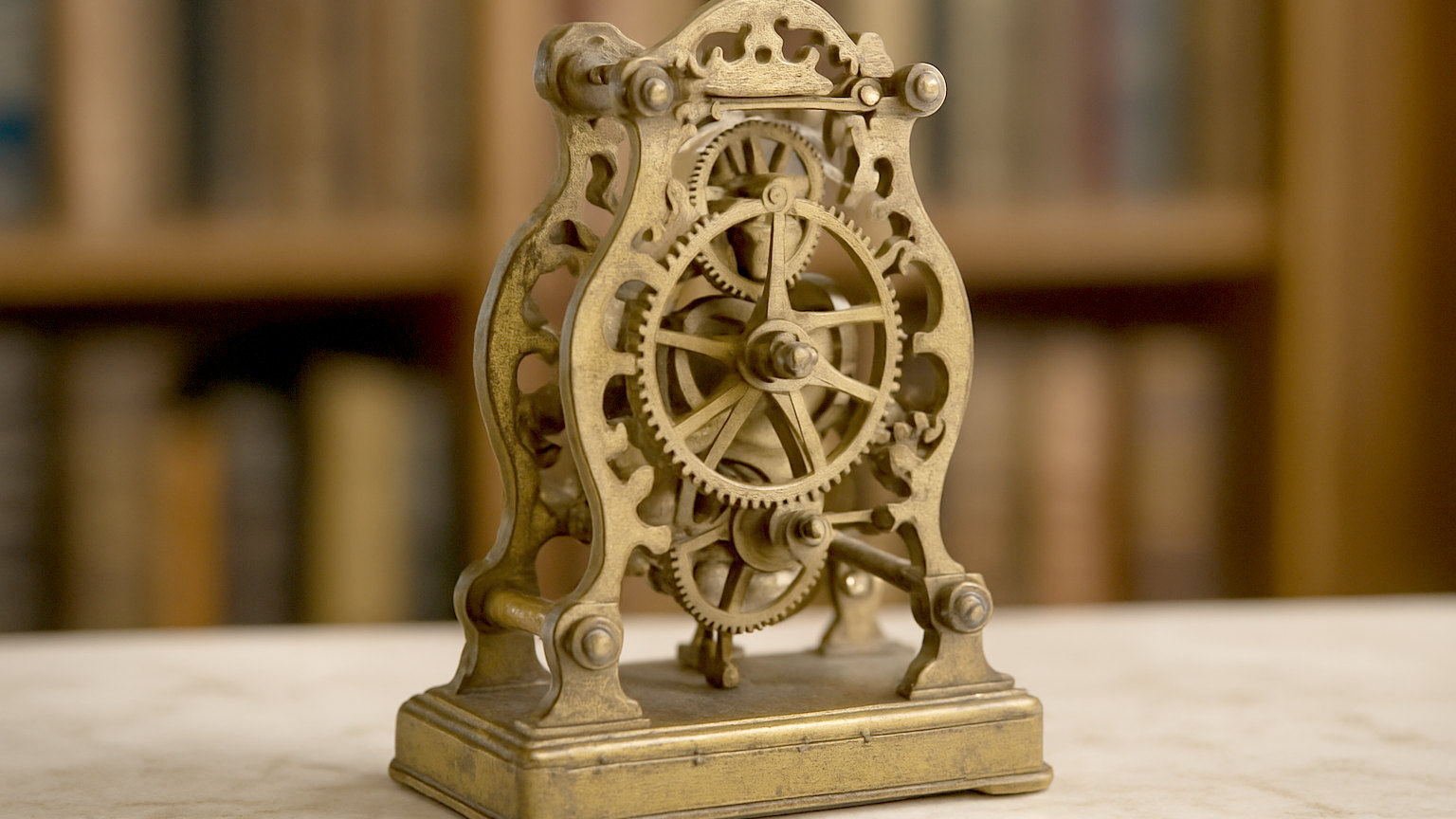
A skeleton clock is built to be looked at. The plates are pierced and shaped so the wheels are visible, there is no case to speak of, and the whole mechanism is displayed under a glass dome. That openness makes them unusually easy to assess, because everything that would normally be hidden is in plain sight.
What is a skeleton clock?
A clock with the movement plates cut away to an ornamental outline, mounted on a base under a glass dome, so the working parts are the decoration.
They were made as display pieces rather than as everyday timekeepers, frequently to demonstrate a maker skill. Frames were shaped into scrolls, arches, and sometimes representations of buildings, which is a recognised category in its own right.
What should you look at first?
The movement, since it is entirely visible and it is what you are buying. Look at the finishing of the plates, the quality of the wheel cutting, and whether the pivots run in jewelled bearings.
Better clocks show crisp piercing with filed and polished edges, well proportioned wheels with cleanly cut teeth, and a generally considered appearance. Cruder examples have rough edges, stamped rather than cut parts and unfinished surfaces.
What is a fusee and why does it matter here?
A cone shaped pulley connected to the barrel by a chain, which evens out the declining force of the mainspring as it unwinds. On a skeleton clock it is fully visible and is one of the most attractive features.
Its presence indicates better English work and improves timekeeping considerably. Check the chain is present and intact, since fusee chains break and replacements must match the exact size. Wind gently and stop at resistance, because forcing a fusee is how chains snap.
How do you assess the frame?
By the quality and consistency of the piercing. The frame is the decorative element, and the skill is in how cleanly the outline was cut and finished.
Look at the edges under magnification for file marks and polishing, which indicate hand finishing. Check the frame is straight and undistorted by sighting across it, and look for repairs at the pillars connecting front and back plates, which take the load.
What about the base and dome?
Bases are usually marble, wood or a combination, sometimes with a moulded edge, and they should suit the clock in scale and period. Check for chips and cracks, which marble takes readily.
The glass dome is essential and frequently missing or replaced. An original dome is thin, may have a slight tint or waviness, and sits properly in its recess. Replacing one with a modern dome of the right size is possible but the difference is visible, and a clock without any dome is worth considerably less since dust destroys an open movement.
How do you check the dial and hands?
Skeleton clocks frequently have a pierced chapter ring rather than a solid dial, so the movement shows through behind the numerals. Check the ring is original and undamaged.
Look at whether the hands match each other in style and metal, and whether they are the correct length. Blued steel hands should show even colour rather than patchy heat marks from later treatment. Replaced hands are common and are a cheap substitution that buyers notice.
What condition problems matter most?
Dust and corrosion, because there is no case to protect the movement. A clock that has stood without its dome will show dirt in the pivots and possibly rust on steel parts.
Check for missing components, which are immediately visible on an open movement: click springs, pins, and small levers. Look at screw heads for burring, which indicates unskilled work inside. Because everything is exposed, an honest assessment is far easier here than on a cased clock.
Are they worth buying?
Good ones with fusee movements, fine frames and original domes sell well and always have, since they are decorative and demonstrate real craftsmanship.
Ordinary examples are more affordable. Buy on movement quality above all, since the movement is the object. Have any clock that has stood unused serviced before running, and never move one with the pendulum hanging or the dome in place.