The winding key looks like the most trivial part of a clock and causes a surprising amount of expensive damage. A key that does not fit properly rounds off the square it turns, and once that square is worn no key will grip it. Getting the size right costs nothing and prevents a repair that requires dismantling the movement.
Why does key size matter so much?
Because the winding arbor ends in a small square of steel, and the key must fit that square closely to transmit force without slipping. A key that is fractionally too large grips only at the corners.
Every turn then rounds those corners slightly. After enough windings the square becomes a rounded stub that nothing will turn, and correcting it means removing the movement and either building up the arbor or replacing it. That is a workshop job on a part that is under considerable tension.
How do you measure for a key?
Measure across the flats of the winding square, not corner to corner, using a small gauge or callipers. Clock keys are sold by numbered sizes corresponding to that measurement.
If you have no gauge, take the clock or a careful measurement to a clock shop rather than guessing. Buying a key that is slightly too small is harmless because it simply will not go on. Buying one slightly too large is what causes the damage, so err downwards when uncertain.
What types of key are there?
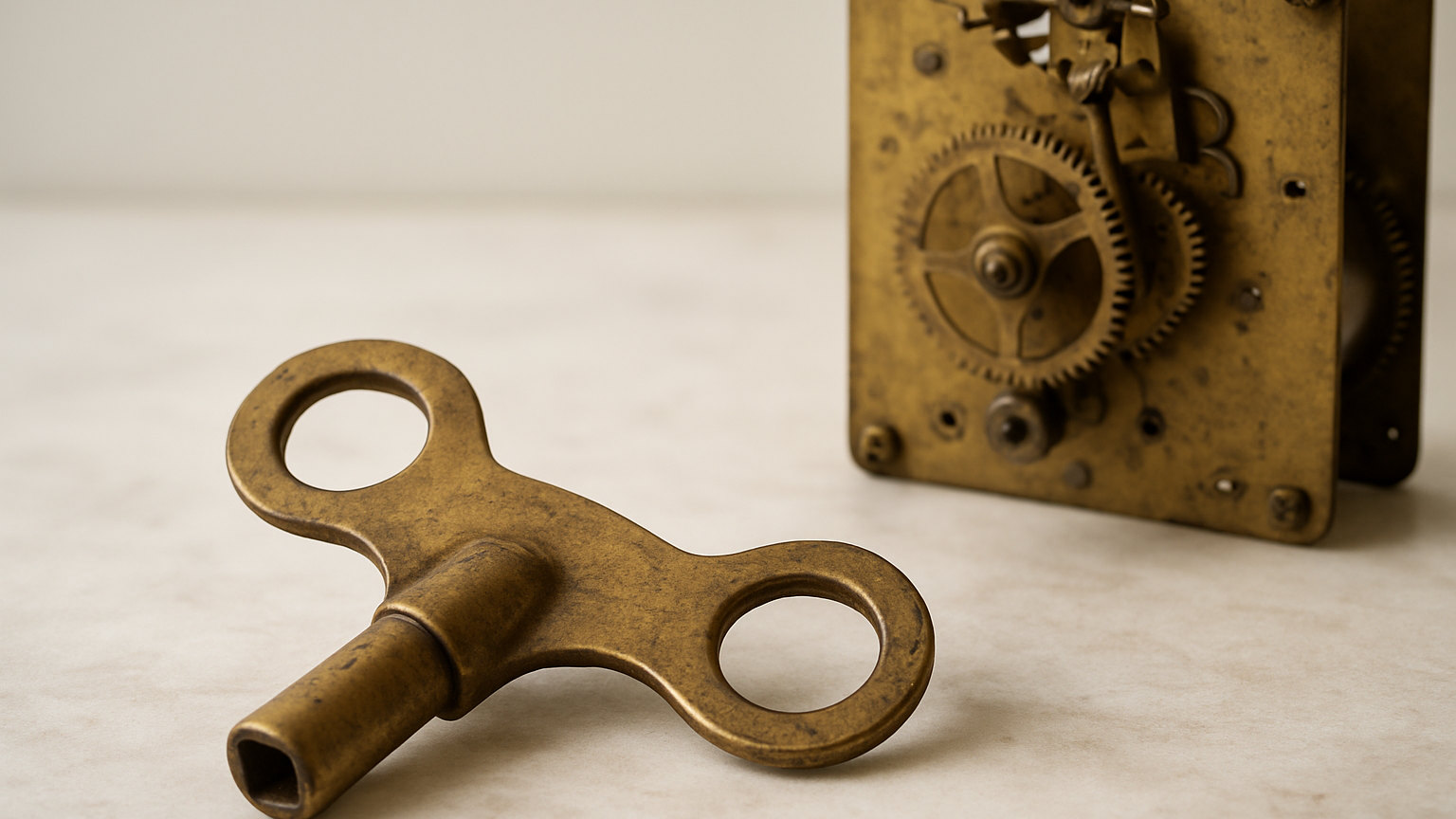
Simple double ended keys with a square socket at each end, single ended keys with a shaped handle, and crank keys with an offset handle that gives more leverage.
Longcase clocks generally use a crank key, because the weights are heavy and a straight key gives insufficient purchase. Carriage clocks often have a small double ended key, one end for winding and the other for setting the hands. Check which type your clock requires rather than forcing whatever is to hand.
How should you wind a clock?
Steadily, supporting the movement where you can, and stopping the moment you feel firm resistance. Turn in smooth movements rather than jerking, and keep the key square on the arbor rather than at an angle.
Angling the key is the other common cause of wear, because it concentrates force on one edge of the square. Hold the key straight and turn evenly. Wind at the same time each day if the clock is in regular use, since consistent winding produces better timekeeping.
What does resistance mean?
That the mainspring is fully wound and you should stop immediately. A spring reaches its limit and simply stops; there is no benefit in forcing another fraction of a turn.
Continuing past that point is how mainsprings break and how fusee chains snap. If a clock suddenly goes slack while winding, or if the key spins freely, stop at once and do not attempt to wind further, since something inside has failed and turning the key again may cause more damage.
Which hole is which?
Count them before you start. One winding hole means a timepiece with no strike. Two means the clock strikes as well as keeps time, and each hole winds a separate train. Three indicates a chiming movement.
The left hole usually winds the strike and the right the going train, though this varies, so wind each in turn and note which is which. Both need winding on a striking clock, since a wound going train with an unwound strike will stop the movement when the strike fails to run.
How should keys be looked after?
Kept with the clock, in the case where there is space for one, since a lost key of the correct size is a nuisance to replace. Many clocks have a small compartment or a hook inside for exactly this.
Check periodically that the socket has not worn, because keys wear as well as arbors and a worn key will damage a good square. If a key feels loose on the arbor, replace it before it does harm rather than after.