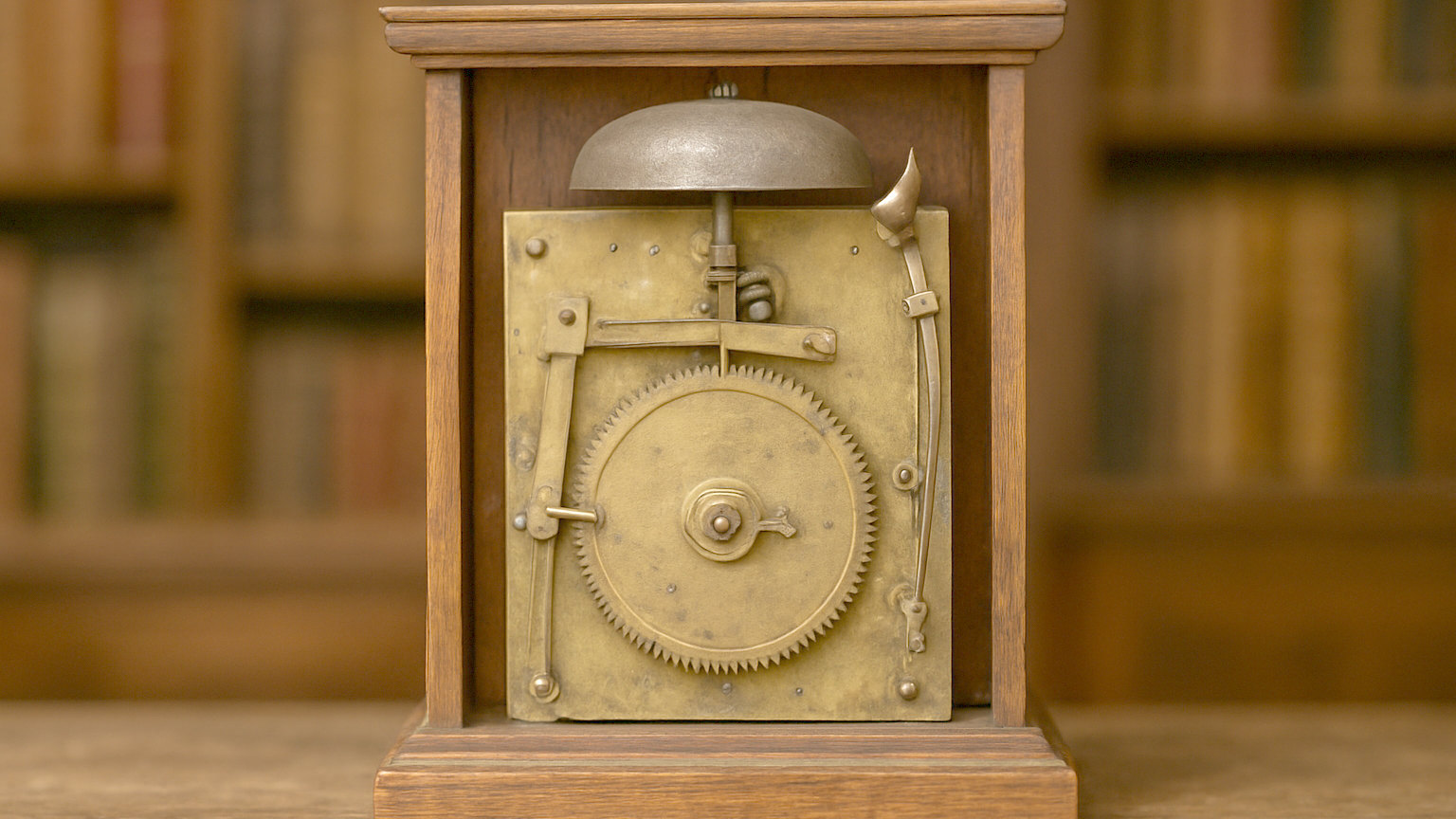
A striking clock contains two largely separate mechanisms: one that keeps time and one that counts out the hours. They are connected only at the moment the strike is released, which is why a clock can keep perfect time while striking the wrong hour, and why that particular fault is so common and so irritating.
What are the two striking systems?
Count wheel striking, sometimes called locking plate, uses a wheel with notches cut around its edge at increasing intervals. The strike runs until a lever drops into the next notch, and the spacing of the notches determines how many blows are struck.
Rack striking uses a toothed rack that falls against a stepped cam, called a snail, mounted on the hour wheel. The depth of the step the rack falls onto determines how many teeth are gathered, and therefore how many blows sound.
Why does the difference matter?
Because they fail differently and are corrected differently. A count wheel clock has no connection between the hands and the number of blows, so once the two fall out of step they stay out of step until the sequence is walked back into agreement.
Rack striking reads the hour directly from the hour wheel, so it is self correcting. Move the hands and the strike follows, which is why rack striking eventually became standard. Knowing which system you have tells you immediately whether a wrong strike is a simple fix or a nuisance.
How do you correct a count wheel clock?
By letting it strike repeatedly until the count matches the hands. Many count wheel clocks have a small lever that can be lifted to release the strike manually, allowing you to run through hours quickly.
Alternatively, advance the hands through the hours pausing at each strike to let it complete, and note how far behind or ahead the strike is running. Work patiently and never force the hands past a strike, since that is how the mechanism gets damaged.
What is the correct way to set the hands?
Forwards, slowly, stopping at every hour and half hour to let the strike finish completely before continuing. This is the single most important habit with any striking clock.
Never move the hands backwards past a striking point, since the levers are designed to travel one way and forcing them the other can bend or break parts that are awkward to replace. On a chiming clock this matters even more, because there are more sequences to disturb.
Why does a clock strike the wrong hour?
On a count wheel clock, usually because the hands were moved without letting the strike complete, or because the clock ran down and stopped partway through a sequence. It is a synchronisation problem rather than a fault.
On a rack clock, a wrong strike usually indicates something genuinely wrong: a slipped snail, a bent rack, or a hand fitted in the wrong position on its arbor. That needs a clockmaker rather than adjustment.
What does the clock strike on?
A bell, a coiled gong, or a set of rods or tubes on chiming clocks. Bells give a bright note and are generally earlier; coiled gongs give a deeper, longer sound.
Check that the hammer strikes cleanly and does not rest against the bell or gong afterwards, which deadens the note. A hammer that has been bent out of position is a common and easily corrected fault, though the adjustment should be made gently and only if you can see clearly what needs to change.
Should you silence a strike at night?
Many clocks have a strike or silent lever, usually on the dial, and using it is perfectly acceptable. What you should not do is stop the hammer by wedging it, which stresses the mechanism.
If a clock has no silent option, leaving it to strike is better than interfering. Running the strike train regularly actually keeps it in condition, and a strike that has stood unused for years frequently seizes. If the strike is failing rather than merely mistimed, have it serviced rather than disabling it.