Pewter sits awkwardly between the rigorously controlled world of silver and the entirely unregulated world of brass. It had a marking system, enforced by trade guilds rather than by assay offices, but compliance varied and records are incomplete. That makes identification a genuine piece of detective work rather than a lookup.
What is a touchmark?
A makers personal mark, struck into the metal to identify who produced the piece. Pewterers registered their marks by striking them onto communal touch plates held by their guild, which is why the term touch is used.
Marks vary enormously in design, using initials, full names, devices such as animals, birds, crowns or ships, and sometimes dates. Unlike a silver hallmark, a touchmark does not certify metal purity and does not encode a year, so it identifies the maker rather than dating the object directly.
Where should you look for marks?
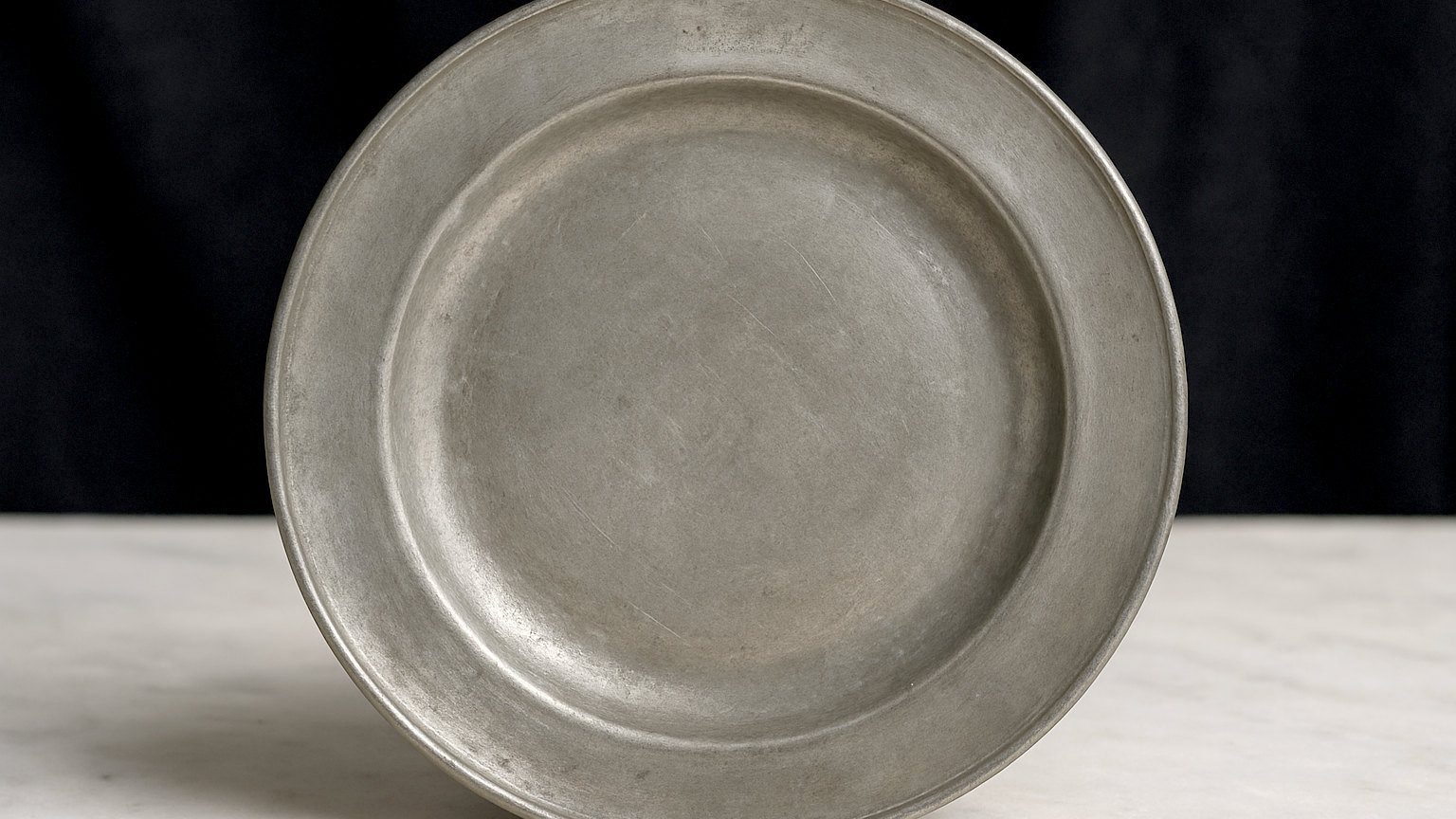
Position varies by form. On plates and chargers, look on the underside and also on the upper surface of the rim, where marks were sometimes struck to be visible in use. On tankards and measures, check the base, the inside of the base, the handle and the lid.
Marks are frequently faint, because pewter is soft and wears quickly. Use raking light from a window rather than direct light, and turn the piece slowly. Photograph from several angles, since a shallow mark may only read clearly at one.
What other marks appear on pewter?
Quality marks resembling a crowned rose or similar devices were used to indicate a better grade of metal, and various words claiming quality appear too, though these were trade claims rather than certified standards.
Capacity verification marks appear on measures and tankards used in trade, since vessels selling liquid by measure had to be checked. These carry monarch initials and local authority identifiers, and they are genuinely useful for dating because the initials change with the reign. Owner initials, often three in a triangle, record a household rather than a maker.
How do you date a piece with an unreadable mark?
By form. Pewter shapes evolved steadily, and the profile of a tankard, the width of a plate rim, the shape of a lid and the style of a handle all move over time.
Construction helps too. Early work was cast in moulds and finished by hand on a lathe, leaving faint concentric turning marks and a slightly irregular surface. Later production is more uniform. Look at the underside of a plate for the small central mark left by the lathe centre, and for genuine irregular wear on the rim where plates were stacked and handled.
How can you spot reproduction pewter?
Enormous quantities of decorative pewter were made through the twentieth century for the gift market, and a good deal is now sold as older than it is. Weight and thickness are the first check, since reproductions are frequently lighter and thinner than period work.
Look at the surface: genuine old pewter develops a soft grey patina with depth and slight unevenness, while reproductions often have a uniform finish or an artificially darkened one that sits on the surface. Check for a cast seam, and for marks that look crisp and modern on a piece with otherwise convincing wear.
Should pewter be polished?
Generally not. The grey oxide patina is what collectors expect and value, and bright polished pewter is worth noticeably less than an untouched example with an even surface.
Never use abrasive polish, and never attempt to remove the hard grey encrustation that forms on some old pewter, since removing it will pit the surface underneath. Wash gently in warm soapy water, dry thoroughly, and leave the colour alone. Do not use pewter that contains lead for food or drink, and assume early pewter does unless it has been tested.
Where does the value sit?
In early dated pieces, in identifiable makers, and in unusual forms rather than in common plates. Documentary pieces carrying a date, a name or a coat of arms attract the most interest because they anchor themselves in time.
Ordinary plates and tankards survive in quantity and remain very affordable, which makes pewter an unusually accessible field for anyone who wants to handle a lot of genuine early metalwork without spending heavily.