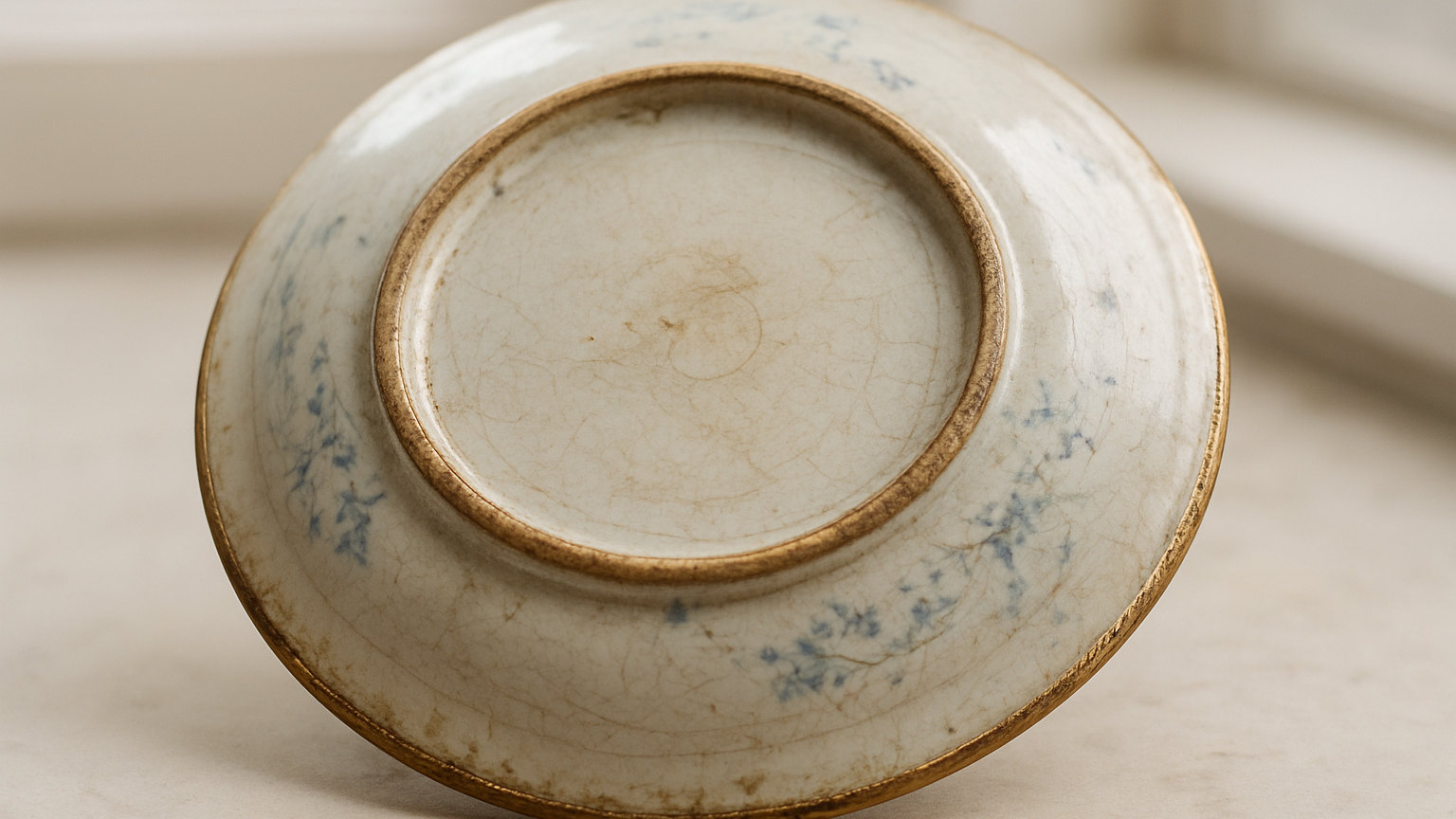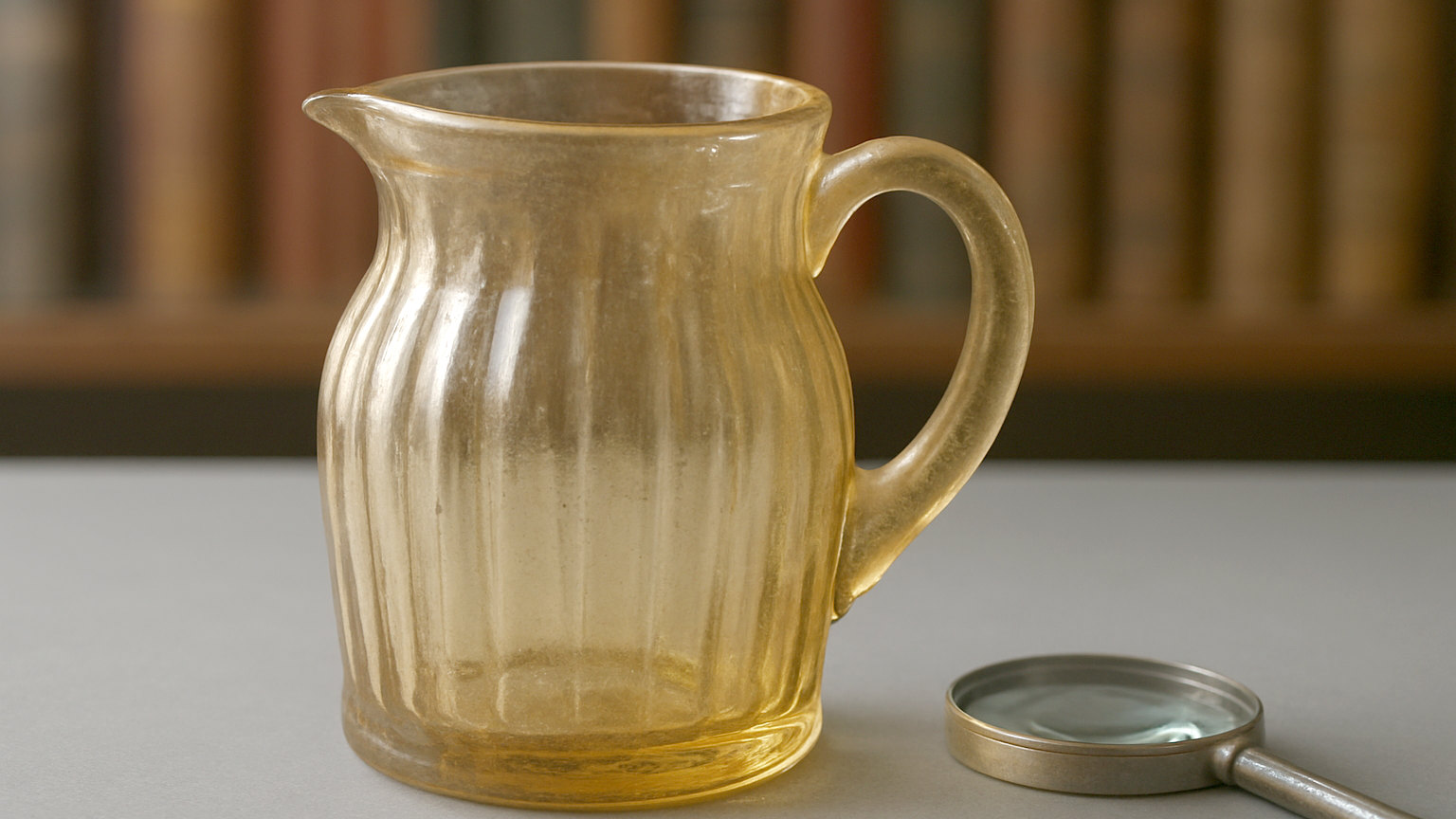
Vases and jugs are the most common antique glass forms and the easiest to assess, because the two places that reveal how a piece was made are both immediately accessible. The base shows the making method and the handle shows whether it was applied by hand or moulded with the body.
What does the base tell you?
How the piece was held during finishing. A rough or polished pontil scar in the centre indicates hand blowing, since the glass was held on a rod while the rim was worked.
A polished pontil, ground smooth and slightly dished, indicates a maker who took trouble. No pontil at all may mean the piece was moulded, or that a snap tool gripping the body was used instead, so its absence proves less than its presence.
How do you assess an applied handle?
By looking at where it joins the body. A handle applied by hand was drawn from a gather of hot glass and pressed onto the vessel, leaving a slightly irregular join and frequently a small tail or curl where the glass was cut off.
Look at both the upper and lower attachment. Hand applied handles show a visible pad of glass at each join, slightly asymmetric, with tooling marks. Moulded handles formed as part of the body have a uniform smooth transition and no separate pad.
Where are the mould seams?
Running vertically up the sides, usually in two or more places depending on the number of mould parts. They are frequently easier to feel than to see, so run a fingertip down the body.
Seams tell you the piece was moulded, which is not a fault and does not date it late, since moulding has been used for a very long time. What matters is whether decoration is moulded along with the body or cut afterwards, since the two represent very different amounts of labour.
How do you tell cut from moulded decoration?
By feeling the pattern edges. Cut decoration is ground into the surface, so the edges are crisp and can feel sharp, and the facets are highly polished.
Moulded decoration has rounded softer edges and a slightly different surface quality, since the glass flowed into the mould rather than being ground away. Under a light, cut surfaces show a bright polish where moulded ones have a softer sheen.
What does the glass itself indicate?
Age and quality. Older glass frequently has a faint grey, green or straw tint from impurities, visible when you look through a thick section such as the base.
Lead crystal is noticeably heavy and gives a sustained ringing note when tapped gently. Small bubbles and faint striations within the metal indicate less refined production and frequently greater age. Modern glass is water clear and free of inclusions.
What should you check on the rim?
Whether it has been ground down to remove damage. Run a fingertip around the whole rim feeling for changes in thickness, then look along the edge from the side.
A ground rim is usually thinner or flatter than it should be, and the proportions of the piece look subtly wrong because height has been lost. On jugs, check the pouring lip particularly, since it is the most exposed point and the most frequently reshaped.
How do you check for cracks?
By holding the piece up to a strong light and turning it slowly, looking for bright lines within the glass. Internal cracks show clearly this way and are nearly invisible otherwise.
Then tap the rim gently with a fingernail while supporting the piece lightly. A sound piece gives a clear note that sustains; a cracked one thuds. Pay attention to the handle joins, since stress concentrates there and cracks radiate from them.
How should glass be handled and washed?
By the body rather than the handle on anything old, since applied handles fail at the join. Support jugs from underneath when lifting.
Wash by hand in warm water, never hot, with a padded mat in the sink, one piece at a time. Sudden temperature change is what cracks old glass. Dry thoroughly, store pieces separately rather than nested, and never put antique glass in a dishwasher.