Pewter is soft, which is the root of most of its problems. Touchmarks wear until they are illegible, surfaces abrade, and the metal deforms. That leaves form to do the dating work, and fortunately pewter shapes changed steadily enough that the profile of a rim or the outline of a tankard will place a piece reasonably well.
What does a plate rim tell you?
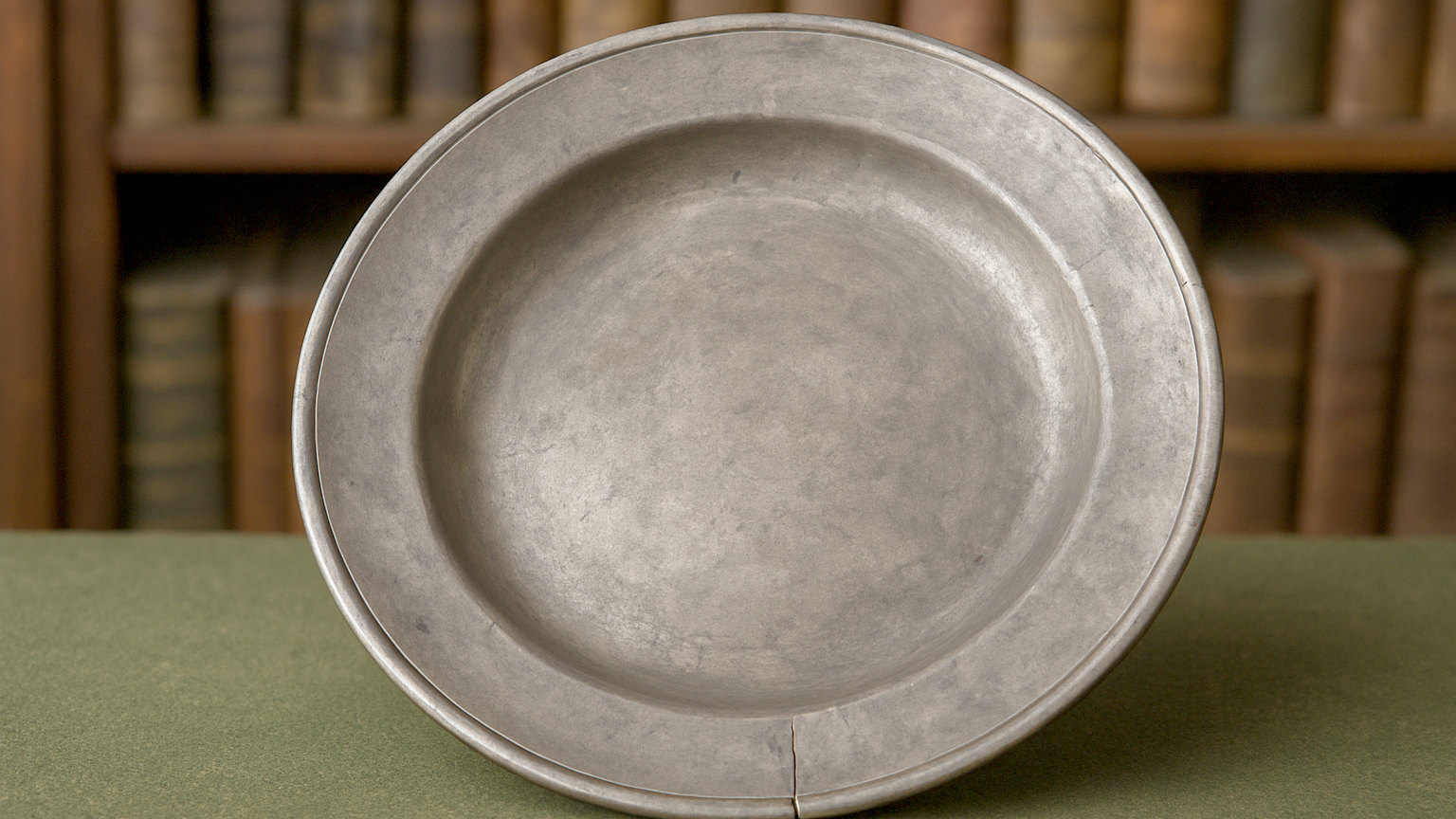
More than anything else on a plate. Rim profiles moved through a recognisable sequence, from broad flat rims through narrower ones, and from plain edges to multiple reeded mouldings and back again.
Look at the width of the rim relative to the well of the plate, whether the edge is plain or moulded, and how many reeds run around it. Compare against reference illustrations rather than judging by impression, since the differences are subtle and easy to misjudge without something to measure against.
How do tankard shapes change?
In taper, in handle form and in lid treatment. Earlier tankards tend to be more strongly tapered with a heavier base, while later ones become straighter sided.
Handles are particularly useful. The shape of the handle terminal, where it joins the body at the bottom, changed through a series of recognisable forms, and the presence or absence of a thumbpiece on a lidded tankard is another dating feature. Look at how the handle is attached and whether it was cast separately and soldered on.
What about measures and flagons?
Vessels used in trade to sell liquid by measure had to be verified, so they carry capacity marks in addition to any maker touch. Those verification marks include monarch initials and a local authority identifier.
Because the monarch initials change with each reign, these marks date a piece far more reliably than a touchmark does. Look for them near the rim or on the body, usually small and struck rather than cast. A measure carrying several verification marks was rechecked over many years, which is good evidence of a long working life.
How was old pewter made?
Cast in moulds, then finished on a lathe. That finishing leaves faint concentric turning marks on the surface, particularly visible on the underside of plates and in the well.
Look for the small central mark left where the lathe centre gripped the piece, usually a tiny depression or scar in the middle of the base. Its presence is good evidence of period manufacture. The surface should show slight irregularity overall, since hand finishing never produces the mechanical uniformity of later work.
What does genuine wear look like?
Concentrated where the object was actually handled. Plates show wear on the rim where they were stacked and gripped, and scratches in the well from cutlery, running in varied directions and depths.
Tankards wear on the base rim where they were set down and on the handle where fingers gripped. Knife scratches in the centre of a plate are entirely expected and reassuring. A surface that is uniformly scuffed everywhere, or scratched in one direction only, suggests the wear was manufactured rather than earned.
How do you spot reproduction pewter?
Weight and thickness first. Enormous quantities of decorative pewter were made through the twentieth century for the gift market, and most of it is lighter and thinner than period work.
Look for a cast seam left unfinished, since period pieces were turned to remove it. Check the surface: genuine old pewter has a soft grey patina with depth and variation, while reproductions frequently have a uniform finish or an artificially darkened one that sits on the surface and rubs off unevenly.
What should you avoid doing to it?
Polishing, which removes the grey oxide surface collectors value and reduces the price noticeably. Never use abrasive polish or wire wool on pewter, since the metal is soft enough to be scratched by almost anything.
Do not attempt to remove the hard grey scale that forms on some old pewter, because it has grown into the metal rather than onto it and taking it off leaves permanent pitting. Wash gently in warm soapy water, dry thoroughly and leave the colour alone.