Every china cabinet contains small pieces nobody can name. Victorian and Edwardian dining produced a specialised vessel for almost everything, and the shapes survive in quantity while the purposes have been forgotten. Identifying them correctly is cheap entertainment and occasionally profitable.
Why are there so many shapes?
Because formal dining required a dedicated vessel for each item on the table, and manufacturers had every incentive to persuade households they needed more of them.
A full service might include pieces for butter, preserves, cheese, sardines, pickles, mustard, salt, toast and eggs, each in its own form. Most of those forms have no modern equivalent, which is exactly why they puzzle people now.
What is a toast rack?
A stand with upright divisions holding slices of toast on edge so they stay crisp rather than steaming against one another. Made in ceramic, silver and plate.
Ceramic examples are less common than metal ones and more prone to damage, since the thin divisions snap. Count the divisions and check each one for repair, and use ultraviolet light since restoration to a broken bar is frequent and hard to see.
How do you recognise a butter dish?
A shallow dish with a domed cover, frequently with a drainer insert, and sometimes with a cutout in the cover rim for a knife handle.
The drainer is the component most often missing and its absence reduces value. Check whether the cover belongs by looking at the fit and the pattern alignment. Butter dishes are frequently sold as small tureens or as cheese dishes, which are larger and usually wedge shaped.
What are pot lids?
Printed ceramic covers from jars that held products such as fish paste, cold cream and toothpaste, decorated with multicoloured transfer printed scenes.
They are collected in their own right, frequently framed and displayed separately from their bases. Subject drives the value, with some scenes far scarcer than others. Check the rim for chips and look for restoration, and note that a lid with its original base is worth more than the lid alone.
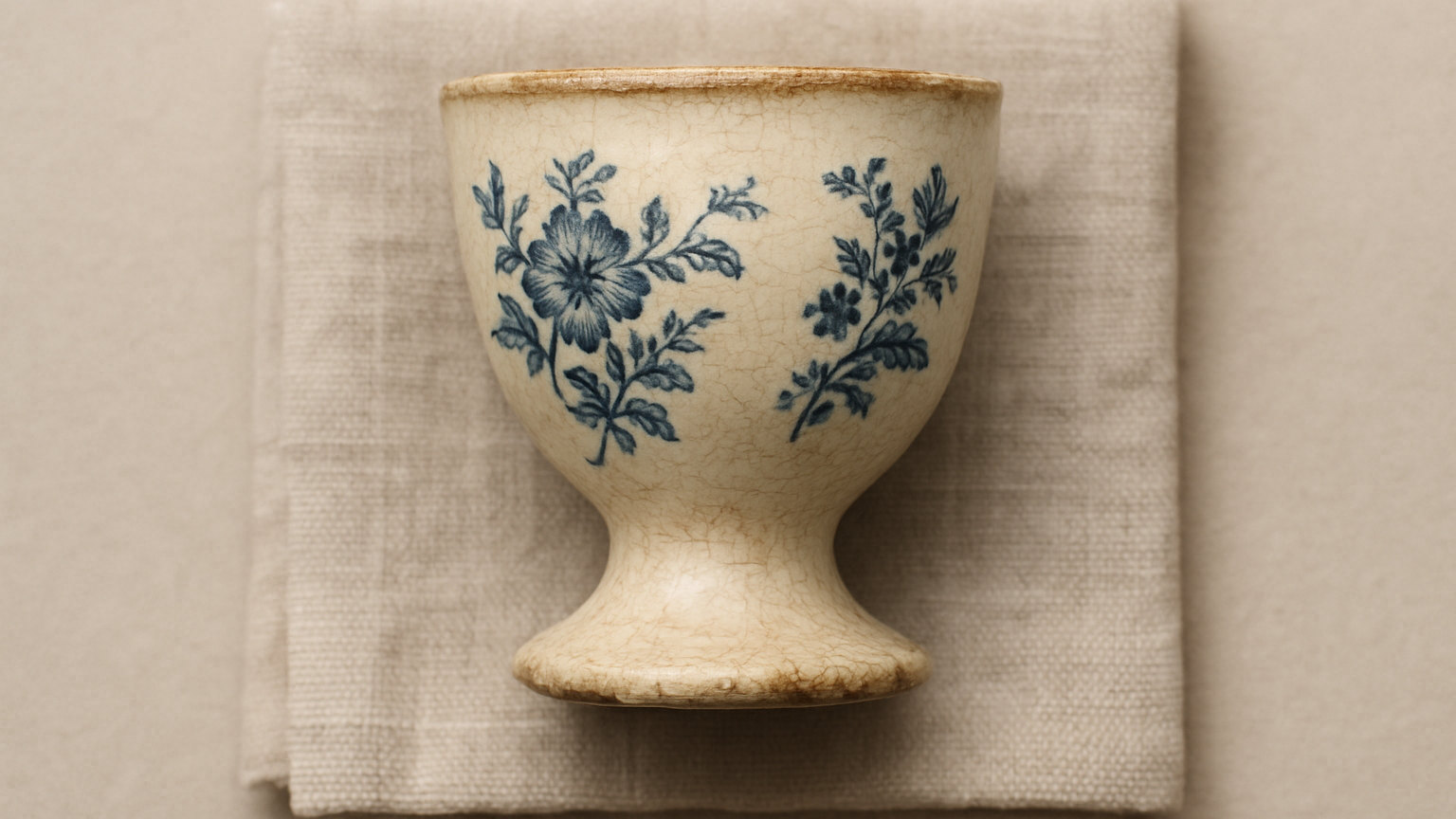
What about egg cups?
Made in single and double ended forms, the latter reversible with a larger cup at one end for a different sized egg. They survive in enormous numbers.
Value sits in early examples, in unusual shapes, in complete sets with a stand, and in anything from a collected factory or pattern. Most are worth very little individually, which makes them an excellent way to learn marks and bodies cheaply.
Which small wares are worth money?
Those from collected factories, those with fine hand painting, and those in patterns people are completing. A small piece in a sought after service pattern can be worth many times an identical shape in a common one.
Scarce forms matter too. Anything unusual enough that collectors of that factory need it for completeness will find a buyer. Sardine dishes, cheese stands and preserve pots with their covers all do better than the ubiquitous egg cup.
How do you research an unfamiliar shape?
By describing the function rather than the appearance. Look at the size, whether there is a cover, whether there is a drainer or a liner, whether there is a cutout, and what would fit inside.
Then search that function together with the period. Replacement china specialists and collector societies identify unfamiliar forms routinely, and museum catalogues frequently name pieces precisely. Working out what it held is usually the moment the name arrives.
Are they worth collecting?
They are the best value teaching material in ceramics. Small pieces cost very little, so you can handle a great deal of genuine marked material and learn bodies, glazes and marks by direct comparison.
They also fit anywhere, which matters given how much of the antique market is constrained by size. Buy on condition and on interest rather than on expectation of profit, and check for restoration on anything with a projecting part.