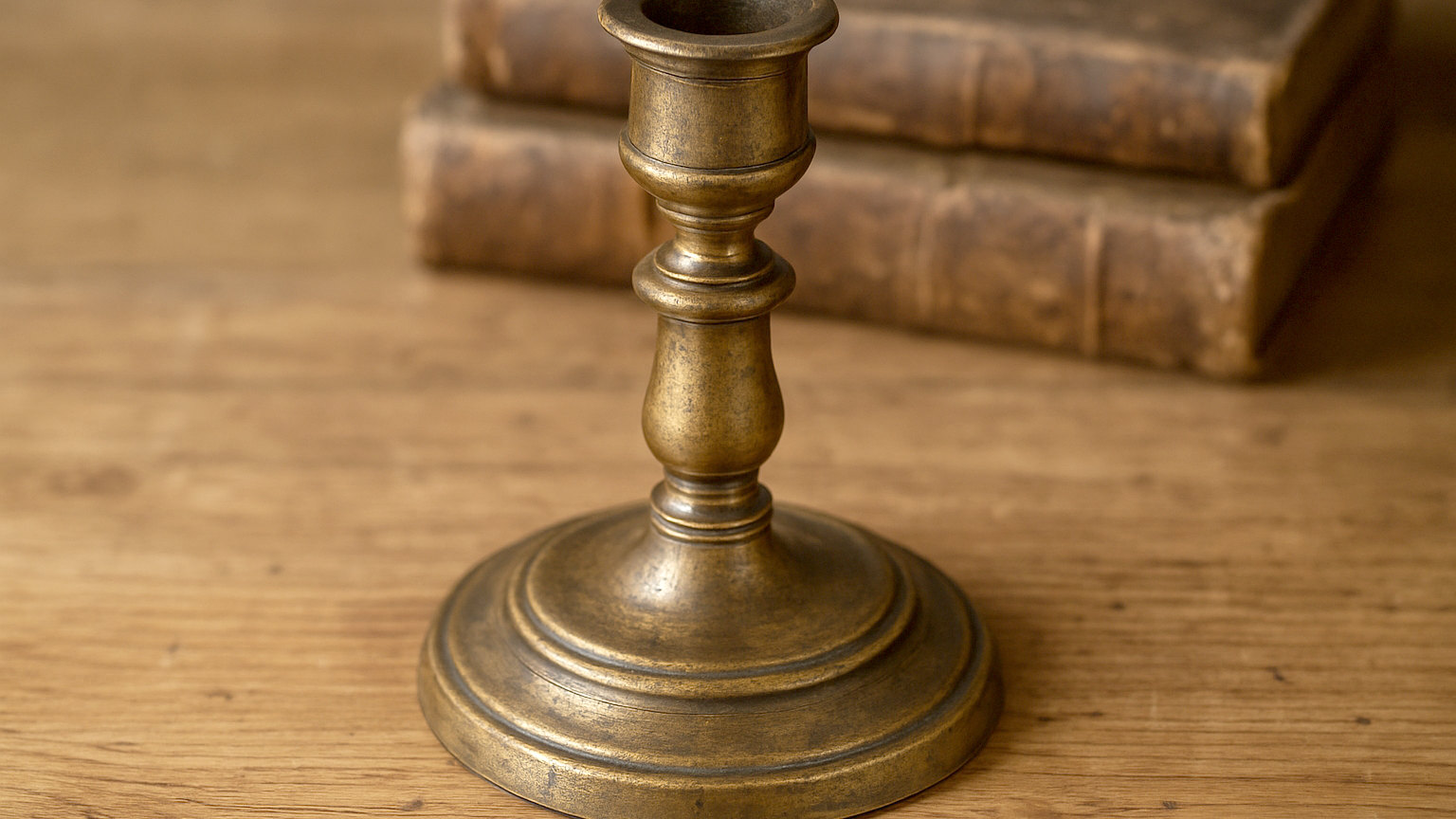
Brass candlesticks are among the most commonly encountered antique metalware and among the most reproduced, which makes them a useful thing to learn to read. The shape alone tells you very little, because popular forms were copied continuously, but how a stick was actually made is far harder to fake.
How were early candlesticks made?
Cast in sections and joined, rather than formed from one piece. The base, the stem and the socket were cast separately in moulds, then assembled, which leaves evidence at every junction.
Look inside the socket and underneath the base for casting texture, which is slightly grainy rather than smooth. Early casting produced heavier, thicker metal with visible file marks where the caster cleaned up seams by hand. That combination of weight and hand finishing is the clearest early indicator.
What is a seamed candlestick?
One made from sheet brass rolled into shape and joined along a vertical seam rather than cast solid. Run a fingertip down the stem and around the base to feel for that line.
Seamed construction generally indicates later production, since it uses far less metal and was quicker. It also makes for a lighter stick. A seamed stem with a hollow feel is a different proposition entirely from a solid cast one, and worth considerably less.
What should you check underneath?
A great deal. Turn the stick over and look at the base interior, which nobody finished. Early sticks frequently show a rough cast surface and sometimes a hole where the caster removed the core.
Look for genuine wear on the rim of the base, irregular and concentrated where the stick actually rested, with scratches running in varied directions. Some later sticks are weighted with pitch or plaster and closed with a disc, which is a construction to recognise since it changes how the piece should be cleaned.
What are the main form changes?
Broadly, from wide based sticks with a drip pan partway up the stem, through forms where the pan moves to the base, to later designs with removable nozzles. Stem treatments moved from simple to knopped to fluted and back.
Look at whether the drip pan is integral or separate, and whether there is a removable nozzle in the socket. Nozzles are frequently missing, and a pair complete with matching original nozzles is worth noticeably more than one without.
How do you check a pair?
Carefully, because assembled pairs are extremely common and worth much less than a genuine pair. Stand them side by side and compare height, base diameter, the exact profile of any turning, and the depth of the casting detail.
Weigh them if you can, since a genuine pair cast from the same moulds should be closely similar. Compare the colour and the pattern of wear, which should broadly match on two sticks that stood together for a century. Small differences in height are the usual giveaway.
How do you spot a reproduction?
By weight, by finish and by the absence of honest wear. Reproductions are frequently lighter, with thinner metal and softer detail where the original would be crisp.
Look for a uniform machine polished surface, an artificially darkened finish that rubs off unevenly on a cloth, and wear in places nobody would touch. Modern casting leaves a smoother interior than early work. A stick that looks old on the outside and perfectly clean inside the base deserves scepticism.
Should they be polished?
Generally not, and this affects value directly. Patina on brass is a stable surface that took decades to develop, and stripping it with metal polish removes metal along with the colour.
Repeated polishing visibly softens cast detail and rounds crisp edges, which is exactly what you are trying to read when dating a stick. Dust with a soft brush, remove greasy deposits with warm water and mild detergent, dry thoroughly, and apply microcrystalline wax if protection is wanted. Leave the colour alone.