Pick up a pair of silver candlesticks and they feel reassuringly heavy. A good proportion of that weight is not silver at all. Loaded or weighted candlesticks are made from thin sheet silver formed over a filling that provides stability, and understanding the construction changes almost everything about how you should value, clean and repair them.
Why were candlesticks loaded?
Stability and economy together. A candlestick needs a low centre of gravity or it topples, and achieving that in solid silver would require an enormous quantity of expensive metal for an object that is mostly empty space.
Making the stick from thin sheet and filling the base with a heavy inert material gave the necessary weight at a fraction of the silver content. The technique was entirely standard and openly used, and loaded candlesticks are perfectly legitimate hallmarked silver rather than any kind of substitute.
How can you tell if a candlestick is loaded?
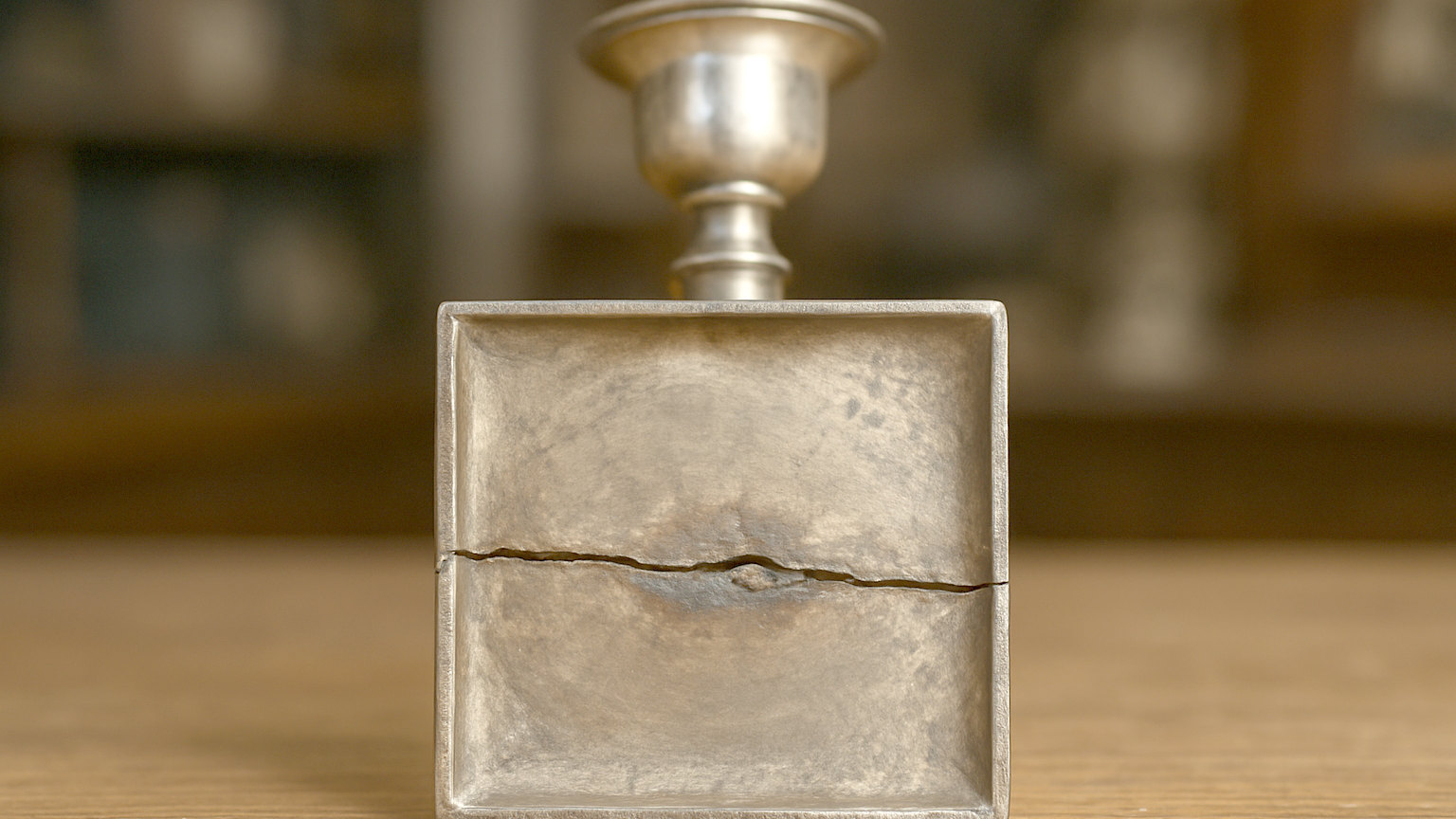
Turn it over. A loaded base is usually closed underneath with a disc of green baize, felt or thin metal covering the filling. A solid cast candlestick has an open or finished silver underside with no covering.
Weight distribution is the other clue. A loaded stick feels bottom heavy in a way that is disproportionate to its size, while a cast one has more even heft. Tap the base gently: a filled base sounds dull and dead, whereas solid silver rings.
How does loading affect value?
Considerably, because the silver content is a small fraction of the total weight. A loaded pair cannot be valued by weighing them, and any offer based on the scale reading will be wildly wrong in the sellers favour.
They are valued instead on form, maker, date, condition and decorative quality, exactly as any other silver object should be. Never sell loaded candlesticks to a buyer offering a price per gram, and be cautious of anyone who weighs them without comment.
Why must they never be immersed in water?
Because water enters through the seam at the base and cannot get out again. Once inside, it sits against the filling and the inner surface of the silver and causes corrosion that works outward from within.
The damage shows later as staining, bubbling or splitting along the seams, and by then it cannot be reversed without dismantling the piece. Clean loaded candlesticks with a barely damp cloth, dry immediately, and never put them in a sink, a dishwasher or a dip solution.
What damage is common on loaded pieces?
Dents and splits, because the silver is thin. Handling, knocks and the pressure of tightening a nozzle all deform sheet metal that has no solid support behind it.
Leaning is the other frequent problem. Where the filling has shifted or the stem has been stressed, a candlestick will no longer stand true, and correcting that means opening the base. Look along the stem from the side to check it is straight, and check that a pair actually match in height.
Can they be repaired?
Yes, by a silversmith, and it is skilled work. Repairing a loaded piece frequently means removing the base covering, extracting or working around the filling, correcting the silver, then refilling and closing it again.
The filling can be pitch, plaster or a similar material, and it responds badly to heat, which complicates any soldering. This is not a job for a general jeweller, and it is certainly not one to attempt at home. Ask specifically whether a repairer has worked on loaded pieces before.
What should you check when buying a pair?
That they really are a pair. Compare height, the profile of the base and stem, the pattern of any decoration and the hallmarks, since assembled pairs from two sources are common and worth substantially less than an original pair.
Check that detachable nozzles are present, since these protect the sconce from wax and are frequently missing. Look at the seam where the silver meets the base covering for splits, and check the underside covering is intact rather than torn or replaced with something unsuitable.