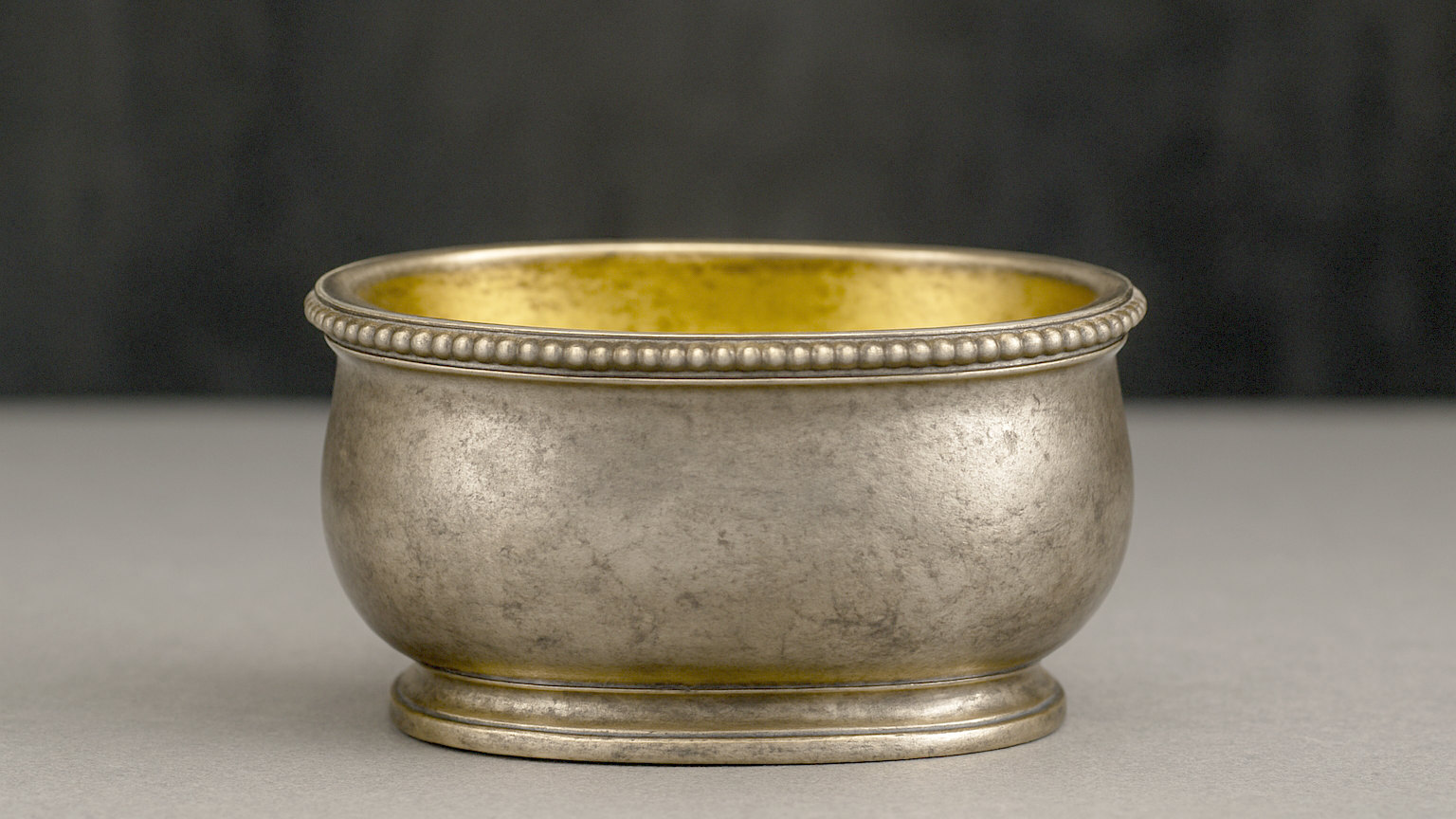
Small open bowls with gilded interiors turn up constantly in silver, and people frequently wonder why the inside is a different colour. The answer is entirely practical. Salt is one of the most corrosive things you can put in a silver vessel, and the gilding is there to stop it eating through the piece.
What does salt do to silver?
It attacks it aggressively, producing pitting and dark corrosion that eventually eats right through thin metal. Damp salt is far worse than dry, and salt left sitting in a cellar between uses will do serious damage within a season.
The corrosion is not simply tarnish that polishes away. It removes metal, leaving a pitted surface that cannot be restored, and on thin gauge silver it can perforate the base entirely. This is why salt damage is the commonest fault in the whole condiment category.
Why were interiors gilded?
Because gold does not react with salt. A gilded interior gives the salt nothing to attack, and the gold layer protects the silver beneath completely as long as it remains intact.
Gilding was applied to the inside of salts, mustard pots, cream jugs, sugar bowls and the bowls of salt spoons for exactly this reason. It is functional rather than decorative, which is why it appears on plain utilitarian pieces as well as elaborate ones.
What are glass liners for?
The same job by different means. Many salts and mustards were made with a removable glass liner, usually blue, clear or cranberry coloured, which holds the contents and keeps them away from the metal entirely.
The pierced silver bodies you often see were designed around this, since the decorative openwork only makes sense with a coloured liner showing through. A pierced salt without its liner is incomplete and worth substantially less, because the piece cannot be used and looks wrong.
How often are liners missing?
Very often, because they are glass and they break. This is the single most important thing to check when buying, and it is easy to overlook in a photograph.
Replacement liners are available but matching an original in colour, size and profile is difficult, and a modern liner is obvious to anyone who knows the category. Where a set of four salts survives with all four original liners intact, that completeness is worth a real premium.
What condition problems should you look for?
Pitting and perforation in the base, which is where salt sits and where damage concentrates. Hold the piece up to a strong light and look through the base for pinholes.
Check whether the gilding is worn through, which shows as patches of silver colour appearing within the gold. Once the gilding fails, corrosion begins underneath and spreads. Look also at splits at the rim, damage to any feet, and repairs in soft solder, which appears as a dull grey deposit quite unlike silver.
Can the gilding be renewed?
Yes, and it is a legitimate repair rather than a cosmetic one, since the purpose is protective. A silversmith can regild an interior, and doing so on a piece you intend to use is sensible.
Have any corrosion assessed first, because regilding over pitted metal simply covers the problem. Disclose regilding when selling, as with any restoration. On a piece kept purely for display, leaving worn original gilding alone is usually the better choice.
How should condiment silver be used and stored?
Empty it after every use without exception. Never leave salt or mustard standing in a silver vessel overnight, and wash and dry thoroughly immediately afterwards.
Mustard is acidic as well as salty and does its own damage. Store the pieces dry, with lids open rather than closed so moisture cannot be trapped, and keep liners separate wrapped in tissue so they do not chip. If you would rather not take the risk, use the pieces for display and put modern liners in for actual dining.