Small hinged silver boxes turn up constantly and are frequently misidentified, because several quite different objects share a similar outward form. What they were for is usually written inside rather than outside, and knowing where to look separates a vinaigrette worth a good deal from a later pill box worth much less.
What is a vinaigrette?
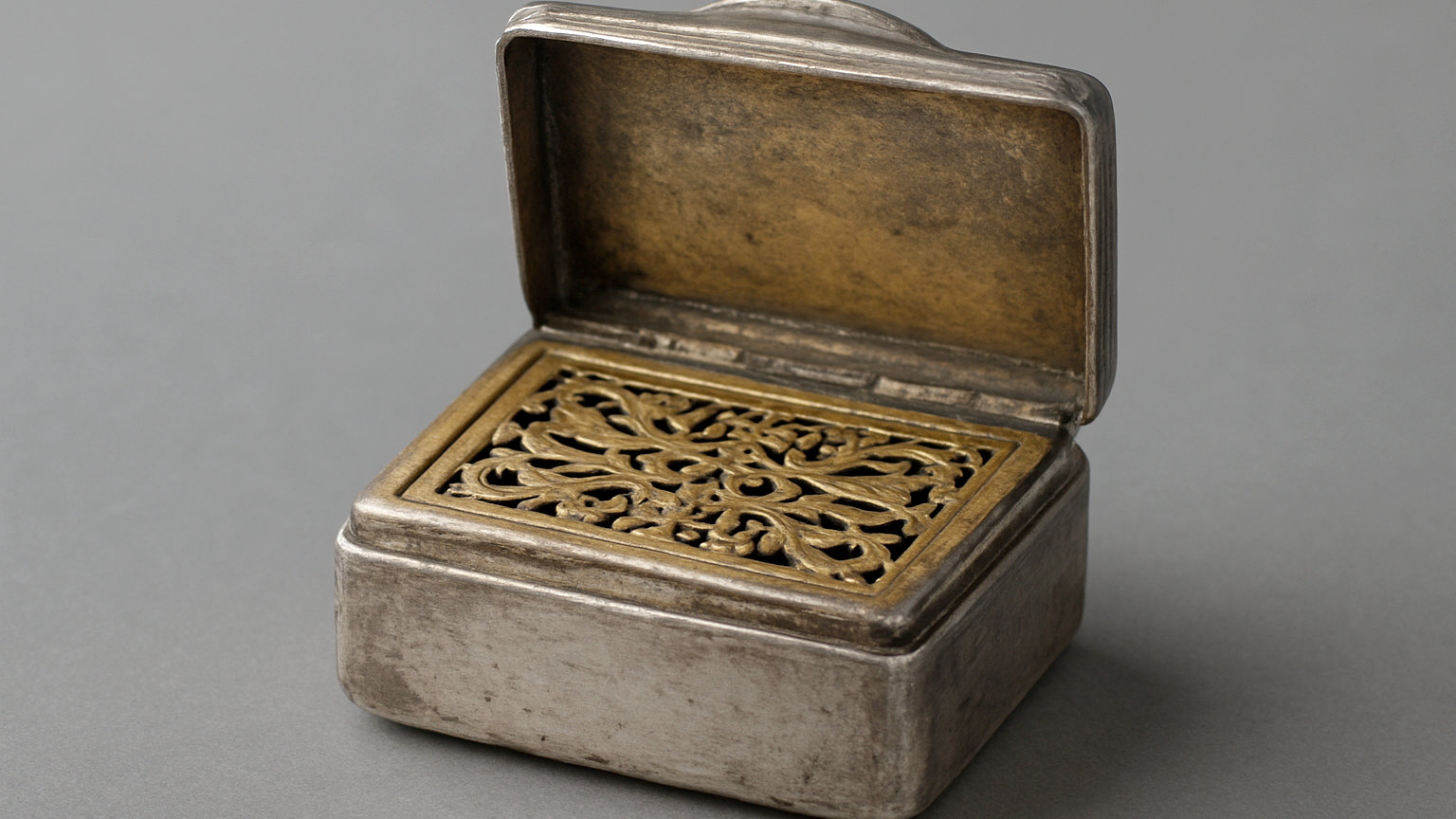
A small box holding a sponge soaked in aromatic vinegar, carried to be sniffed against unpleasant smells. Inside the lid sits a hinged pierced grille, and beneath that grille the sponge sat.
That grille is the defining feature and the first thing to check. Open the box and lift the inner cover: if there is a decorative pierced plate on its own tiny hinge, you have a vinaigrette. The interior is always gilded, because vinegar corrodes silver aggressively and gold does not react.
How does a snuff box differ?
No grille, and usually a larger, flatter form with a well fitting hinged lid designed to keep powdered tobacco dry. Snuff boxes are frequently gilded inside as well, since snuff was slightly acidic.
Look at the lid fit. A good snuff box closes with a definite action and sits tightly, because a loose lid meant spoiled snuff. The hinge is usually integral and carefully made rather than applied, and better boxes have a hinge running the full width of the box.
What other small boxes turn up?
Patch boxes, pill boxes, stamp boxes and card cases, all similar in scale. Later pill boxes are usually plainer, sometimes not gilded inside, and often much lighter in gauge.
Stamp boxes may have a sloping interior floor. Card cases are flat and considerably larger, made to hold visiting cards, and frequently decorated with a view of a building on one face. Identify by the interior arrangement rather than by the outside decoration.
Why is the gilding so important?
Because it is functional rather than decorative. Vinegar and snuff both attack silver, and the gold layer prevents that entirely as long as it remains intact.
Check whether the gilding is worn through, which shows as patches of silver colour within the gold, usually at the base corners and around the grille. Once it fails, corrosion begins underneath. Regilding is a legitimate repair on a piece you intend to use, though it should be disclosed when selling.
What should you check on the marks?
That the box and its lid both carry marks and that those marks agree. Small boxes were marked on the base and separately inside the lid, frequently with a partial set on the lid.
A lid with different marks from the body is a marriage, which is common because lids were dropped and lost. Check the grille too, since better vinaigrettes carry a mark on the grille itself. Because these boxes are small and valuable, examine the marks for insertion: breathe on the area and watch for a fine rectangular outline appearing as the condensation clears.
What condition problems matter?
Hinges above all, since they take constant use and are the commonest failure. Open and close the lid several times and feel whether the action is smooth or loose, and look for repairs at the hinge knuckles.
Check for splits at the corners, dents that have been raised leaving a rippled surface, and thinning where a box has been over polished. Worn decoration reduces value considerably, since the appeal of these boxes rests largely on the crispness of the engraving or chasing.
Why are they so collected?
Because they combine fine workmanship with small size, which suits modern collectors with limited space. They are also precisely datable, since the hallmarks are usually complete and legible.
Value rests on maker, quality of decoration, subject where a scene is depicted, and condition of both hinge and gilding. Boxes showing identifiable buildings or unusual subjects attract a substantial premium, and named makers who specialised in small work are followed closely by collectors.